October 25, 2007

Goudey Trade-away #50: Torre and Bellhorn for Abreu and Duke


This trade comes in from Rob in Santee, California.

Giving: Bobby Abreu, #16 (red back); Zach Duke, #100
Getting: Mark Bellhorn, 2005 Topps Post-Season Highlights; Joe Torre 2007 Topps

As a lifelong Red Sox fan, it brings me a little sadness that the two best things about this trade have to do with the cards of the Yankees. First off, I've been on the record as liking this Goudey set for a while now, and this card of Bobby Abreu is just another feather in its cap.

My friend has labeled the Jim Rice card a forgotten Warhol portrait. In the same vein, the hint of stadium, the Rothko-esque blocks of red – the fact that this card is of Abreu is irrelevant. The real star of the card – and for the most part, this set – is the background image.

The other card that really makes this trade is the Joe Torre. Rob writes: "The second card I hate– not because it's Joe Torre, but that woman behind him! A real lazy hand over your heart!" Yes, she's sort of lackadaisical, but isn't that the new Yankee Mystique? (and why hasn't some opportunistic, enterprising sweatshop come out with Yankee Mystique Bodyspray yet?) Think about it: The Yankees have been coasting for almost ten years now.

They're making great money in merchandising, they've put together a team of All-Stars who fill seats, plus they make going to a game a beat-you-over-the-head, All-American patriotic experience (where else do they sing 'God Bless America' during the seventh-inning stretch at every home game?). So who cares if their lineup is anchored by a guy whose post-season psyche is so far ruined that the best thing for his team to do would be to leave him off the post-season roster or trade him to a team that has no chance of making the playoffs? (And yes, I'm talking about A-Rod. Really, the smartest thing for him to do is sign with a team like the Giants: world class city, passionate, knowledgeable fans, tiny daily sports section in the major paper, and a team that's really not very good.) The traditional Yankee Mystique of continuous winning isn't an undisputed fact or a fog that clouds the minds of the opposition like a South Bronx Brigadoon anymore: it's a brand.

So back to this card of Joe Torre. He's one of the best managers ever, no question. But 2007 for the Yankees was like the last year of The Gilmore Girls: coasting on past laurels, with bad writing and a sloppy ending unworthy of it's former glory. It's almost as if Torre knows he's at the helm of a ship about to run out of gas at sea.

Oh sure, you're probably thinking, it's easy for me to say all this the day after my beloved Red Sox laid a beating on the Rockies, but just look at him on this card: He's tired. He's been there. He's done that. He knows that the road to the World Series no longer runs through New York (and may not for a while).

So here's to being the one man in that New York dugout that Red Sox fans really feared, to twelve years of giving me baseball-related ulcers, and to hoping that if Torre does come back to manage, he goes to the National League.

October 24, 2007

Goudey Trade-away #49: Ripkin for Wang


This trade comes in from Bill in Milwaukee, Wisconsin.

Giving: Chien-MIng Wang, #128 (red back)
Getting: Cal Ripkin, Jr., 1992 Major League Baseball Aces (9 of diamonds)

Just a few quick questions. 1) Did the US Playing Card Company or its printer employ a proofreader, or did anyone who works there casually follow sports? I know ... it's not like that job would be very demanding: make sure there are four suits, that there's fifty-two cards per deck, and that none of the face cards are subliminally flipping the bird ... but if the answer is 'yes' to either of those questions, why in God's name did they let Cal Ripken's name go out as 'Ripkin'? Unbelievable.

2) Why has Cal been relegated to the nine of diamonds? If I worked at the US Playing Card Company and was asked for a brilliant idea to really set those bastards at the Bicycle Card Company back on their asses, I would've suggested - maybe - possibly - putting Cal on a face card, if not on an ace (and if I were allowed to sport a little tongue in cheek humor about the whole thing, ol' Cal woulda been the six of diamonds).

October 22, 2007

Goudey Trade-away #48: Phillips for Bigbie

This trade comes in from Chris in Columbia, Maryland.

Giving: Brandon Phillips, #139 (red back)
Getting: Larry Bigbie, 2006 Topps

Of course, my scanner is not working, so you don't get to see that this Larry Bigbie card is not of Larry Bigbie. It is a card of Brian Roberts. In an airbrushed Rockies uniform, and stamped with a Cardinals team name. So here's the real question: Why did Topps stop there? Why not just show him wearing half of the Phillie Phanatic costume, smoking a cigarette and donning a top hat? Or better yet, a picture of the real Larry Bigbie scratching his head in front of a departures screen at BWI Airport. That would've at least been the most accurate thing for Topps to do.

October 21, 2007

Goudey Trade-away #47: Cuddyer for Kubiszyn


This trade comes in from David in Alexandria, Virginia.

Giving: Michael Cuddyer, #134 (red back)
Getting: Jack Kubiszyn, 1979 TCMA All-Time Indians

You know, I'm not entirely sure that this card of Kubiszyn is from the All-Time Indians set. I don't have my SCD Catalog with me, so if someone else knows where this card is from, please leave a comment.

So I'm just going to assume it's from that set. And the fun thing about All-Time sets is that they include everybody. It's something that I wish one of the major manufacturers would make soon for all the teams. I'd think it would be a regional best-seller: in Boston it would be a 1,000 card set of Red Sox, with each guy from each year's roster included. They could even include a different card of each player for each year, in that year's style of baseball card. So there would be at least 23 different cards of Yaz (one for each year, 1960 to 1983), plus special team leaders and postseason cards. And it would be a field day for their designers, as new designs would be needed for those years that didn't have cards. This kind of set could be distributed in packs and then in a monster factory set, just in time for the holidays.

October 19, 2007

Notes & Observations 10/19

This post will run on Beckett.com this afternoon.


Cents and Sensibility

Everybody makes mistakes. It's part of human nature. But with Michael Vick cards popping up in Topps Chrome Football, are we to believe the company when they say including him was unintentional? It almost seems that low- and mid-level product lines can't compete today without a well-publicized error card or cards. Alex Gordon and 2006 Topps Baseball. Derek Jeter and 2007 Topps Baseball. Blank-backed Lucky 13 rookies and 2007-08 Fleer Ultra Basketball. And now Michael Vick and 2007 Topps Chrome Football.

You know that news of the "unintentional" inclusion of Vick will spur sales. It almost feels like Topps is banking on that happening. So it begs the question: Is this what we have to look forward to? Deceivingly small checklists for base sets, potentially full of endless parallels, regional variations and the requisite error card? I wonder, does a set with 400 cards and 1,600 parallel versions test higher with audiences than an 800 card checklist with one or two parallels each?


To Have and Have Not

The topic of pack searching is one of the most controversial in the hobby today. There seems to be something ethically wrong with the practice, though it is not illegal. In a letter published in this week's Sports Collectors Digest, the reader writes that he no longer purchases packs for the chance at game-used memorabilia cards. Instead, he says he simply buys those individual cards, thus avoiding the topic of pack searching and cuts down on the overall bulk of his collection. I'm paraphrasing here, but the gist of the letter is that he now simply owns what he wants.

It's this idea – owning what you want – that gets to me. How does this particular collector know that he doesn't want the other cards he'd get from a presumably pre-searched pack? Also, why doesn't he just buy those product lines that offer greater odds on pulling memorabilia cards? There are plenty: Topps Co-Signers, Topps Sterling, UD Sweet Spot...


Baseball Card Art

To me, baseball cards are tiny works of modern art, especially those from classic sets like 1949 Leaf (newswire photos and woodblock prints) and 1959 Topps (like little covers of jazz records). They capture perfectly the prevailing design sensibility of the year they were made. Alternatively, when a design falters, one of the reasons usually has to do with it not "fitting" with its surroundings in contemporary design. Today's retro issues work, not just because the current collector values a sense of nostalgia, but because retro themes are common in today's design landscape. Look at any catalogue from stores as varied as Anthropologie to Restoration Hardware to even big box stores like Target and IKEA; you'll see what I mean.

Also, because cards figure into today's design landscape, artists have accepted them as subject and medium. Closing this weekend is the fantastic exhibition at The Pennsylvania College of Art & Design: The Artist and the Baseball Card, featuring over 100 works. Click here for more info.

This is Cool

If you have a spare second, click on this link: Mattingly Mosaic.

It's a neat idea, reminiscent of the wall-sized baseball card mosaic found behind the main stairs of the ESPN Zone restaurant in Times Square. But what I want to know is, why did the artist pick Don Mattingly and not Juan Samuel or Gary Gaetti? Or even better, a mosaic of every card from the 1988 Topps set that comes together to form a card of Floyd Youmans would've been a real feat. In any case, check it out.

October 16, 2007

Goudey Trade-away #45: Thomas for Griffey, Jr.


This trade comes in from Clark in Tampa, Florida.

Giving: Ken Griffey Jr. Heads Up, #241
Getting: Frank Thomas, 1991 Upper Deck

One of the biggest crimes of early Nineties baseball cards was that Upper Deck failed to include Frank Thomas in their 1990 set. Instead, fans had to wait until 1991 for this gem of a card: Baby-faced Frank sitting on the bench, giving the finger to an unknown hater on the other end of the bench. Also, the guy behind Thomas looks a lot like Sammy Sosa, though I could be wrong.

About the Griffey card: I'm really confused about the blue bib illustration just below Griffey's chin. I'm hoping that it's not supposed to be the crew neck of the uniform, but actually a poorly-hinted-at Amish beard. Griffey with an Amish beard would rock. I think that should be his next goal to reach. 500 home runs is nice, but can he play with an Amish beard? If Brian Daubach can do it, I'm sure Ken Griffey Jr. can do it successfully.

For Love of The Common Star

This post will run on Beckett.com today, Tuesday, October 16, 2007.


If I know anything at all about baseball, it's that a star can emerge at any time. A guy can put together a hot streak (or an entire hot season), or a timely post-season hit or amazing defensive play, and his cards will catapult from common-dom to the dollar bin and beyond. Take a guy like Cecil Fielder. Or Denny McLain. Or Zoilo Versailles. There are a lot of players on this list (rookies not included).

But the thing about catapulting out of nowhere and becoming a star is that it's also very likely that same player will catapult back into nothing. You know what I mean? Those same three players I mentioned above fit this category nicely. (Actually, Versailles is part of a peculiar group: Former league MVPs whose cards can be found in the commons bin.) They were all good players after their breakout seasons, though none ever quite captured all of the magic again.

So why are certain players hobby stars and others not? It's not just benchwarmers who are commons. Some guys that have strung together long and impressive careers are considered commons, too. (And what's it like for a current or former player to come across one of his cards in the commons bin? First of all, I would be impressed that he was a collector, and second of all, it's probably pretty humiliating. Also, if you go to shows to buy cards of yourself, is that the baseball card equivalence of a musician kicking back and listening to his or her own records?)

In a previous column I brought up the idea of a player outlasting his rookie hype. Here's another question: How long does it take for a great player to become a common? Also, is that a course that cannot be reversed? In other words, if you were once a hobby star, but are now a common, can you ever be a hobby star again?

To illustrate this point, let's look at 1982, 1983, 1984 and 1985 Donruss. Here are the players I compared: George Brett, Dennis Eckersley, Dale Murphy, Eddie Murray, Jim Rice, Lee Smith, Fernando Valenzuela and Dave Winfield. Every card of the four Hall of Famers, in terms of book value, is listed over a dollar apiece (in NM condition). Only two cards of the other four players are over a dollar: Lee Smith's 1982 rookie ($4) and Dale Murphy's card from 1984 ($1.50), and I'm fairly certain the value of the Murphy card is inflated; it's from the 1984 set. Another interesting note: The Lee Smith card from 1983 is listed at twenty cents. That's a devaluation of 95% from 1982 to 1983. Just incredible.

And Valenzuela? He's about as close to being a common (commonstar?) as you can get. Case in point: Smith's 1984 card is listed at twenty-five cents. Same with his card from 1985. And this is pretty much par for the course for mid-Eighties Donruss: 1984 provided a half-life for 1985's prices. But Valenzuela? While his 1984 card is listed at twenty-five cents, his 1985 card is right back down to common ground: Ten cents. So then for retired players, enshrinement in the Hall of Fame has to be the ultimate life preserver from a lifetime in the commons bin. Without enshrinement, a regional following (and regional pricing) is probably the most you can hope for.

And for those players whose regions no longer exist – who is left to revere Le Grande Orange? – well, here's to hoping they get another job and forget about their baseball cards. (Or don't mind living a one-in-a-million life and leaving a twelve-for-a-dollar legacy.)

October 13, 2007

The State of The Blog

When I started writing The Baseball Card Blog in January 2006, I thought that investing emotion into the pursuit and appreciation of baseball cards was an idea whose time had come. In fact, I was a little shocked that no one had beaten me to the punch.

I've had a lot of fun writing over the past two years. I've enjoyed the publicity, reading your emails and letters, and helping rekindle the collecting passion in those who'd lost hope in the hobby.

So why am I addressing you tonight? I know what you're thinking, but no, this is not a swan song good-bye note. I'm addressing you tonight as a way to motivate myself into making this blog better. I'm as frustrated as those readers who are bored with the Great Goudey Trade-away. I've always approached writing this blog as if I had an audience, though never once have I taken any of you for granted. I've put a lot of work into maintaining the site and keeping the content fresh enough for readers as passionate and as worthwhile as all of you are.

I appreciate your interest and attention greatly. This blog has helped me meet a number of exciting people and has given me an insight into my collection and collecting habits. And as it turns out, I'm not as lonely and eccentric in my pursuit as I once thought.

When I started this blog, I didn't know how long I'd be able to keep it going. Two years is actually much longer a lifespan than I initially would have guessed.

So, is The Baseball Card Blog still alive? Yes. Is it currently in a good place? No. Can it be saved? You bet. Am I the one to do the saving? I think so, but there's a lot of re-tooling to be done.

You know, the more I think about it, The Blog could be simply the start of something much bigger. A Pack A Day is going great. And there are other ideas that never really got off the ground earlier in the year. So, despite the problems we have weathered, the future is bright for The Baseball Card Blog.

Here's to another two years. (All right, technically it's been 340 posts over one year, ten months and thirteen days.)

October 12, 2007

Goudey Trade-away #43: Santana and Smoltz for Rudi and Brown

This trade comes in from Stewart in Rancho Cucamonga, California.

Giving: Johan Santana, #63 (red back); John Smoltz, #64 (red back)
Getting: Joe Rudi, 1973 Topps; Kevin Brown, 2001 Fleer Game Time Lumber

Stewart writes, "Rudi was always one of my favorites growing up. This card represents what most of my '73 Topps looked like – Off-center with worn corners from me bringing them with me everywhere ... This card [of Kevin Brown] represents my feeling of him perfectly – I hate pitcher cards that show the pitcher batting, but best of all it has a piece of his personality on it – a slice of wood."

I don't know how to follow that up, except that I agree about Rudi. I like to remind myself from time to time that he was on the Red Sox at the height of his career, even if it was only for a day.

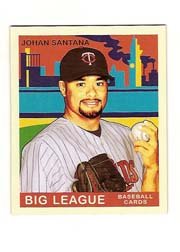
I guess I would also add that this card of Santana is probably one of my favorite from this set.

October 11, 2007

Goudey Trade-away #42: Mora for Hamelin


This trade comes in from Mark in West Chicago, Illinois.

Giving: Melvin Mora, #166 (red back)
Getting: Bob Hamelin, 1995 Fleer Ultra 2nd Year Standouts


The 1990s were a wonderful decade for over-hyped rookies, weren't they? Ben McDonald was going to be the savior of the Orioles, Van Poppel not only was going to follow in the footsteps of previous Oakland greats, he was going to break the mold. And what of Brien Taylor and Heath Shuler and Ryan Leaf and Rick Mirer? For all the bluster about these guys, most of them didn't even have one effective year in the majors.

It leaves me to assume that there must have been a training manual given to all card copywriters in the early Nineties called How To Set Impossible Standards for Players Who Show Promise. If I'm right, this card of Hamelin could have been a whole chapter:


Some call him "The Babe of the 1990's," and although this is obviously jumping a rather large gun, Kansas City's resident '94 rookie "Bambino" has proven to be a spectacular longball lasher. The American League 1994 Rookie of the Year finished last season first among his fellow AL rookie diamond dwellers in doubles (25), taters (24), RBI (65), walks (56), runs (64), hits (88) and slugging percentage (.599). This DH/1B will be banging them wayyy out for years to come.

These are not the cards I was looking for ...

This post will run on Beckett.com on Thursday, October 11.


It's always the same: I go to a card show with want list in hand, and I come home with a stack of random cards I don't really remember wanting (or purchasing, for that matter). It's like I enter a euphoric sleep walk between the orderly rows of eight-foot dealer tables, amongst Baby Boomers in over-stuffed, well-worn Mets t-shirts whiling away the hours haggling over commons, commiserating about the cards they used to have, and trading stories about forgotten utilitymen who still sign through the mail. It doesn't matter where the show is. Arena, junior high school cafeteria, or drunk tank – the feeling is the same: Bliss.

This past Saturday, I took the train up to the White Plains October Regional (I'm unclear about the show's actual name) at the Westchester County Convention Center in White Plains, New York. The County Convention Center is an old Art Deco/Neo-classical hall that, if I had to venture a guess, was probably built as part of a WPA project in the Thirties. It had that musty public library vibe in spades. It was fitting, perhaps, that one dealer's endless stacks of old sports books were relegated to a corner.

The show was good; my haul was good. I'm a dollar-bin, off-grade kind of guy, and shows like this one are great places for guys like me. I got a handful of mid-Sixties league leaders cards, a whole bunch of cards to help complete my 1978 Topps baseball set, and a number of cards of two of my favorite forgotten Dodgers, Claude Osteen and John Roseboro, including a perforated 1961 Post Canadian edition with John's last name spelled 'Rosboro' ... I'm finding it more and more enjoyable to buy cards from oddball sets. Perhaps it's a subconscious rebellion against the homogenized cards made today, but I'm having a great time discovering Topps' Venezuelan issues – new favorite card: Koufax's 'Retirado' Venezuelan Topps card from 1967– weird Topps inserts from the Sixties and Seventies, and Redman Tobacco cards from 1954 and 1955. I've also found that I appreciate those sets with weak rookie classes much more than I do sets with strong ones ... 1964 and 1959 Topps are especially high on my list ...

I bought a 1969 Topps card of Johnny Podres on the Padres, though shied away from having it signed by the man, even though he was in the building and I got a free autograph with my paid admission (I hope the show's promoters paid Mr. Podres well; there were a lot of people at the show).

I've always done that; I don't feel comfortable asking famous people for their autographs. Even though I guess from a celebrity's standpoint, signing autographs comes with the territory, I've never felt comfortable about asking. I'd have a pretty good collection, if only I'd have had the nerve: On a family trip to South Dakota one year, my dad and my sister and I saw Oil Can Boyd (still in his cleats) sitting on the hood of his Caddy in the parking lot of our motel in Sioux City, Iowa. My dad hustled us over to meet him, then told him that, as we're from Boston, we loved him. Then he and my dad shared an awkward handshake (or high-five, or hug – I'm not sure which) ... Luis Tiant, Norm Van Lier, and a few other semi-forgotten superstar athletes came to my elementary school to do a workshop on teamwork and when it was time for us to get El Tiante's autograph, I stood off to one side and watched ... My dad used to take my sister and I to Celtics Rookie Camp (back when they had such a thing), and while she collected the autographs of future stars like Vin Baker, in the one time I asked, I got shrugged off by John Havlicek ... And I feel the same way about asking through the mail. I find it's awkward to write a letter to a player when it's obvious to both of us that I want an autograph. I mean, I did get a couple of signatures this way, including Anthony Young (a pitcher for the Mets who lost a whole bunch of games in a row) and Loy Vaught (the poor man's Derrick Coleman).

But my enjoyment at the show wasn't only from the cards I bought. It also came from the eccentrics who surrounded me. I overheard numerous guys congratulating themselves on finding the rogue common that had eluded them for years and a few guys in mid-gloat about all the rare, valuable and fantastic cards that they had back home that were in much better condition than similar ones the dealers had for sale. My two favorite moments: First, two dealers agreeing emphatically that the Yankees, in an 0-2 hole and on the brink of elimination, had the Indians right where they wanted them. (That strategy worked out well.) Second, an older man with a cane limping down an aisle and stage-whispering into his cell phone that no, he was not at the baseball card show. He was at home, resting.

Like I said before, it was a good day. And then, on the train ride home, everything seemed to come full circle, like it was meant to be. There was a mother and her young child. The mother, though still young, was doing a very good impersonation of the classic overbearing mother. Even at a young age, the kid seemed to know what he was in for (the mother repeatedly asked him "PLEASE don't bang your head, Robert"). So while I'm hoping that little Bobby figures out a way to break the chains later on and listens to a lot of heavy metal (or his generation's equivalent), I've also come to appreciate mothers like this. I mean, let's be honest: Card collecting would be in a very different place were it not for the best intentions of overbearing mothers everywhere.

So let me amend my previous sentiment for young Robert: Let us hope that he breaks free of his mother's clutches, but let us also hope that she retaliates by throwing out all of his baseball cards, thus preserving the time-honored ebb and flow of this, our great hobby.

October 10, 2007

Goudey Trade-away #41: Holliday and Cantu for Marichal and Buice


This trade comes in from David in Acworth, Georgia.

Giving: Matt Holliday, #118 (red back); Jorge Cantu, #184
Getting: Juan Marichal, 1966 Topps; DeWayne Buice, 1988 Topps


About DeWayne Buice, Dave writes, "Just wanted to point out that if he didn't get the munchies for Chinese food, there might not be a 2007 Goudey set."

Duly noted. But also, if it weren't for Buice's random stop, the hobby might not be obsessed with high-end card sets, and maybe also not used to spending a week's salary on a box of eight cards.

Goudey Trade-away #40: Hall for McGwire


This trade comes in from Jim in Minneapolis, Minnesota.

Giving: Bill Hall, #109 (red back)
Getting: Mark McGwire, 1996 Sportflix UC3


UC3? I only have eyes for one. I want to go on record that I have never seen a better photograph of Mark McGwire anywhere as the one on the back of this card. It's a shame that Sportlix didn't use this photo as their marketing centerpiece on all their boxes, on their packs and in ads. In fact, why did they bother including any other players in the set? They could've been ten years ahead of the game if they had only used McGwire's "Look How Laidback I Am Even Though I'm Really Full of Steroids" photo on every card (only changing the checklist number).

Goudey Trade-away #39: Sanchez for Estes


This trade comes in from Matthew in Long Beach, California.

Giving: Freddy Sanchez, #127
Getting: Shawn Estes, 2003 Topps Total

Matthew notes in his letter than he especially liked how the crack Topps designers airbrushed Estes' uniform to be a Cubs home jersey, even though it's very obvious that he's pitching in Shea Stadium.

You know what I like the most about this card? It's that it's the best part of this card. Boy, Topps Total is ugly. And what's with just the one line of stats on the back? Do we really need to know that Shawn's looking forward to reuniting with Dusty Baker in Chicago? And really, don't use a word like 'reuniting' on a baseball card; that word is reserved for only two situations: 1) they were former lovers, or 2) they were in a band a long time ago, back before Elwood was living next to the elevated and Princess Leia was actively trying to kill Joilet Jake.

October 09, 2007

Goudey Trade-away #38: Perez for Lee

This trade comes in from Robert in Walpole, Massachusetts.

Giving: Carlos Lee, #23 (red back)
Getting: Pascual Perez, 1982 Topps

Is this Pascual Perez card not the greatest of the twentieth century? All right, that may be leaning slightly to the extreme, but seriously, it is, right? Check out the letter by letter signature (what penmanship!). The simple mime of hands clasping air as if they were working a baseball (the man's a true Method actor). Not to mention that he wears the ridiculous early-Eighties Pirates uniform as naturally as flip flops and a sarong. But the one thing that truly makes this card one of the best is the bizarre drive-in movie screen in the background, like Perez owns a drive in theater in the off-season (I bet he only shows romantic comedies, because Pascual's a lover, not a fighter, baby).

Goudey Trade-away #37: Teahen for James


This trade comes in from Jason in Rochester, Illinois.

Giving: Mark Teahen, #124 (red back)
Getting: Bob James, 1987 Donruss

Bob James is rocking out in this photo. He genuinely looks like he's having a great time being ... on the White Sox. Wait a minute ... it looks like, yes, he appears to be missing a tooth. Or maybe it's a gold tooth. OK, so here's Bob James's backstory: He's either a fun-loving mountain beast who was being shot at by poachers and climbed into the Guillen family van while they were on vacation in Appalachia (and Ozzie taught him how to live and dress like a person, though he still shits in the woods!), OR he's a free-spirit pirate who's got a great story to tell you about how he lost that tooth, but it's really long and you probably wouldn't understand (or believe!) half the things he would say, as he spent all those years on the high seas developing his own language, which he now takes city to city with him, one he calls Esperanto.

Mark Teahen is obviously E.T. In a Royals uniform.

October 07, 2007

Goudey Trade-away #35: Rice for Posada


This trade comes in from Kevin in Vancouver, Washington.

Giving: Jorge Posada, #175
Getting: Jim Rice, 1984 Donruss

There was a character on Sesame Street named Sully, who was a garbageman. He appeared in episodes where Oscar the Grouch's garbage can had to be moved, so that Oscar could take part in sing-a-longs, etc.

Sully was actually one of the more complex Muppets, as he was a full-body Muppet (the Muppeteer was inside the costume), plus – and I'm still not entirely sure how this worked – another Muppeteer had to have access to a travel version of Oscar the Grouch and his garbage can. Like many people in my generation, not only do I completely glaze over when Sesame Street is on TV, but I find the detail and technical work behind the creation of the Muppets just amazing.

The list of instances that prove Jim Henson was so far ahead of the game is endless. If I could boil it down to just one performance, watch the episode of The Muppet Show with Zero Mostel as guest host. Few could match Mostel in terms of screen presence, but here Henson's wizardry goes toe-to-toe, playing to Mostel's strengths as the perfect complement.

The reason all of this is important is because whenever I look at Jorge Posada, all I see is Sully the Garbageman.

Goudey Trade-away #36: Three for Three

This trade comes in from Gary in Mesquite, Texas.

Giving: Mark Teixeira, #77 (red back)
Jason Bay, #51 (red back)
Prince Fielder, #84 (red back)
Getting: Earl Wilson, 1963 Topps
Dave Hillman, 1961 Topps
Roger Clemens, 1994 Upper Deck Electric Diamond

Gary sent three cards, with the stipulation that I send one of the cards to his godson Sam, who he's trying to get into collecting cards. Glad I can help. Hope Sam likes Mark Teixeira.

These are some great cards, coming in and going out. I especially like the Teixeira card I'm giving up; he looks genuinely excited that he's on a baseball card. Also, how can you not love a card of Earl Wilson on the Red Sox? He was another guy the Red Sox gave up on before his best season.


October 05, 2007

Goudey Trade-away #34: Schmidt for Ramirez


This trade comes in from Steve in Wynnewood, Pennsylvania.

Giving: Manny Ramirez, #74
Getting: Mike Schmidt, 1987 Topps

Aahhh, the 'Mike Schmidt with a Boner' card. Always good for a laugh. How unfortunate... Anyway, Steve sends a nice note questioning this one-liner on the back of Schmidt's card: "Mike lists electric trains among his hobbies."

You're right, Steve. It is weird, especially with Schmidt coming off his MVP year in 1986. What's even weirder is that Topps checklisted Mike at #430, not at a full hundred number. Schmidt was at the point in his career when he should have been placed at Hero Worship numbers every year, especially coming off an MVP season. I think #100 or #700 would have been more appropriate.

Finally, it's fitting on more than one level, that Steve will get this card of Manny Ramirez. Both respected hitters, both recognizable by their many awkward baseball cards.

Goudey Trade-away #33: Blue Jays for Beckett


This trade comes in from Matt in Garland, Texas.

Giving: Josh Beckett, #67
Getting: Blue Jays team card, 1978 Topps

How good was Beckett Wednesday night? This trade almost seems plausible in the real world. I mean, based on his ALDS Game 1 performance. If you were Ray Hartsfield – manager of the 1978 Toronto Blue Jays – wouldn't you trade your entire roster for Josh Beckett? Granted, your entire roster would be in their fifties or sixties today, but so what?

Beckett could be a one-man expansion team, play his home games in old Exhibition Stadium, wear those old blue-stripe uniforms and pitch nine innings every single day and bat at least 27 times a game. He'd probably lose more than he won, but I bet he'd beat the Yankees. He's a certified Yankee-killer.

For Sale: Tiger Stadium


Detroit: A Scavenger's Dream. And for a limited time, you don't have to do your hunting in the cover of night. That's right, they're selling off Tiger Stadium, one visitor's clubhouse urinal at a time.

I remember that when they tore down the old Boston Garden, there was a similar blowout auction-cum-free-for-all. I snuck into that with my friend Andrew (we had to go up one of the back exit ramps off Causeway Street), and it was like a poacher's paradise, with teams busily stripping the old girl for all she was worth.

Well Detroit, here's hoping you're a little kinder to your sports mecca.

Tiger Stadium Sale

October 04, 2007

Goudey Trade-away #32: Igawa for Bagwell


This trade comes in from Mike in Portland, Oregon.

Giving: Kei Igawa Heads Up, #270
Getting: Jeff Bagwell, 2005(?) Topps Hit Parade

This card of Igawa is pretty great. I especially like the illustration callouts around him on the front of the card, including "Igawa enjoys playing shogi". I also like that it's obvious that Kei's trying very hard to look like a bad-ass, and he just looks fat instead.

As for the Bagwell, I don't really know what to make of it. If you hold it at an angle, you can see your reflection. If you move it slightly, it gives the impression that it's bong hits this card is celebrating, or perhaps career bong hits. Bagwell looks kind of out of it, too, so maybe this estimate isn't too far off-base.

Goudey Trade-away #31: Ortiz for Hernandez


This trade comes in from Eric in Sacramento, California.

Giving: Felix Hernandez, #39
Getting: David Ortiz, 2006 Upper Deck

When I was younger, I didn't understand why Upper Deck chose to use photographs of the players off the field, in the clubhouse, and generally away from actually playing (including the inevitable card of Jose Rijo and his trusty supersoaker). I always thought that there were so many exciting things about baseball, why remove that element from the equation? OK, so flash forward to today and though I've been writing about cards now for almost two years, and I've dissected Upper Deck and its use of photographs, I still don't get it.

Take this card of Ortiz. He's had so many big moments in the field ... he's charismatic ... not to mention his swing is naturally dramatic. So why show him pooping around the field? Was it to get the American flag in the shot? Because if that's the case, that's pretty lame.

Goudey Trade-away #30: Veal for Wood


This trade comes in from Russell in Humble, Texas.

Giving: Kerry Wood, #70 (red back)
Getting: Coot Veal, 1962 Post Cereal

Here's what I like about this trade: Russell not only sends a worn, beaten-down card of Coot Veal on the Senators, with writing on it, but he sends it sandwiched between three rounded-corner Hackers-styled Stadium Club checklists and three weirdly blank-backed, late Eighties Topps sweatshirts pack filler.

That's why I'm especially pleased that this Kerry Wood card randomly came up, because there's no one more beaten-down than Kerry Wood. Even compared to a Coot Veal card with writing on it. Kerry Wood wins.

October 01, 2007

More Press for The Card

If I know anything about my audience, it's that they see right through the baseball card media's silence towards the recent, controversial book from Michael O'Keeffe and Teri Thompson. In case you aren't familiar with The Card, it tells the story behind the most famous card in the hobby: The former Gretzky/McNall T206 Piedmont Honus Wagner. It raises some interesting ideas, including that the card has been trimmed, that PSA had knowledge of it being trimmed, that Mastro's kind of a jerk, and many more fun little tidbits that makes this hobby great.

I've written my fair share about the book, including a lengthy interview with one of the book's authors. In case you want more coverage, head over to Gelf Magazine. Gelf will also be hosting O'Keeffe and Thompson as part of their Varsity Letters reading series this Wednesday in New York City.

Goudey Trade-away #29: Madlock for Zambrano


This trade comes in from Paul in Wayne, Pennsylvania.

Giving: Carlos Zambrano, #24 (red back)
Getting: Bill Madlock, 1975 Topps

When I look at these two cards side by side, it becomes apparent how great this trade is. I have no idea how much this Zambrano red back is worth, but I can tell you right now that I would trade it for this creased up Madlock even without the Trade-away. It's that good.

Although, I am a little sad to see Zambrano and his stoic Native American tribal chieftain pose–complete with little Six Nations flags behind him–depart.