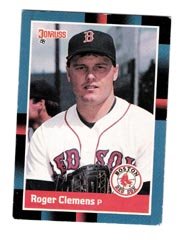
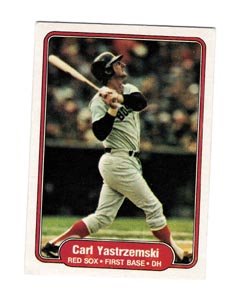
Yes, to quote every single high school valedictorian speech and yearbook table of contents (and Bill Walton on more than one occasion), what a long, strange trip it’s been. I naively thought I’d be able to get through this list in about a week. But then I realized how deeply I cared for each and every set, and how important they figured into my formative years.
I promised myself I wouldn’t cry, so I’ll quit this premature eulogizing with another Walton quote: ‘This is just whore-able.’ Wait, that wasn’t the one I was thinking of… here it is: ‘Throw it down, big man. Throw it down!’
Consider it throwed-down.
10. 1980 Topps
 When, in the course of baseball card set ranking related events, a person comes upon the 1980 Topps set, what does that person think? Does this set resonate or does the person even care? I, for one, never realized how much I cared until I spent a little quality time with it and now I realize that this set is one of the most underrated of the decade. It lacks the splash of later-decade Topps sets as it has very few subsets, the All-Star denotation is on regular cards and rookies (for the most part) are not announced. But it makes up for this lack of pageantry with a strong checklist, including the desirable 2nd year Ozzie Smith and third years of Molitor, Trammell and Murray, plus great cards of hobby powerhouses Nolan Ryan, George Brett, Yount, Winfield and a cache of others like Reggie Jackson, Pete Rose and Bench, Fisk and Yaz. And how could we forget: this set features the rookie of, according to Bill James, the fourth greatest left fielder to ever live, Mr. Rickey ‘Refers to Himself as Rickey’ Henderson.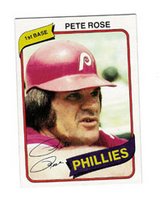
But most importantly, this was Topps’ last year as the only major issue. 1980 was the last year of Topps’ 18-year run as a baseball card monopoly (beginning with Fleer’s 1963 issue and not counting SSPC’s attempts in 1975 and 1976). This is important in myriad ways. First, it was the last year that there was (obviously) only one set put out, so there is only one Nolan Ryan card that year, and only one version of the Henderson rookie. It was the last year before Topps began issuing yearly traded sets, so if there were going to be big rookies or guys on new teams, the company had to try extra hard in not screwing it up.
 I think that these last two points are huge. I started collecting right in the thick of things: there were already three card companies going strong, an upstart was encroaching on valuable space (Sportflics) and it would be less than three years before there would be 5 major players vying for my baseball card dollar. If I pined for a Bo Jackson card, I was pining for as many as six Bo Jackson cards, all of them with a legitimate claim to being his rookie. But with Rickey, there was only one set, so there’s only one rookie. And for there to be only one rookie of Rickey Henderson seems fitting, as he broke every mold the game had to offer. (And by the way, when Rickey finally gives up the ghost and officially retires from showing up newbies at Spring Training, he should call up former SuperSonic Michael Cage and they should join the WWE circuit as the tag team Steal Cage, and the WWE scriptwriters could pit them against other tag teams and then at Wrestlemania Cage could turn on Rickey and Rickey would enlist Dave Henderson (who would be a plant in the audience, much like Hasselhoff was at the American Idol finale) and Hendu would come in the ring and rip off his tear-away warm up pants to reveal yellow and green wrestling tights and stomper boots, and thus Steal Cage would be dead and the Flying Hendersons born. I don’t know what would happen to Michael Cage…maybe he could get Old Man Larry Nance off the couch to tag team as Achilles Knees…You know, you could put together a formidable pro-wrestling circuit made up entirely of former legitimate sports figures. Tree Rollins and Jon Koncak would be Ebony & Ivory, Dan Majerle and Darryl Dawkins would be ‘Thunder Brothers’ and Kurt Rambis could wrestle on his own as Oculoptopussy, cause Rambis wore glasses and because I personally hate the Lakers. In fact, I might pay around $10 to watch a battle royale featuring Hot Plate Williams, The Refrigerator Perry, Stanley Roberts, Don Baylor, Gabe Kapler, the Phillie Phanatic, Kevin Duckworth, Leon Lett and Rickey Henderson. I would bet Rickey would win that one, even if he was scripted to lose. He’s just that good.)
Aside from the star quality and strong checklist, this set has a kick-ass design. You know, it’s funny that it’s so strong because really Topps was just riffing on itself: it took the bland, forgettable 1974 design (the one with the squarish pennants) and made it more dynamic, tilting the pennants 30 degrees, ballooning the picture (one of the largest photo spaces of any set from the 1980s, possibly the largest) and adding a facsimile signature. This last design element is really an added bonus because you got to see who had mastered the art of penmanship and who could barely scratch out an ‘X’ (my personal favorite is Willie Aikens). Topps did this on the fronts of a handful of sets before 1980: 1952, 1954, 1955, 1959, 1967, 1971, 1975 and 1977, and only once after 1980 (1982). They also had it on the back of cards in 1953 and 1974.
 It was a fun design element that added a personal touch to the cards, blurring the line between player and collector, like the player had held his card only moments before you got it in your pack. The fact that Topps didn’t use this feature on any design after 1982 (I can only think of the silver and gold signature cards in Upper Deck’s Collector’s Choice series and one or two of Leaf’s Studio sets in the mid-1990s that did) leads me to believe that autographed baseball cards sets are so ludicrously popular today because my generation didn’t know cards could feature facsimile autographs. Can you imagine a clunker like 1990 Topps with facsimile autographs? I would argue they’d be more desirable than the quick-fix mudroom insulation they’ve become.
While I’ve been doing this countdown, I’ve tried to elevate certain ‘iconic’ cards, ones that I think could do a fair job representing an entire set. Some have been obvious, like the Canseco Rated Rookie from the 1986 Donruss set, others not so much, like Dewey Evans’ 1981 Topps card. For 1980 Topps, you could make a pretty persuasive argument that the iconic representative should be the Rickey rookie—it is, after all, the most desirable and valuable card in the set. But for now, while I don’t necessarily disagree with the Rickey argument, I’m going to put forth Biff Pocoroba as the iconic card of this set. Here’s why. Have you ever gone through your cards
 looking for a weird photo or a weird name or a player that’s especially hairy or ugly? Of course you have (maybe it was the reason you started collecting in the first place, to feel better about yourself). Usually any given set will be split 50/50 between weird and normal players, but if you take a look at the Atlanta Braves team, it’s like there was something in the water down there. Pull out their cards the next time you’re going through your box of 1980 Topps and you’ll see what I mean—it’s like a lineup for a less-intimidating version of The Dirty Dozen. No wonder they finished in the basement (even though Phil Niekro won 21 games, he lost 20. Now that’s some Hall of Fame pitching!).
1980 Topps is underrated. There’s no doubt about it. And, in fact, I would argue that every set in the 1976 to 1980 corridor deserves more love, attention and support. Today a typical player who probably won’t accomplish very much in his career will have upwards of 15 to 20 rookie cards, each valued at some ridiculous and unwarranted price. But guys like Ozzie Smith, Dennis Eckersley, Rickey Henderson—certifiable Hall of Famers who changed the game itself—only have one rookie each, and they’re not worth as much as their accomplishments should demand.


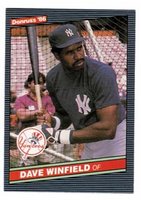 This set was an entirely foreign concept to me when I started collecting. Even after ten years of collecting I had maybe two or three cards from the set. I think this has to do with the Canseco Rated Rookie (where he’s sporting a ridiculous mustache…of course he was doing steroids! Thinking his dead-rat facial hair was a good idea is a dead giveaway…), which I couldn’t afford at the time as a single card and therefore couldn’t afford the packs. Also, just starting out in ’86, it blew my tiny mind that there was more than one card company. I mean, I was really only interested in Topps (I couldn’t afford the other two), but still--three different kinds; that’s pretty fucking sweet when you think about it. Anyway, I never had any cards from this set.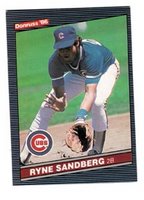
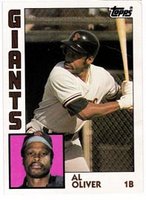 There are certain things that sometimes-great-mostly-mediocre players can do to make themselves remembered after they retire. For Dave Roberts, that meant stealing second in Game 4 of the 2004 ALCS. For Billy Hatcher, it meant tearing the A’s a new one in the 1990 World Series. And then there are the lucky players to be traded or called up in 1984, enshrined in the 1984 installments of Topps Traded and Fleer Update.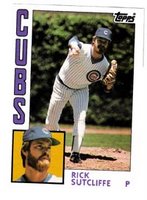
 You know, actually, as I read these last few sentences back to myself, Topps’ guessing wrong on Clemens and Puckett was a major blunder. If you look at the 1984 Topps set, which I will do in a minute, Mattingly was a big deal. But he was a big deal in every regular issue set that year. You could look at the 1984 Fleer Update set as the seminal set of the 1980s: at its essence it reaffirmed the shift in the balance of power that the regular issue Donruss and Fleer sets of 1984 started. After the Update set, Topps had to kick it into high gear to even stay relevant. They accomplished this with the Olympic team subset in the 1985 set, but by then the embarrassment that was 1984 Traded was reality, not some wild, doomsday scenario thought up at the bar after a long day at Topps HQ.
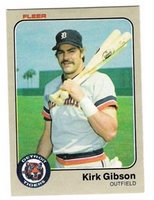 1983 Fleer deserves more credit than it has received. While it takes a lot for a man to pull himself together after hitting rock bottom (just ask J.R. Richard), I would argue it takes even more for a card company to regain its respectability (or just plain gain respectability) after it turns out a heaping pile of shit like 1982 Fleer. Seriously, how did they rebound with such a strong set?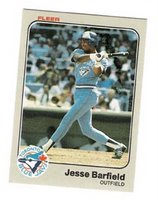
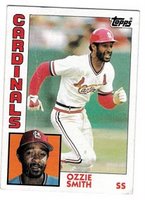 1984 Topps is one of my all-time favorite card designs. I think it has to do with the headshot. I was never really a fan of the 1983 design, which to a lot of collectors is the Holy Grail design of the 1980s. In my opinion, 1983 was too technical: the card front was partitioned into five sections (action shot, head shot, name/position text, team name in colored bar and outer white border). There was no chemistry between the elements; the action and headshots were cordoned off from each other (they didn’t really even touch). Sure, it was a marked improvement from 1982, hands down the most boring Topps card front design of the decade, but it seemed overtly technical and not nearly emotional enough.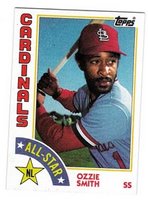
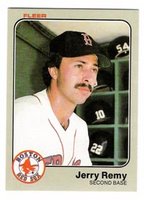 This card of Remdog is one of three things: unfailing proof that steroids were rampant in baseball in the early Eighties, an optical illusion, or the photo was taken minutes after Remy was taken off the rack. Seriously, did he enjoy standing next to nuclear waste? In his playing days, Jerry Remy was fit, but not physically intimidating. Neither was he tall. In fact, on the back of the card it lists him at 5'9", but he could in fact be shorter than that. I'm talking Tom Cruise-short, maybe like 4'10". But his head is scraping the roof of the dugout!?! What gives? (If you need more proof that his mind couldn't take the torturous physical regimen he or someone in the Red Sox trainer's room was putting him through, check out his headshot on the back of the card. Gotta love Remdog: smiling in the face of even the most bizarre, if not arduous predicaments. Self-inflicted gigantism is nothing to be ashamed of, Jerry. Even little guys are allowed to dream big.)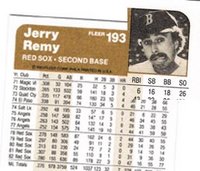
 ’81 Topps, or ’89 Topps Traded in the top 33 at all. I’m prepared that every set will be somebody’s favorite; maybe someone’s first set was ’84 Topps, someone else’s last set ’86 Donruss or ’83 Fleer and therefore that set is firmly planted at the top of their own Best Set list. I guess all I can say is that I’m not letting nostalgia cloud my review and ranking of the remaining sets. If there was a Canseco rookie in a given set (for example), and mostly everybody spent their youth pining for it and saving up the $35 to buy it, you bet I’m going to take that into consideration. But no way in hell does that make that set better—especially if it was just Canseco and a pile of commons—than one with a wider selection of quality rookies, stars and cards in general.
  Not exactly a Canseco and a pile of commons, but pretty close. Okay, that’s not a fair assessment, but this Fleer set is so uninspiring. And this was right in the middle of the Fleer/Donruss golden years from 1984 to 1987, so why so many goddamn headshots? I mean, c’mon. You’ve got second years of Puckett, Clemens, Gooden; you’ve got a Coleman rookie, a Canseco rookie—on one of those awesome rookie doubleheaders found at the back of the set, no less (Fleer’s neat but ultimately pathetic stab at the Donruss monopoly on rookie-cool)—and a sleeper rookie in Cecil Fielder (also on one of the rookie doubleheaders at the end of the set).
  So while this set gets negative points for design, it does get back a few of those points when it comes to graded cards. I can imagine that, like with the ’86 Donruss set, it must be hard to successfully slab a card from this set at 9.5 (or even at 8.5). Those blue borders were a bitch to keep sharp.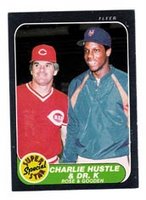
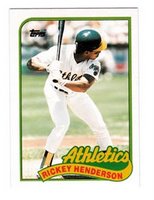 I would argue that Topps never really went away in the 1980s. They never put out a forgettable design, nor did they ever really miss the boat on players (and if they did on some, then they didn’t on others, or had others that Fleer or Donruss didn’t have. Future Star Pat Dodson, anyone?). So I don’t think that it’s a stretch to have the ’89 Traded set on the cusp of the top 30. And yes, I would rate it higher (and thus more deserving) than ’86 Fleer, for a couple of reasons.
  First, this set is helped by the Griffey Factor, and not at the expense of the regular 1989 Topps set, which is a great set without a Griffey rookie. In contrast, I would argue that the 1989 Score Rookie/Traded benefited from the Griffey Factor at the expense of the regular Score set, because 1989 Score needed all the help it could get. I’ll admit, the logic is a bit confusing, but I would say that because of a strong regular Topps set, the Griffey Factor is doubly beneficial to the Traded set.
 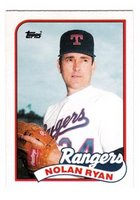 I would also argue that 1989 Topps Traded benefits as the last set that qualifies for ‘pre-Upper Deck’ status (even though, because it came out in 1989, that’s technically not true). This set is the last set pre-UD to showcase ‘event cards’, like the Griffey and the Nolan Ryan wearing his Rangers cap like a trucker (or a model train engineer). I think you could say that Upper Deck redefined the event card, making it more difficult for cards to attain this status.
  When I first saw this card I totally thought Murray had sold out. He had always been one of my favorite players and had made it acceptable to silently root for the Orioles, even as a diehard Red Sox fan. For him to go to the Dodgers was blasphemous. Not only did he desert his lifelong team, he deserted me. Whenever I think of 1989 Topps Traded I think of that Murray card, more so than the Griffey.
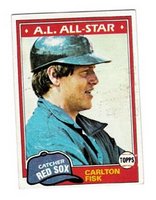
 1981 Topps was the last set to denote an All-Star on his regular card. That changed in 1982, when All-Stars were given their own subset for the first time since 1974. 1981 was also the first set to include team rookie cards since 1972, and the first to split the cards up (not put them all together at the end of the set) since that same year, 1972. As for design, it was one of the best

 Topps Executive 1 “Heard it in a dream, huh?”