
In the summer of 1989, political scientist Francis Fukuyama published an essay in The National Interest titled "The End of History?" Fukuyama argued that Western liberal democracy marked the end of humanity's social evolution and that, contrary to Marx, democracy would be the prevailing style of government going forward.
If we replace "Western liberal democracy" with "nostalgia," this thesis could also accurately describe the approach and mind-set of Topps in 1989. Nineteen eighty-nine saw Topps's re-introduction of the Bowman brand, complete with oversized cards, a la 1953. While oversized cards were used for only the inaugural set, the design choices put forth in 1989 Bowman catered to those nostalgic adult collectors, and set the company on the path to today's hobby landscape: obsessed with retro designs, with fewer and fewer original designs and new ideas.

But while Topps was using Archives as a reprint brand for baseball (and football), the company took the innovative route and lent the Archives name to a basketball card set that predicted the direction of the brand today: a smaller set using legacy designs and heavy with contemporary stars.
The set was called "Topps Archives: The Rookies," featuring NBA players shown in their rookie years, using the baseball card designs from those years. This was significant because Topps did not create basketball cards for 10 seasons (1982-83 to 1991-92), thus missing out on a decade's worth of star rookies. I really liked this set; its concept, designs, checklist, and price per pack appealed to me as a collector (and the fact that you can still find boxes of unopened wax for under $15 is pretty cool as well).
The current iteration of Archives could not exist without a third nostalgia-tinted brand: Topps All-Time Fan Favorites. Released from 2003–2005, these sets featured popular regional favorites from the last 50 years—not necessarily each team's biggest stars. Designs included every year of the Topps canon, from 1952 on. And while the checklist got more and more tired with each passing year, the brand concept was fresh (though it did start to border on my parody idea of an Archives set comprised entirely of commons).

This combination—a yen for nostalgia, legacy designs, and a mix of contemporary and retired players on a shorter checklist—is what makes a set like Topps Archives tick.
But yes, it's a hodgepodge. The checklist is a mix of today's stars and rookies and retired Hall of Famers. The set's got a bit of history for younger collectors who don't know the legacy designs, it's got parallels (like every other Topps product), and it's got short-printed hot-stuff rookies (Masahiro Tanaka and Jose Abreu).
It's also devoid of original thought, or new ideas, or really any ideas that go outside the box. And if you don't like the designs included in the set, you're probably not going to want to collect it. The brand has also, in its three years of existence in this form (2012–2014, so far), been plagued with lousy paper stock, odd inserts (Karate Kid villain autographs, anyone?), photography shared with other sets, and eerily similar checklists from year to year.

But did I mention it has on-card autographs? Of current stars and retired fan favorites? I never wanted a Shawon Dunston reprint 1990 Topps card, but I do cherish the auto'd Dunston reprint I got in a pack of 2012 Archives. But with 2014 Topps Archives pushing $100 a box, I hope I would find an autograph of someone better than Shawon.
This year's crop of inserts presents a nice mix of designs; my favorites are the 1969 Topps Deckle (what, no short-printed Jim Wynn or Joe Foy or their more recent equivalents Ron Gant and Alex Gordon?), and 1987 Topps Future Stars. Both of these inserts will fit nicely as I build mega master sets for both of these years (1969 Topps and 1987 Topps, respectively).
And it's here that Topps's dumpster dive into the past connects with me. I'm actively collecting cards that use a particular design to create a "mega master set." I'm doing this for a handful of years: 1965, 1969, 1976, 1978, 1986, and 1987 Topps. It adds a new wrinkle to collecting these sets and makes newer brands like All-Time Fan Favorites, Heritage, and even Archives worth paying attention to.
Have we reached the end of original thought in the hobby? Well, nostalgia is the prevailing selling point for many, if not virtually all, of the new baseball card sets in 2014. Gypsy Queen, Allen and Ginter, Heritage, Archives, Turkey Red—all of these sets are based on old designs. Topps flagship base-card designs have been interchangeable since 2010. Bowman? Ditto. And inserts in these flagship sets hark back to the legacy of each brand.
 |
| Don't let your set be a victim of repetitive photography! |
So while 2014 Archives lacks the new idea to make it a memorable set, that's not a surprising development. It would be truly surprising if it did present something new.


 ’81 Topps, or ’89 Topps Traded in the top 33 at all. I’m prepared that every set will be somebody’s favorite; maybe someone’s first set was ’84 Topps, someone else’s last set ’86 Donruss or ’83 Fleer and therefore that set is firmly planted at the top of their own Best Set list. I guess all I can say is that I’m not letting nostalgia cloud my review and ranking of the remaining sets. If there was a Canseco rookie in a given set (for example), and mostly everybody spent their youth pining for it and saving up the $35 to buy it, you bet I’m going to take that into consideration. But no way in hell does that make that set better—especially if it was just Canseco and a pile of commons—than one with a wider selection of quality rookies, stars and cards in general.
  Not exactly a Canseco and a pile of commons, but pretty close. Okay, that’s not a fair assessment, but this Fleer set is so uninspiring. And this was right in the middle of the Fleer/Donruss golden years from 1984 to 1987, so why so many goddamn headshots? I mean, c’mon. You’ve got second years of Puckett, Clemens, Gooden; you’ve got a Coleman rookie, a Canseco rookie—on one of those awesome rookie doubleheaders found at the back of the set, no less (Fleer’s neat but ultimately pathetic stab at the Donruss monopoly on rookie-cool)—and a sleeper rookie in Cecil Fielder (also on one of the rookie doubleheaders at the end of the set).
  So while this set gets negative points for design, it does get back a few of those points when it comes to graded cards. I can imagine that, like with the ’86 Donruss set, it must be hard to successfully slab a card from this set at 9.5 (or even at 8.5). Those blue borders were a bitch to keep sharp.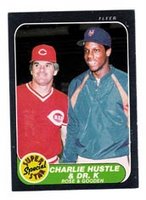
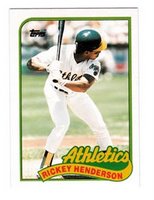 I would argue that Topps never really went away in the 1980s. They never put out a forgettable design, nor did they ever really miss the boat on players (and if they did on some, then they didn’t on others, or had others that Fleer or Donruss didn’t have. Future Star Pat Dodson, anyone?). So I don’t think that it’s a stretch to have the ’89 Traded set on the cusp of the top 30. And yes, I would rate it higher (and thus more deserving) than ’86 Fleer, for a couple of reasons.
  First, this set is helped by the Griffey Factor, and not at the expense of the regular 1989 Topps set, which is a great set without a Griffey rookie. In contrast, I would argue that the 1989 Score Rookie/Traded benefited from the Griffey Factor at the expense of the regular Score set, because 1989 Score needed all the help it could get. I’ll admit, the logic is a bit confusing, but I would say that because of a strong regular Topps set, the Griffey Factor is doubly beneficial to the Traded set.
 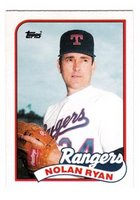 I would also argue that 1989 Topps Traded benefits as the last set that qualifies for ‘pre-Upper Deck’ status (even though, because it came out in 1989, that’s technically not true). This set is the last set pre-UD to showcase ‘event cards’, like the Griffey and the Nolan Ryan wearing his Rangers cap like a trucker (or a model train engineer). I think you could say that Upper Deck redefined the event card, making it more difficult for cards to attain this status.
  When I first saw this card I totally thought Murray had sold out. He had always been one of my favorite players and had made it acceptable to silently root for the Orioles, even as a diehard Red Sox fan. For him to go to the Dodgers was blasphemous. Not only did he desert his lifelong team, he deserted me. Whenever I think of 1989 Topps Traded I think of that Murray card, more so than the Griffey.
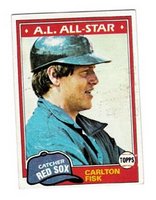
 1981 Topps was the last set to denote an All-Star on his regular card. That changed in 1982, when All-Stars were given their own subset for the first time since 1974. 1981 was also the first set to include team rookie cards since 1972, and the first to split the cards up (not put them all together at the end of the set) since that same year, 1972. As for design, it was one of the best

 Topps Executive 1 “Heard it in a dream, huh?”