Showing posts with label BBC Blog interviews. Show all posts

June 23, 2015

Interview with "Kaiju Baseball" artist Chet Phillips

We here at The Baseball Card Blog appreciate fine art and its place within the hobby. From the bubbly, Topps-approved artwork of David Coulson to the punk aesthetic of Pat Riot (and everyone in between), the baseball card is the perfect pocket-sized canvas. 

Continuing our occasional interview series, today we're talking to Chet Phillips, who has just completed "Kaiju Baseball," an homage to Japanese Menko cards of the 1960s and the kaiju monster demons from the worlds of Godzilla and Ultraman.

The Baseball Card Blog: Tell us a little about your background as an artist.

Chet Phillips: With a BFA in painting and drawing, I worked as a commercial illustration with traditional tools for a decade. Clients included ad agencies, design firms, publishers and corporations. In 1992 I purchased my first Mac and switched to digital art, using the natural media software program Painter (I still use it to this day). A highlight for my commercial work came in 2000 when I was hired by Warner Brothers to illustrate 100+ pieces for the Harry Potter merchandising style guide. 

In the late 90s, I began a new chapter in my career, creating my own merchandise to sell online. It started with a handful of cigarette card–inspired sets of monkeys as WWI generals, steampunk monkeys and dogs and cats as famous authors, artist and musicians. I also have produced a number of limited-edition books, hand-bound by my wife (she's a professional bookbinder). I still do occasional commercial jobs, but spend the bulk of my time creating my own work for online sales, conventions and art galleries.

BBC Blog: Did you collect baseball cards as a kid? Or do you still collect?

CP: I did a little baseball card collecting when I was young, but gravitated more towards collecting comic book type cards. I was a big fan of Norman Saunders and collected his Batman series. I was never able to collect the entire original Mars Attacks! set, but did a trade with a schoolmate once for a dozen or so that I still treasure to this day. 

BBC Blog: What led you to kaiju, baseball, and Menko? 

CP: I've always loved the look and feel of Japanese printmaking. Over the last two to three years I've explored creating my own version of artwork with a similar feel. This series includes an alphabet book of kaiju monsters of my own design titled "Land of Kaiju," and a series that placed pop culture characters engaging in childhood activities, each with their own hiaju poem ("Childhood"). "Kaiju Baseball" was inspired by the look and feel of vintage Menko baseball cards with a parody mashup of kaiju monsters from the Godzilla and Ultraman universes.

BBC Blog: It's interesting that you chose to create a stand-alone baseball card set as part of this project. Did you have the intention to create a card set all along? Or was it borne out of the process of creating the art?

CP: This was intended to be a card set from the outset. Unlike past sets that I've created, I decided to take the idea further and produce an 18 x 24 poster of the group and also produce a cloisonné enamel pin. 

The set is divided into four teams that I devised, each with nine players. The set also includes four team cards for a total of 40 cards. Each card includes the team name, character name, team number and field position on the front in Japanese with the portrait. On the reverse I've included the same info in english along with a few basis stats. 

The card backs include a symbols for rock, paper and scissors as well as a fighting number system (for use like the children's card game War). Cards were professionally printed on sturdy 100-lb premium uncoated card stock. Each set comes in a green handcrafted Japanese-styled paper portfolio. The Japanese characters for the words "kaiju baseball" are stamped in gold foil on each label.

BBC Blog: What's your next project? 

CP: With our 6th year of exhibiting at San Diego's International Comic Con coming up next month, I'm putting the finishing touches on a book of characters and stories of my own invention that will be in the tradition of American tall tales. This, along with the new card sets, posters and pins will be available at my Small Press table (O-01, across from Oni Press.)

Check out Chet's Etsy shop if you're interested in purchasing the set or viewing more of his great stuff.

April 02, 2012

Interview with Pat Riot, baseball-card artist

I think it was 1996 or 1997. I was a senior in high school and completely obsessed with the Pop Art sensibility of using old images in new ways. For me, it culminated in making about 200 copies of a blown-up 1930s clip art image of a toaster and posting them everywhere in my high school. (The janitors hated me. Not kidding.) 

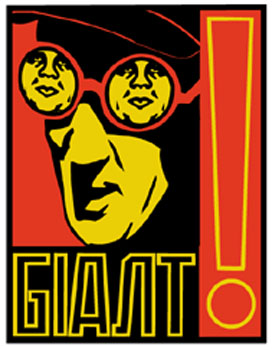
Glasses, Shepard Fairey, 1997
Around that time I found out about Shepard Fairey. I became obsessed with Fairey's "Obey Giant" artwork, and when Fairey launched his online print store, I saved up the $22 and purchased a great poster he cribbed from the Russian avant garde cinema posters of the 1920s (see image at right). (That $22 poster, tack holes and all, now hangs in my living room.) 

There is relevance in my bringing this up. I was convinced then that Shepard Fairey was on the cusp of the next step in art. He was pulling seemingly random ideas – with their own individual meaning – out of pop culture and mashing them together in anti-establishment ways to create a new meaning: the tongue-in-cheek graffiti artist warning against the police state. That his work eventually found notoriety and mainstream acceptance at established art museums would not have surprised 17-year-old Ben.

So when Pat Riot contacted me about his custom cardwork series "Discard," I sat bolt upright. His work is in the same vein as old-school Shepard Fairey, and evokes the same feeling: that this is a next logical step for art. 

Riot's work turns the traditional hero worship inherent to baseball cards on its ear, forcing the viewer to question the very purpose of a sports card while poking fun at the covetous nature of the hobby. 

I don't mean to characterize Riot as an amateur; he is not. He is a working, professional artist. His body of work as a collage artist is impressive (I recommend his "Race War" series, colliding NASCAR with Civil War–era imagery). He's had solo shows in the Greater Los Angeles area, and his work sells.

Nor do I mean to characterize baseball-card art as a new thing. Clearly, it is not. From renegade Punk Rock Paint to sketch cards officially sanctioned by the card companies, I would say that we are currently in a baseball-card-art renaissance. 


The Baseball Card Blog caught up with Pat via email.

BBC Blog: What is your background?


Pat Riot: Having dropped out of art school, I am more interested in the do-it-yourself variety. Art categorized as "outsider art." Henry Darger's work ethic is a huge influence. And I like a lot of "street art." Space Invader is great. I like that he's playing a game with his art. I also love the absurdity of Surrealism.

BBC Blog: I think your baseball-card-based work is ingenious. How did you decide on baseball cards as a medium?

PR: It's always the simple things that seem so ingenious, right? I wish there was some big, smart moment when I made the discovery, but honestly, I was just messing around in my studio one day back in 2005. I had been cutting up a lot of old books and magazines for a collage and also had some old cards that I had lying around so I decided to give it a try...

BBC Blog: You refer to this series as "re-faced cards," which begs the question: Do you have a card in mind first, or a re-purposed face?

PR: A little bit of both. Usually I just sit down with my cards, scissors and a high stack of potential.

BBC Blog: Tell me about the cards.

PR: My story is all too familiar. My mom threw away my collection. It was pretty worthless, anyway. I buy most of them from the era when I remember collecting, the 70s and 80s. I found some amazing uncut sheets of cards on eBay that I've been working on. The '87 woodgrain! It looks seamless and awesome as a whole sheet. I DEFACED the Barry Bonds rookie card!

BBC Blog: Do you create pieces to exist individually, or are they meant to be viewed together as a whole?

PR: They stand alone as one-offs, but they carry a lot of punch as whole set. They look nice in a book, too!

BBC Blog: Are any cards sacred to you?

PR: No card is sacred. I'm actually ADDING value to these old (in most cases) cards. I'm giving them new relevance and view ability... [Though] I would never hurt a Mark Fidrych card. Or a Hank Aaron.

View more of Pat Riot's work in our Custom Cardwork gallery, and at his official website.


Check out more of The Baseball Card Blog interviews from the past five years here.

January 20, 2010

Interview with Bob Lemke, Vintage Card Editor at Standard Catalog of Baseball Cards

For nearly 30 years, the name Bob Lemke was synonymous with the unbelievably comprehensive Krause publication The Standard Catalog of Baseball Cards, the bible of card collectors across the country. These days, he's the editor of the Vintage Card section of the Standard Catalog, creates his own custom cards, and blogs about card variations at Bob Lemke's Blog. Bob stepped aside for a few minutes this week to answer a few questions.


BBC Blog: You've been identified with the publication of the annual Standard Catalog of Baseball Cards for many years. How did you get involved with the publication in the first place?

BL: In 1979 I had been employed by Krause Publications for five years, working in the firm’s numismatic division. As I returned to active card collecting in the mid-1970s I recognized that the card hobby was at a state that the coin collecting hobby had been in 20-30 years earlier.

BBC Blog: What are the origins of the Catalog?

BL: A basic hobby publishing tenet that KP’s founder, Chet Krause, had developed since the early 1950s is that to grow and prosper, a collecting hobby needs four basic types of publication: 1) A “trader” paper, published monthly or more frequently, that can connect buyers and sellers (this was in the days before the internet), 2) A glossy national newsstand magazine that can be used to attract the general public, 3) A comprehensive reference/pricing catalog that will allow even the beginning collector to be in the same ballpark as the advanced collector and dealer in terms of basic knowledge of what is available and what it’s worth, and, 4) A periodical price guide to allow for keeping collectors and dealers current in fast-changing markets.

After unsuccessfully trying to buy one or more of the existing hobby trader publications, in the Spring of 1980 we published the premiere issue of Baseball Cards magazine, the first national newsstand magazine for the hobby and instantly the largest circulation publication (125,000) ever in that field.

An integral part of BBC was a price guide section for 1948-date Topps and Bowman cards. That became the basis for the data base that produced the first Standard Catalog of Baseball Cards in 1983. As editor, then publisher of the sports division at KP, I was responsible for developing the line of products that eventually numbered something like seven papers and magazines and more than a dozen books. By the late 1980s we had a full-time editor for the catalog, and I took over than position in the mid-1990s when I semi-retired from my corporate responsibilities.

In May, 2006, I left Krause Publications and the catalog. I returned to the book on a part-time basis in the summer of 2009.


BBC Blog: It's obvious that an enormous amount of work goes into maintaining it each year. Do you work with a set group of people? What is the dynamic like?

BL: The catalog has an in-house staff responsible for maintaining the database and the presentation of the modern (1981+) sections of the book. My bailiwick is maintaining the database and presentation of the vintage major league and minor league sections. I don’t maintain an official cadre of outside contributors, but work with dozens of specialist collectors and dealers year-round who keep me apprised of new discoveries, market (price) movement and popularity trends.

BBC Blog: How do you handle "new" discoveries?

BL: The inclusion of new discoveries is made easier in this day and age by the instant communications offered by the Internet and the ease of providing “evidence” in the form of scans. Even though it is a shadow of itself, eBay for many years offered a huge 24/7 international card show where new things were discovered and up-to-the-minute real-world market values were readily available.


BBC Blog: A great number of vintage Spanish sets are included in the Catalog (Toteleros, Topps Venezuelan, etc.), but very few vintage Japanese sets. Was this done on purpose?

BL: Yes. The principal reason that so many vintage Caribbean and South American card issues have been included in the past is that those professional winter leagues typically included former and future major leaguers, and Negro Leagues players who didn’t appear on career-contemporary “American” cards. Because these players populate the checklists of such sets, they are more popular with collectors in the U.S. than Japanese cards.


BBC Blog: In addition to your own work on the vintage side of the Catalog, you blog about variations and have created a wonderful gallery of your own custom cards. Can you tell me about why you started to blog? And about why you create custom cards?

BL: I started the blog when I signed back on with the catalog so that I would have a venue to communicate with collectors and dealers for the purpose of gathering information to update the book. It also provides me with an outlet for feature writing about baseball and baseball cards.


Bob's newest custom card, a T202 Triple Folder Honus Wagner/Max Carey.

The custom cards have been, for the past six or more years, my principal hobby. I no longer actively collect sports cards other than to provide materials I need to make my “cards that never were.” The availability of user-friendly computer graphics programs allows me to lose myself for hours or even entire weekends in creating baseball and football cards in the styles of the classic cards of the early 20th Century.

January 14, 2010

Interview with Mark Chiarello, Negro Leagues Artist

Mark Chiarello is an award-winning artist whose work can be found across popular culture, from Batman: Black & White to Hellboy to Heroes of the Negro Leagues. He answered a few questions via email.


BBC Blog: What is your background as an artist?

MC: I trained as an illustrator at Pratt Institute in NY and have been fortunate enough to have made a living as an artist ever since. I somehow get to do what I love for a living, painting pictures of baseball heroes, comic book heroes and movie heroes.


BBC Blog: When did you know you were a fan of the Negro Leagues? Was it a particular experience or epiphany?

MC: I’m a hardcore baseball fan (Yankees), and since my best friend, Jack Morelli lives up near the Baseball Hall of Fame, we go to the ‘Hall’ a few times a year. Years and years ago, Jack and I were walking around, looking at all of the inductee plaques and we both noticed there was a guy named Judy Johnson alongside the likes of Babe Ruth and Willie Mays. Well, our curiosity got the best of us, so we started looking into the Negro Leagues. It’s continued to be a passion of ours for the past 25 years.


BBC Blog: How did you get involved in the "Heroes of the Negro Leagues" trading card set and book?

MC: When Jack and I initially got interested in the Negro Leagues, we realized that there were very few books or information about them. We were pretty astounded that at that point there were no color trading cards dedicated to the League or it’s players, so we took it upon ourselves to create a set, which came out in 1990.

Years later, we were approached by Abrams Publishing and asked if we we’d be interested in collecting all of the cards in book form, which ultimately became “Heroes of the Negro Leagues.” We had a great time expanding the number of players, which required doing forty new paintings for the book.


BBC Blog: Did you get any feedback from the players and/or their families?

MC: We’ve gotten to meet a bunch of the players over the years, including Leon Day, Ray Dandridge, Double Duty Radcliffe and Monte Irvin. And, I have to say, it was pretty darn cool when Monte told me he really liked my painting of him a lot.


BBC Blog: You've become involved with the Josh Gibson Foundation and just recently produced a limited edition print to help them fundraise. Can you tell me more about how you became involved?

MC: I was invited to the unveiling of the Josh Gibson statue at Nationals Stadium last year, by Josh’s great grandson, Sean Gibson. After the ceremony, we got to talking, and we came up with the idea of doing a limited edition print. I’m very honored to be able to contribute to that great foundation, but honestly, I really just wanted to do another painting of Josh, he had such a great face.


BBC Blog: Was this a one-off collaboration, or will there be more projects down the road?

I’m hoping to do some more Negro League player prints, plus I’m looking into the possibility of doing something with the legendary Gale Sayers. Keep your fingers crossed for me!


BBC Blog: Are you a collector?

MC: Yes, I collect any and every card that features a Negro Leaguer. And, although I’m trying to complete my 55’ topps set, my real mania when it comes to collecting is 3D cards, especially the Kelloggs sets that came in cereal boxes when we were kids. The 1970 Kelloggs baseball and football sets are just gorgeous!


Mark Chiarello's limited edition Josh Gibson print can be found at ArtInsights.com (scroll down for ordering info). Remarqued edition prints include a small pencil drawing by the artist (see image above for example). Also, be sure to visit Mark Chiarello's site to view tons of his work.

April 08, 2008

1990 - 1994 Countdown: #20. 1992 Topps Kids

(This post originally ran on February 22, 2008)

The Popeye muscles. The icicles on the end of Chili Davis’ bat. The Pop art sensibility and the 35¢ packs bobbing like life preservers in a sea of overpriced, insert-laden deadweights. The short 132-card checklist. The fun facts and anthropomorphic baseball equipment trading knowing looks with players and fans. Topps Kids, we hardly knew ye. Well… we knew ye—and some of us really loved ye (just not enough of us for ye’s liking).

This set, while defiant in the face of the mo’ money, mo’ problems hobby, was a product of Topps talking out of both sides of its mouth. Little kids were getting priced out of a hobby that had been geared towards them for generations, and much of it was Topps' doing with sets like Stadium Club. And yet Topps, ever the quixotic cavalier, rode to their rescue with cheap cheap packs, fun cartoons and explanatory tidbits about the game and the hobby.

The set launched a niche within an already niche hobby: what I’ve dubbed ‘Kids Kards.’ Both Donruss and Upper Deck followed the Topps lead with their own Kids Kards sets (Triple Play and Fun Packs, respectively). But while its competitors each churned out a few sets (Donruss produced Triple Play from 1992 to 1994 and Upper Deck made Fun Packs in 1993 and 1994), Topps Kids only survived through one year. Why?

I have a theory. While the cards were fun, and have gained a bit of notoriety for their pre-steroids depiction of players as muscle-bound Goliaths, Topps overlooked one very important thing about the hobby landscape of 1992: kids may have been priced out, but they were still collectors like everybody else: they wanted bells and whistles. They wanted shiny inserts. Upper Deck and Donruss understood this and incorporated these things into their Kids Kard sets. And Topps, though sage to recognize a market ready for its own set, was too wrapped up in its nostalgia of simpler times and simpler cards to see that its creation patronized its target audience.

I loved this set when it came out (and no, I wasn’t a little kid). I loved its playfulness and, as a collector experiencing foil fatigue at the time, I immensely enjoyed the fact that there was a shiny-things-free lower-priced set out there. I also liked the gum.

Though I’d forgotten about the set for a number of years, my admiration of it has grown. I jumped at buying a box online last summer and live-blogged a pack for A Pack A Day (click on the link to read the entry).

Earlier today, I got a chance to pose a few questions to David Coulson, the illustrator for Topps Kids, as well as other Topps sets.


The Baseball Card Blog: How did the set come about?

Coulson: I'd been working for as a freelance illustrator for Topps on and off ever since I started freelancing in the early 1980s. I was initially brought on by Art Spiegelman to illustrate a non-sports display box, and continued working primarily on non-sports projects, although I remember also illustrating a baseball and a football sticker album.

BBC Blog: Did Topps approach you early on in the development process?

Coulson: In the early '90s I was contacted by Brad Kahlhammer, an art director there who I'd worked with frequently, to design the cartoon back for the prototype Topps Kids card. It was a product that they were hoping would get young kids into baseball card collecting again (after years of decline in that demographic), hence the fun look and the low price point.

They had already had an illustrator design a few rough samples for the fronts (Richard McGuire is who I remember). This soon developed into me drawing all of the cartoon backs for the series, and drawing all the illustrations and hand-lettering for the fronts and the packaging as well. Some of the front styles were based on the style of the previous samples, the colored pencil rendered bodies with the photo heads being an example. There were at least 7 or 8 different front designs, all illustrated by me and mostly colored by me, with the exception of the cartoon silhouettes and graphic shapes which were colored at Topps.

For the backs I did only black & white illustrations (and lettering) and they had several different colorists do the colors, which is why if you look closely you can see different techniques of color application.

BBC Blog:With a checklist of only 132 cards, player selection must have been tough (only four or five players from each team). Were there any illustrations that didn't make it into the set?

Coulson: I don't know how they decided which players to include. I was provided with a script and stats for each back along with photo reference for each player and uniform reference for each team. I was able to come up with my own sight gags and similar incidental word balloons based on the scripts.

As far as I recall there were no illustrations that didn't make it into the set, although there were several that had to be revised when a player was traded after their card was drawn but before being printed.

BBC Blog: Finally, I approach baseball cards like they are little pieces of modern art, worthy of attention and critique. Are you a collector? And if so, do you have any favorite cards (that you've worked on or otherwise)?

Coulson: I agree with you about cards in general, although I am not a collector myself (except for my own samples). More recent sports card jobs I've done for Topps include the Bazooka Baseball, Bazooka Football, and Bazooka Basketball full color comic strip inserts series (Don Alan Zakrzewski art director), meant to be reminiscent of Bazooka Joe bubblegum comics, but also very similar in feel to the Topps Kids series. Each of these was a series of 24 insert cards, and unlike Topps Kids, they each continued for at least 2 or 3 years. I also drew black & white cartoon spots for the main series of Topps Baseball and Football cards for the 2006 year (Erik Kroha, art director), which was probably over 500 cartoons!


Here are a few other Topps Kids and David Coulson resources on the web:

Local Cartoonist Wows Kids (Pittsburgh Tribune-Review, 7/12/06)

David Coulson, Topps Kids illustrator (official site)

June 05, 2007

The Baseball Card Blog Interview
with Michael O'Keeffe

If you haven't already heard about it, picked it up, or read Michael O'Keeffe and Teri Thompson's new book The Card: Collectors, Con Men, and the True Story of History's Most Desired Baseball Card, you're missing out. It's a great, comprehensive and controversial read about the hobby's most prized possession (the former Gretzky/McNall T206 Honus Wagner) and the many men who made it that way. Michael O'Keeffe answered The Baseball Card Blog's questions about the book and his take on the state of the hobby.


BBC Blog: Tell me about yourself.

O'Keeffe: I’ve been writing about sports cards since the late ’90s. This has never been a full-time pursuit, but sports collectibles is one of the beats I’ve followed and written about since I joined the Daily News. I did collect baseball cards as a kid, and to a lesser extent, football cards. But I gave all that up by the time I was about 13, 14 years old. I have very fond memories of collecting, trading and flipping cards, and at least indirectly, those memories did play a role in the writing of the book.

BBC Blog: So much of the hobby has built on the intrinsic value of one word: authentic. Does this word have any meaning?

O'Keeffe: I’m not sure what you mean here. Are you talking about “authentic” in terms of a grade from a grading company? Or “authentic” from a memorabilia authenticator? “Authentic” cards are cards that are lower value because a grading service said they were genuine but trimmed or altered. “Authentic” memorabilia means simply [that] some authenticator said it is what a consignor or auction house says it is.

I think the word has meaning when it comes to cards – at least you know what you’re getting, even if it was trimmed or altered. I don’t think it means a great deal when it comes to memorabilia – there are so many unqualified and unscrupulous authenticators.

BBC Blog: One of the questions I ask myself from time to time is, Did Topps invent Mickey Mantle or did Mickey Mantle invent Topps? You could make a pretty strong case that were it not for Mickey Mantle anchoring every Topps set 1952 to 1969, the company would be in a very different position today. But also, were it not for Topps, would 'Mickey Mantle' be synonymous with 'baseball', 'nostalgia' and 'Americana'?

O'Keeffe: I think he was such a phenomenal talent that he would have been a star regardless of baseball cards. He was not only a great ballplayer, he was the right man for the right time – a big, strapping, handsome, easy-going hero for a generation that wanted to return to normalcy after the violence and uncertainty of WWII, Korea and the Cold War. I think he would be an iconic figure regardless of baseball cards, although cards certainly played a role in his fame.

His image certainly helped Topps maintain its monopoly for many years and you’re right, it’s something they can go to every so often to gin up consumer interest and press coverage.

BBC Blog: Similarly, Bill Mastro seems to be the man behind the curtain in the hobby's secondary market; is this a fair assessment of him, or is he just a product of the industry? If not for Bill Mastro, would card and memorabilia collecting be where they are today?

O'Keeffe: As far as Mastro goes, I believe he has played a vital role in the industry’s evolution. He’s a smart and aggressive businessman who has brought a lot of innovation to the hobby. He’s also a very personable guy, and his larger than life personality has attracted a lot of collectors into the hobby. He’s got a lot of critics, too. We compare him in the book to George Steinbrenner – some people love him, some hate him, but you can’t deny he’s played a big role in collectibles.

BBC Blog: Do you think Ray Edwards and John Cobb have gotten a fair deal?

O'Keeffe: Not really.

I can’t say if their card is real or not. It probably isn’t, if you look at the numbers – there are only a few dozen real wagners still in circulation, but thousands of reprints still exist.

To me, their story is interesting because of the lengths they have gone to to prove their card is real. It’s like that Lucinda Williams’ line, “June bug vs. hurricane…” The hobby has jumped on these guys with a viciousness that is frightening. A paper expert and a printing expert have both said their tests indicate it is consistent with a 1909 card – that raises interesting questions to me. Many have ripped their card without ever seeing it or examining it in person. Why should industry executives be the final word when the industry has so many ethical lapses, when authenticators typically spend just a few seconds examining the average card, when the grader/auction house relationship is so fraught with conflicts of interest?

I was pretty horrified by the way collectors and dealers attacked Ray and John on Network 54. The overt and suggested racism in some of the posts was pretty disappointing. The hobby is dominated by white men, and in reading some of those posts, you get the feeling the only way a black guy would be welcome in the club is if he is a superstar athlete or a waiter. If the Cobb/Edwards card is so obviously a fake as Network 54 members say, why get so angry? Why rant on and on about two guys who will probably never sell that card, at least for not more than a few bucks? Why call them “Stimeys?” With all the problems in the industry, why pick on a couple of working guys from Ohio?

BBC Blog: Could the sports memorabilia and vintage card secondary markets survive if Mastro admitted to trimming the Wagner, and PSA admitted to knowingly rewarding a trimmed card with an 8 NM-MT?

O'Keeffe: Yes, I think the markets would survive. I’m not sure much would change. I get a lot of calls from collectors who say this auction house ripped them off or that authenticator made a mistake and I should write a story exposing them for the crooks they are. I always ask this question: Why do you buy this stuff if the hobby has so many problems? “Because I really need it, because I don’t want somebody else to get it…” is usually the reply. It’s a joke.

These guys act like vintage cards or old jerseys are as vital as food and water. Some people might drop out of the hobby but many won’t. Some collectors are like junkies. I think it’s rather sad that so many people tie their happiness and identity to an old cardboard card.

BBC Blog: Should we be more worried about the demise of Topps?

O'Keeffe: It doesn’t keep me up at night. But it would be a shame if a venerable old company many of us grew up with would be swallowed up by Upper Deck. UD strikes me as a sterile, soulless corporation; at least Topps has a great history.

BBC Blog: Nearly all of the available writing about the baseball card hobby is resoundingly positive in nature, even though by many accounts what has happened to it over the past twenty-five years or so has been negative (per-pack and per-card prices driving young collectors away, too many sets and a rapidly shrinking list of national manufacturers). It's almost as if collectors, dealers, publications and auction houses have their heads in the sand when it comes to the state and future of their hobby. Why do you think the hobby is like that? Is it really all about the money?

O'Keeffe: It is really about the money. Collectors and dealers are heavily invested in the status quo; if a grading company is exposed as chronically sloppy or incompetent or corrupt, the cards it has graded become suspect and the value of those cards becomes uncertain. The hobby publications are more interested in advertising dollars than real, honest coverage. The mainstream press is not interested in educating itself about the problems the hobby faces; it’s easier to write a “gee whiz, isn’t it crazy that a baseball card sold for $2 million” than do real reporting. Still, I’m encouraged by a lot of the coverage I’ve seen in recent years. The collapse of Topps, the rise of Upper Deck have sparked some good stories. Pete Williams' Card Sharks, although over 10 years now, is a vital read for anybody who cares about the hobby. Kevin Nelson’s book Operation Bullpen is also quite good.


BBC Blog: Could the Wagner phenomenon happen with any other card?

O'Keeffe: I don’t know, but certainly the Gretzky T206 Wagner benefited from the perfect storm.


The Card: Collectors, Con Men, and the True Story of History's Most Desired Baseball Card is available through online retailers and at bookstores around the country.