
I’m basing this list on a few criteria: design, short and long-term impact of key cards (including rookies) and how I feel about the set. There were seriously tons of sets made in the 1980s. I thought about maybe limiting the list to just the major issues from the big card companies, then I contemplated adding in all the Kmart issues and other little guys that you could buy like a deck of playing cards, and then those other ones that you had to cut out of the backs of macaroni and cheese (I also think I ate more Drake’s cakes than humanly possible when cards were on the backs of the boxes), but I had no idea where you’d find a comprehensive list of these sets. Enter the Sports Collectors Digest 2006 Standard Catalog of Baseball Cards, which lists every goddamn set ever made (though I thought I had it stumped when I went looking for the Topps Kids issue from 1992, but really it was there). I decided there can be no middle ground in this kind of list.
So for now I’m just going to do major issues by the big companies. By my count there were 53 different major issue sets released in the 1980s. This includes regular base sets as well as Topps Traded, Donruss Rookies, Fleer Update and Score Rookie/Traded. I’m not counting Tiffany or other parallel sets, like the 1984 Nestle Topps set, or O Pee Chee or the late Eighties Leaf sets. Basically, none of the major Canadian sets are counted, just because I’m not convinced that there was enough of a difference between these sets and their Donruss/Topps counterparts (except logos, card numbering, the presence of French text, the ‘Canadian Greats’ subset in the Leaf sets and the peculiar “Now with new team” text on certain traded players’ cards in the O Pee Chee sets). I also didn’t include Sportflics in the list, because my emotions would’ve gotten the better of me and we’d end up with a Sportflics set in the top 20 based purely on sentimentality of the mind-blowing technology used to get Pete Rose, Mike Schmidt and Steve Garvey on one card…truly amazing. But I also didn’t include Sportflics because all their sets kind of looked the same. Ah, fuck it, I’ll include the 1986 set, if only for the fact that I thought they were so goddamn awesome when I was 7 years old.
I’m going to count down from #53, though you should take into mind that sets will be kind of random until about the top fifteen, so you may not agree that 1989 Score is around #45, and on another day I might see it your way, but for now it’s somewhere around #45 because while it’s got an okay design, it’s riddled with statistical errors and it really was kind of a lame sophomore effort from Score, especially coming off a hot Traded set in 1988, not to mention a great inaugural set (setting the tone with different colors, as well as not being afraid of mixing it up at the end of a set with the Reggie through the years hero-worship a la Topps).
53. 1989 Bowman
The last major-issue set the Bowman arm of Topps released was in 1955, with the TV set border—a classic set in terms of design. Just as memorable was its re-entry set in 1989, but for all the wrong reasons. The card size was bigger than the modern standard size. And while this may have seemed quaint and perhaps even necessary in the board room when they decided to make the ‘new’ Bowman remind collectors of the ‘old’ Bowman, it was a disaster for collectors (and when I say ‘collectors’, I mean ‘me’). I hated 1989 Bowman. Hated it so much that I bought one pack and then quit. Hated it so much that even when that one pack had the Griffey Jr./Sr. card in it, I still didn’t care. The stats were totally illogical to my 10 year-old mind; who cares how a batter did against one specific team? I mean really, what kind of shit is that? Also, and I don’t know if I already mentioned this, but the cards were too big to fit into pages, boxes, top loaders or plastic sleeves.
When Fleer came out with Extra Bases in the Nineties, I thought Goddammitt, here we go again, and even though I bought more packs of that set than I did ’89 Bowman, making cards bigger may have made the set stand out, but would never guarantee the company any kind of widespread appeal. 1989 Bowman is the Betamax tape in a VHS world. Maybe someday someone will write his or her dissertation on how the 1989 Bowman set was of superior quality to the other sets on the market at the time. Too bad that person will be confusing 1989 Bowman with 1989 Upper Deck, and will thus receive a D+ on said dissertation (they’ll get a ‘D’ because the topic’s not accurate nor defensible, and a ‘+’ because the judges will have a soft spot in their hearts for Jimmy Piersall, good ol’#66b).
52. 1988 Donruss
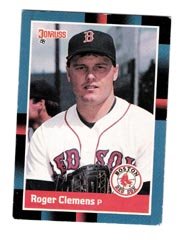 You know, there is something to be said for he who comes in next-to-last. Coming in last is pretty easy (I come in last in my fantasy baseball teams nearly every season), but coming in next-to-last is not so easy: you give it your all (or at least half of your all) and still you suck pretty hard. Coming in last almost always means you suffered some spectacular failure and pretty much everyone who’s following knows that you’re in last (just ask Larry Brown). But next-to-last—that’s an anonymous spot. You’re unmemorable. Maybe there were expectations but people knew enough not to expect anything stupendous. It’s here that we find 1988 Donruss.
 Let’s see: lame card design? Check. Poor rookie class? Check. Overabundance of cards? Check. Dale Murphy on the box? Check. I have to admit that I had certain expectations for 1988: I knew it wasn’t going to be ’87 redux, but I prayed it wasn’t going to suck. ’87 Donruss was a helluva set: so many great rookies, the thrill of opening a pack you really couldn’t afford but bought anyway…but then ’88 came out and it was crap. You know that first time you saw a new card design it was either hard to swallow or love at first sight? Well, 1988 Donruss remains hard to swallow.
51. 1982 Fleer
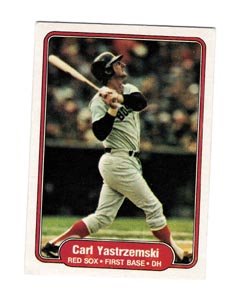
This set has a great thing going for it that only 3 other sets can claim: it has a Ripken rookie in it. Without this card, 1982 Fleer would probably be the worst set of the decade. I’ve already written extensively about why this set is horrible, but I’ll hit the key points again here. The cards were printed onstage during Amateur Night at the Apollo, and they were going to be great but the guy got booed off the stage halfway through the process. An 8 year-old kid took the photos on the one day during spring vacation when her parents didn’t take her to Disney World. Not even Fleer’s first foray into the special card subset helps. Just a real shitty set. You know, I see star cards from this set at shows and stuff and I almost can’t bear to pay the asking price for them because the set just envelops you in its aura of poor quality and overall cheapness.
50. 1985 Fleer Update
Why did they even make this set? I ask myself this every day when I get up and look in the mirror. What drugs were they taking at Fleer when they came up with the idea of making a hundred times more of these sets than the one from ’84, putting almost no desirable rookies in it (besides Vince Coleman) and almost no stars (besides Rickey Henderson)? Why? I think the Topps Traded from this year is valued at $2 for the whole set. This one is currently at $4, and that’s because Fleer was right at the height of its higher standards, higher quality, higher price days from 1984 – 1987. A comparison of bona fide, national stars included in the 1984 and 1985 Fleer Update sets:
1984 Update
Dusty Baker
Roger Clemens
Ron Darling
Alvin Davis
Dennis Eckersley
John Franco
Dwight Gooden
Goose Gossage
Mark Gubicza
Jimmy Key
Dave Kingman
Mark Langston
Joe Morgan
Graig Nettles
Phil Niekro
Tony Perez
Kirby Puckett
Jose Rijo
Pete Rose
Bret Saberhagen
Tom Seaver
Rick Sutcliffe
22/132 = 16.67% Success Rate
8/22 CFS* = 36.37% *Clutching For Straws kind of stars (i.e. Dusty Baker)
1985 Update
Dusty Baker
Tom Browning
Gary Carter
Jack Clark
Vince Coleman
Darren Daulton
Ozzie Guillen
Rickey Henderson
Teddy Higuera
Howard Johnson
Fred Lynn
Don Sutton
Mickey Tettleton
13/132 = 9.85% Success Rate
7/13 CFS = 53.85% Clutching For Straws kind of stars (i.e. Dusty Baker)
See what I mean? When you make a list of all the big names that moved or got called up from the farm that year and the fifth name on your list is Fred Lynn, you may just want to hedge your bets and make a four card insert set to your factory set; don’t bother with an Update set that nobody’s going to buy.
Coming Soon: Sets 49-46

