August 31, 2008

Fantastic Misprint of the Day


I give you 1968 Topps #38, Tony Pierce, with razor-sharp sides and corners, and I-swear-it's-original-gloss. It's well-centered on the front and the tid-bit of fantastical info on the back is incredible (Tony once struck out 5 batters in one inning at high school). But best of all, you'll go blind looking at it.

This particular piece of cardboard badly misaligned when it was time to hit the blue rollers in the printing process, resulting in an almost 3-D effect on the team name and missing ink in other areas. It all feels like a waste, too, since the photo is so boring (it looks like the photographer asked Tony to take his hat off and gaze stoically into the distance, like a tired farmer at the edge of a field). If only this had happened to a card featuring a more dynamically posed player... but this was 1968, so I guess that rules out Vicente Romo doing jazz hands (1970), or Dock Ellis thrusting the ball at the camera in an attempt to get the viewer as high as he was (1969).

Football Sidebar

Like everything else, I could be weeks, months, or possibly even years late on this. Well, probably not years, because as far as I can tell, this is something new for 2008. I'm referring to a new promotion Topps is going to roll out for their football products in 2008, called Topps Player Collection.

The gist of it is that the 30 best players will be found on the same checklist numbers in every Topps NFL set for 2008. It's an interesting idea, and you have to think that if it tests positive with dealers and collectors, something like this will end up as the practice for other sports.

The problem I see with it carrying over to other sports is that it throws off the meritocratic checklisting system Topps baseball really just put back into circulation. Let's say Albert Pujols is #500 in 2009 Topps. Does this mean that every Topps baseball set will have at least 500 cards? Or is it much more likely that cards #1 through #30 are super stars?

Also, here's a great piece by Tyler Kepner in today's New York Times about major leaguers and their fantasy football teams. [NY Times.com]

August 28, 2008

Make Your Own Yankee Stadium Legacy Set


Overwhelmed by the massive, 1,000+ card Yankee Stadium sets that have come out this year? Me too. That's why I've got a better idea. If you want to celebrate Yankee Stadium in your own way, collect those cards that feature it in the background. The same can apply for those of you sick and tired of all things Yankee, who would rather focus on Shea Stadium and the Mets.

Because Topps calls New York City its home, many of its cards feature the two current New York City ballparks as part of the background. 1970 was a big year that comes to mind immediately, but there are plenty of others. And the best part of these DIY Yankee and Shea Stadium legacy sets is that your sets won't be composed of just Yankees or Mets--your set will include most or all of the other major league clubs as well.

Now I'm not a Yankees fan, but something like this appeals to me as a fan of baseball history, much more than a set full of cards of the same handful of players ad nauseam.


(From sorting through a few thousand cards from the 1970s, a Fenway Park Legacy set could also be put together this way.)

The Trouble with Money Cards

One thing I always wanted: a clear resin toilet seat, the kind that comes embedded with hundreds of pennies. You can find this type of thing in gigantic Las Vegas souvenir stores and other fine outlets of all-American kitsch. I mean, c'mon-- who doesn't like finding money where you least expect it?

So then let's fast-forward to the end of September, when Topps releases Treasury Basketball, a product featuring cards literally stuffed with cash. Each box is guaranteed a rip card, with exactly 429 of them containing actual United States currency (neatly folded $10, $20, $50, $100, $500, and $1,000 bills).

OK. I can find a lot of problems with this, the least of which being that Topps has to remove their pack disclaimer that they don't claim to know if cards will have any future value, since 429 cards will be worth at least $10. But that's petty in comparison to the pandora's box this opens. What Topps has created is a lottery. Not just a pseudo-lottery that the card industry has become in general, with packs containing rare autographs and game-used memorabilia, but an actual one with predictable odds and real money changing hands. Kind of scary, isn't it?

Here's something else to consider: let's say you find one of the cards containing a $20 bill. Do you open it up? Or is it more valuable than $20 if you leave it intact? Also, what if it's stamped with a 1/50 serial number? Does that make it more valuable than $20?

But perhaps the harshest indictment of the state of the card industry is this: Topps is proclaiming that finding actual cash in a pack is the next step in the evolution of the insert card. And they may have caught on to something: it is probably far cheaper to include cash in a product than spending lots more on securing contracts for autographs and game-used memorabilia. And besides, autos and relics have become so commonplace that finding one in a pack no longer carries the same weight it once did.

If cash cards in a basketball product with limited originality or appeal works, the practice will soon become a staple of the hobby.

Read the article at SCD.com

August 25, 2008

Fantastic Miscut of the Day


I've been held captive by the 1953 Topps Eddie Mathews Mystique for years. It's officially my favorite card, and I've put off buying it until I had enough money for one in near-mint condition. But then something strange happened. I began to really love miscut cards. And it turned out that there are a plethora of miscut cards from the 1953 Topps set. Needless to say I jumped on this one as soon as I found it.

Here's where it gets really great. That other card that's along the bottom? It's the lower tenth of Roy Campanella's card, who's my other favorite player from Mathews' era. I think it's interesting to note that, using this card and the one of Clem Labine I posted previously as examples, Topps seemed to line up their cards one row up, one row down on their uncut sheets. Because the design featured a black box along a portion of the bottom of each card, you'd think that this set would've had a ton of miscuts.

August 20, 2008

Lil' Kwame Brown

I keep a mini card of Kwame Brown on my desk, one that I've dubbed Lil' Kwame Brown. And I've been thinking: what if Lil' Kwame was real? I've come up with one possible movie for him, based on his real-life basketball exploits...


But this would be just the beginning. I think Lil' Kwame has three-picture deal potential.

In "Swishinpoofs" he would star as a troubled-but-talented ballplayer, forced to join the college a capella group in order to stay academically eligible.

And in "The Lil'est Spy", Brown would infiltrate an underground drug network, with a climactic death race sequence shot in real time, between Lil' Kwame and life-size Andrei Kirilenko.

And if Hollywood doesn't pan out, Lil' Kwame definitely has boy-band potential.

(And by the way, I'd love to see other movie posters for fake films starring sportscards.)

August 19, 2008

Pack Break with Ben Henry

Fantastic Card of the Day


Because I'm on a miscut kick, today's card of the day is this version of Ike Brown's 1970 Topps card. A few other great things about the card (besides Brown sharing it 90/10 with Richie Scheinblum of the Cleveland Indians (card #161)):

• Scheinblum didn't make the Indians roster for 1970, but then went on to make the American League All-Star team in 1972 with the Kansas City Royals.

• Ike Brown's card in the Topps Baseball Cards Book is also poorly centered. Does that mean that the Topps file version of the card is also a terrible version?

• I'm beginning to find that I like cards of players where there are other players milling about in the background. Ike Brown's card has another player walking through the frame, making it seem like the Topps photographer either got to the stadium late to photograph Brown or had to squeeze him in. This theory actually makes sense, because Brown was a rookie in 1969.

• Because this version exists, there is at least one sheet of messed-up miscuts out there from the 1970 set.

August 18, 2008

1948 - 1979 Countdown:
#34. 1959 Fleer Ted WIlliams


Before Topps' institutionalized exaltation of players like Pete Rose, Hank Aaron, Nolan Ryan, and Mickey Mantle, and Upper Deck's lavishly illustrated Baseball Heroes, hero worship was one of the many options in composing a baseball card set. Witness Fro Joy's 1928 Babe Ruth, and Lou Gehrig's face and facsimile signature on every card in the 1934 Goudey set. But most of all, feast your eyes on the big wet sloppy kiss on the lips that is Fleer's 80-card set from 1959: Baseball's Greatest, Ted Williams.

Six cards of a guy I can live with (that's about the length of a standard subset). And even 250 cards with Gehrig's little smirking face in the corner isn't bad (Gehrig is just part of the design, not the subject of each card). But 80 cards of the same player? You'd think that would be overkill. Of course, you'd be right. It turns out that you can form a pretty good picture of who Ted Williams was as a ballplayer with just five or six cards, not 80. And you really only need one card to form a solid image of who Ted Williams was as a human being: card #54, "Dec. 1954, Fisherman Ted Hooks a Big One."

From the back:
"Ted is an avid and expert fisherman. He devotes more time to fishing than anything else, except baseball. His status in the fishing world is as renowned as his status in the baseball world. Williams is particularly interested in game fish, such as marlin, tarpon or sailfish. On December 10, 1954 at Cabo Blanco in Peru, Ted caught the 8th largest black marlin ever landed with rod and reel. It weighed 1,235 lbs. Ted calls this 'my greatest fishing thrill.'


(The Best of the Set is Ted Signs for 1959 (card #68). It's by far and away the most valuable card in the set, and the most important for set collectors.)

Fleer made a big splash by signing Williams away from Topps in 1959, and they planned on getting their money's worth out of the deal. The set from 1959 was just the start of Teddy's cardboard coronation as he approached retirement. 1960 saw the first of two Baseball Greats sets of retired players, which lauded Williams as the brightest star among stars.

So then why, if 80 cards is overkill, does this set pull rank on a number of full-bodied sets made up of a season's worth of players? For a number of reasons, not the least being that it was the first post-war set of unabashed hero worship.

Fleer wasn't the first rival of Topps to sign away one of its major stars, but it was the first to do it after Topps swallowed Bowman in 1955. Also, it wasn't just a small-time regional star Fleer built around. It was Ted Williams, The Greatest Hitter Who Ever Lived. I don't know if this is a fair assessment, but if Fleer doesn't land Williams in '59, does it release baseball cards in 1960, 1961, and the aborted series in 1963? I'm not sure those other sets happen without Williams on board. Heck, the whole reason the Baseball Greats sets exist at all was to include cards of Williams as part of his contract.

Also, if this set didn't exist, I'd argue that subsequent hero worship would've looked a lot different. Remember, Topps' Babe Ruth Story subset in the 1962 set came on the heels of Williams' defection to Fleer (and Maris' record-breaking 61 home runs in 1961). Before the BRS subset, Topps had limited experience in the way of hero worship: they gave Ted Williams card #1 three times (1954, 1957, 1958) and within the first five in 1955 and 1956. The only other instance I can think of is Roy Campanella's post-accident 'Symbol of Courage' card (#550) in the 1959 set.

Following the BRS, hero worship was part of the Topps repertoire, to be used in 1974 with Hank Aaron, 1985 and 1986 with Pete Rose, 1990 with Nolan Ryan, and in the recent abyss composed of every Mickey Mantle, Alex Rodriguez, Mark McGwire, Sammy Sosa, and Barry Bonds insert set the company has felt compelled to produce. All of these go back to the Babe Ruth Story subset in 1962 Topps, which in turns goes back to Fleer's 1959 set, Baseball's Greatest, Ted Williams.

August 16, 2008

A Miscut Above


I've been silent lately, but I've been thinking. Is there anything more beautiful than a miscut baseball card?

As collectors, we expect certain things from card manufacturers. One is that their design and photography departments are competent enough to create cards that we will want to collect. Another expectation is that the card-cutting machinery at their printing plants work correctly. Because without proper framing, we're just collecting cardboard rectangles.

As collectors, we bring a lot to the table in our understanding of how to read a baseball card. When a card is miscut, it's no longer a card in the most traditional sense. It lacks focus, a subject, or even proper boundaries. Our approach to reading it is thrown off.

A miscut card is cast aside as a goof with no real value. And while I won't argue the monetary value aspect, I've come to appreciate miscut cards as art, and worthy additions to my collection. And the best part? Every set ever produced has had miscut cards—it's part of the printing and cutting process—so there examples out there from almost any set you can think of. A definite boon for the miscut collector.

August 11, 2008

1948 - 1979 Countdown: #35. 1963 Fleer

Up until my most recent week's absence from writing, I was on a tear, one not unlike Fleer's first series of cards in 1963. I'm not in any way equating my writing with this set in terms of importance within the hobby, nor is Topps suing The Baseball Card Blog to get the idea into my thick skull that baseball cards is their thing, not mine.

Because Topps blocked Fleer in the courts, what could have been a landmark set and perhaps the start to a beautiful Fleer decade was stopped before it really got started. With only 66 cards, plus a scarce, unnumbered checklist, the set Fleer released has to be viewed as incomplete.

As far as formal checklist strategy is concerned, there are a number of interesting things going on. This is the first Fleer checklist to group team members alphabetically by team, though on a much smaller scale than in the sets released in the 1980s. 1963 opens with a handful of Baltimore Orioles, then a bunch of Boston Red Sox, followed by a few Cleveland Indians, Kansas City A's, New York Yankees, Minnesota Twins, Washington Senators, Chicago Cubs, Cincinnati Reds, Houston Colt .45s, LA Dodgers, Milwaukee Braves, New York Mets, Philadelphia Phillies, Pittsburgh Pirates, St. Louis Cardinals, and San Francisco Giants.


At 66 cards, not everybody from these teams is included. Take the Yankees: only Ralph Terry and Bobby Richardson are in the set. Presumably Howard, Mantle, Maris, et al would've been in a later series. What is surprising is the All-Star quality found in the short checklist. Brooks Robinson, Roberto Clemente, Carl Yastrzemski, Sandy Koufax, Bob Gibson, Warren Spahn, Don Drysdale, and Willie Mays all made it in. And let's highlight the Mays card for a second. His is the only card separated from the rest of his team (Mays is on card 5, while the other Giants are on 64-66). Another notable card in the set is that of Milwaukee Brave Joe Adcock (#46). This is a short-printed card, making it harder to find than the other 65.

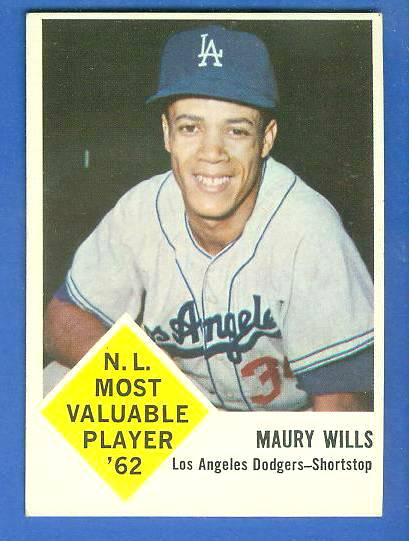
The design is classic Fleer, following 1960's and 1961's lead with white borders. This set also marks the first modern-era use of fielder position silhouettes in the front-of-card design (1973 and 1976 Topps being the others). Finally, the Best of the Set is the rookie of Maury Wills (#43). For reasons that are still hard to figure out, Wills was one of the very few players whom Topps did not tender a player contract to before his rookie season. Therefore, this is his true rookie card. His first Topps card would not come until 1969. All those times you've seen Maury Wills on a 1962 Topps design? Yup, card doesn't really exist.

August 04, 2008

For Only $1,619,993 More, I Could've Had...


Over the weekend I bought this great 1910 T218 Mecca Jimmy Walsh card for $7. (By the way, it turns out that Walsh and I share a hometown (Newton, Mass.).) And while I was busy scrounging in my pockets and smoothing out dollar bills on the store counter to pay for that great boxing card, over at the latest Mastro auction at The National in Chicago, a guy paid $1.62 million for a copy of the T206 Honus Wagner. All this gets me thinking: Can you imagine buying a beat-up copy of any card of a baseball player from that era for less than $10?

The whole atmosphere surrounding baseball history is singular in its intensity. I guess that's what you get for being the national pastime, but when you step back, the whole situation seems a bit unreal. I mean, why isn't the same focus fixed on old football or boxing cards? I guess there's the argument that that focus is present, but you have to add the signifier that it's only present to a certain extent, and never at the fever pitch baseball experiences on a daily basis.


Here's what's keeping these other sports back: there are no 'white whale' cards in either sport that have pervaded the national conscience like baseball's T206 Wagner.

Wagner Sells for $1.62 million (AP)

August 03, 2008

The Rookie Card Through the Years

In a conversation with Andy of the 88 Topps blog, this topic came up: How long has the hobby been obsessed with the rookie card? Or, perhaps more importantly, how long has the rookie card been important to card manufacturers? And has it become more important through the years, or is its importance just a quality we as collectors project?

Andy made the point that historically, rookies had to prove themselves in the minor leagues with at least a few good seasons under their belts, before they made the jump to the big leagues and got their card in a baseball card set. In contrast, in the last 20 years, young players have been on cards from the moment they were drafted, and sometimes even before they were drafted (the Team USA subsets in 1985 Topps and 1988, 1991, and 1992 Topps Traded).

It seemed obvious, at least to us, that the rookie card has taken a much more significant role in sets as the years, and hobby, have progressed. But then after the conversation ended, I got to thinking: Do rookies really take up a larger percentage of today's sets than in years past? I looked at ten random sets: the T206 White Border monster, 1954 Bowman, 1957 Topps, 1966 Topps, 1978 Topps, 1983 Fleer, 1991 Donruss, 1994 Bowman, 1998 Upper Deck, and 2006 Topps. Here are the percentages:

T206 White Border: 2.1% (11/525)
(incomplete tally, though most glaring rookie omission is that of Hall of Famer Harry Hooper, which is surprising considering the set included more than a few cards of flashes-in-the-pan like Lucky Wright.)

1954 Bowman: 1.8% (4/224)
(I didn't count cards of players making their manufacturer debut, like Jim Gilliam and Bill Bruton, much like you can't count Mantle's 1952 Topps card as his rookie card.)

1957 Topps: 5.4% (22/407)

1966 Topps: 16.6% (99/598)
(This set included many team and league rookie cards. In those instances, I counted each individual player, not card.)

1978 Topps: 20% (145/726)

1983 Fleer: 3.5% (23/660)

1991 Donruss: 11.8% (91/770)
(Coincidentally, this set and others in the early 1990s got screwed out of having more true rookie cards because of earlier player appearances in other sets. In this set, the most notable instance is Tino Martinez, whose only 'true' rookie is his Team USA card in 1988 Topps Traded.)

1994 Bowman: 26% (177/682)

1998 Upper Deck: 3.1% (23/750)

2005 Topps: I can't find a single rookie in this set


It's surprising that the second highest concentration of rookies in this list of random sets is in 1978 Topps. I would've guessed that the later sets had more. But what's even more surprising, if we follow our earlier assumptions, is that there were a handful of players pictured in the monster 1909-1911 T206 White Border set that were only in a league for one or two seasons, guys like Harry Gaspar and Lucky Wright (this smacks of the modern-day Bowman plan of giving everybody a card). Their inclusion may not seem important to the makeup of the set, but by including cards of Gaspar and Wright, American Tobacco left others (perhaps more deserving) out of the set, most notably Harry Hooper.

Another interesting idea is raised, this one for modern sets. When a player is included in a set many years before his actual major league debut, can those cards issued directly preceding or after his major league debut be considered rookie cards? Let's go back to the example of Tino Martinez. He made his cardboard debut in 1988 Topps Traded, as a member of Team USA that participated in the 1988 Summer Olympics in Seoul, South Korea. His next cards came three years later in 1991, as a member of the Seattle Mariners. None of his cards from 1991 are considered his rookie card, but is this fair?

Maybe. Maybe not. Whatever your opinion, this issue is an important one that still affects the hobby (thus the need for and adoption of an official 'rookie card' notation in recent years).


(The card shown, 1989 Topps Gregg Jefferies, is not his rookie card.)