Showing posts sorted by relevance for query generation now. Sort by date Show all posts

July 26, 2008

How to Make Relics Mean Something Again

Here's a funny thing to consider: the term "relic" means something from a bygone era, or of historical interest. Only recently has it taken on the connotations of game-used memorabilia. And only really recently has the term come to mean both: cards with game-used jersey swatches and bat shavings are in such proliferation that the idea no longer seems fresh.

So how do we remedy the situation? There's the argument that companies create less of these cards, but telling someone interested in making a profit to create less of something rings too naive. Instead, what if companies begin Game-Date Stamping?

A year ago I was all up in arms because Topps rammed the Generation NOW insert set down the hobby's throat. But there was an interesting idea at the root of those cards: the celebration of an individual achievement. The problem was that it was replicated ad nauseam. But what if companies married the two––relic cards and Generation NOW--together?

I read yesterday that Major League Baseball is asking teams to collect all the bats that break over the course of this season. Card companies should buy up those broken bats, keep records of those games in which they broke, and then serial-stamp the date of the game onto cards containing a shaving of the broken bat.

Let me put it another way. Which would you rather have: A bat card of Jason Varitek, or a bat card of Jason Varitek stamped with the game date of the bat's final use? I think Game-Date Stamping would inject life into the state of game-used memorabilia cards.

February 18, 2008

1990 - 1994 Countdown:
#36. 1993 Pinnacle


Black borders and a single white hairline surround crisp photography. Player name along the bottom, team name along the top. Thinly glossed. And a full-color back (de rigueur by 1993), featuring a simple, elegant headshot on what looks like a sponge-painted, GlamorShots backdrop. The only faults may be the choice of body copy font, the little dots that separate the information on front and back, and the Pinnacle logo itself. Otherwise, it’s one of the most striking designs of the early Nineties, and possibly one of the simplest.

You could characterize 1993 Pinnacle as a ‘sophomore slump’ set. The brand’s 1992 debut was a hard act to follow, and the by-then classic Score mindset took over for 1993’s checklist: choke ’em to death with subsets. Of the 620 cards in the base set, only 437 had no extraneous logos, and weren’t part of a subset. But it wasn’t only subsets that killed this checklist—it was an overkill of inserts. Though some of them were good, even great, and all of them of flawless design, there were just so many of them: 195 in all. That’s practically enough for a third series of cards!

Collectors harp on sets with a glut of inserts, not because we don’t like getting them in packs (we do). It’s because it’s a daunting proposition, as if the manufacturer understands neither the collector nor the climate of the hobby. A collector may like your product, even so much so that he or she decides to collect your set. But inevitably they will like other sets as well, so if you overwhelm them with inserts, you will most likely end up with a number of beleaguered collectors turned off by your product. This same thing happened to Topps recently with the Generation Now and Home Run History inserts. There were so many (seemingly) different inserts that collectors (or at least this one) were turned off to the product. But I digress.

Like 1992, this set was released in two series. Like 1992, the black borders and backs set off the clear, somewhat washed-out colors of the photos. The highlight of the set is without a doubt the “Now & Then” subset, horizontal cards featuring a slew of veterans shown in two photos: one taken in 1992, the other in their respective rookie years (like this one of Robin Yount doing his best early Larry Bird impression). It makes for a classy card, and I don’t think I’m too far off base by naming it one of the early decade’s best subsets.

I want to like this set more, but I just can’t. The rookie class is weak beyond Jeter, the Expansion Draft subset has a chokehold on much of the checklist, and the inserts, despite their overall quality, outweigh the base set. It’s really the Now & Then subset that keeps me coming back, and really only–you guessed it–now and then.

July 07, 2007

What Do Collectors Want?

Thanks to a never-ending stream of mainstream news articles, we are aware of what's going on in the boardrooms and back rooms of our favorite card companies. But what about in the product development departments? What are they up to? Presumably, Upper Deck will have a lot on its shoulders should it capture Topps: if the cards aren't right for 2008 and beyond, wouldn't it follow that collectors would show their disgust and demand better cards? Or spend their money on other things?

But what is it, exactly, that makes a card set great to today's collectors? Admittedly, what I would consider the cornerstones of a great set are probably not relevant to the collector weaned on inserts, autographs and relic cards, short prints, parallels and refractors. Do today's collectors (and by 'today's collectors' I mean collectors that specialize in new sets) really want insert sets like Topps' 'Generation NOW', or do they want it because they are told to want it? I don't know if I have a definite answer, though I'm leaning towards the latter.

We all want to see the hobby flourish, right? When even the most pessimistic readers write that they see card collecting as a dead hobby, there's a pang of sadness in their words. No one wants to see the hobby die. So wouldn't it follow that the card companies (or company) would make it a habit of listening to collectors before they create another crappy set that no one can afford?

And even if it turns out the companies don't want to add it to their agendas, I want to know. That's why I'm writing today.

Leave a comment to this post and tell me what you want to see in a set and what you think makes a set great. Ask your friends, go into the shops and ask dealers, other collectors, guys at shows, the message boards you post on, the guys and girls you trade with or even the man on the street. Everybody's got an opinion on what baseball cards and the act of collecting means to them. Now's the time to express it.

November 02, 2011

The Purple Sky of Destiny


Rondell White, 1992 Upper Deck, Top Prospect ‘92

It was a starry, purple evening, like out of a {person who writes about that stuff} novel, when Rondell White, Top Prospect of ’92, first contemplated his existence. “What is the meaning of life anyway? Why do I have two bats? What is an Expo? Is the moon really made of cheese?” But the most important question Rondell asked himself that night was this one: “What does the future hold for me, Rondell White? Will I ever hit 30 ding-dongs?”

“Ha, ha! Sloooow down, Rondell!” said the purple sky.


Comparisons are often tough to live up to,

Is that true? I honestly cannot think of a single occasion when a person—especially an athlete—failed to realize the expectations prematurely placed on him by others. Every human being I have ever known has simply morphed into the person with whom he or she was most often compared. That’s a fact of life. And it’s easy, no? I am going to send that statement to our research department, and I will get back to you.

but scouts say White reminds them of the Cubs’ Andre Dawson and the Pirates’ Barry Bonds.

Comparisons are often tough to live up, but here are two comparisons for Rondell White to live up to, the latter of which is one of the greatest players ever in history. Good luck, Rondell! Sincerely, Upper Deck.

In ’91, White worked on his one weakness, throwing, by moving from left field to center field

Mngr: Hey, Rondell, come here for a sec. Listen buddy, I’m gonna break it down for you, tough-love-manager-style. You got four tools. Fif? Ehhh, not so much. In layman’s terms—you can’t throw. But here’s what I’m gonna do for you. I’m gonna move you from left field, where it’s a little easier to throw, to center field, where traditionally you gotta be able to throw a bit farther. You’re only 19, so your arm’s got plenty of time to grow magically stronger and also longer, like a slingshot. Now listen—I know it seems like I’m exposing your one weakness rather than hiding it. But by doing this, I’m really just implying that you’re not trying hard enough to throw better. This is your future at stake here! Prove me wrong, Rondell. Prove me wrong. I mean, prove me right? Whatever. Now get out there.

How did it go?

And he lit up the South Atlantic League with one fantastic catch after another


Mgr: (Leaning back, feet on his desk, newspaper sits on the desk with headline about Rondell White's game-saving catch the previous night) Had a guy here a while back. Scouts told me he couldn’t hit. So what’d I do? Stuck him in the cleanup spot. What happened? Became the ace of our staff. Didn’t have to hit anymore. That pitcher’s name? Walter Johnson.

The story of Rondell White conquering his weakness of throwing by being able to catch the ball better so that he wouldn’t have to throw—except for runners tagging, but really, how often does that happen?—is one that should be passed down from generation to generation. The lesson: If you can’t do something well, do something else so that you don’t have to do the other thing so much.

He also improved his ability to hit the curve ball.


Rondell White improved on his one weakness, throwing, by learning to catch better. He also improved on his other weakness, hitting a curveball, which wasn’t so much a weakness, I guess, as it was, like … a thing with room for improvement?, by hitting more curveballs.

And so it was that Rondell White, with two bats, hit endless curveballs into the purple night sky, and lit up that sky with a flair for making fantastic catches. One year he even hit 28 ding-dongs, which is almost 30, and he married Jerry Manuel’s daughter, and showed up in the Mitchell Report. When he saw the name “Rondell White” in the report, he said, “Who’s that?” Because by then, there was no doubt—he was Andre Bonds.

June 25, 2007

Midsummer Night's Live Blogging

Nice night we're having, perfect for some pack-opening live blogging. It's 9.02 in the pm where I am, and I have a short stack of six-card packs from a Kmart big box of Topps Series 2 I purchased earlier today. Let's get right down to it.

Pack 1
First, before we get started, I want to say a little thing about box and pack iconography. I don't know when it stopped, but boxes used to have images of lots of cards from the set plastered on them. Take 1984 Topps. A huge picture of Steve Carlton on the box top with other guys like Jim Rice around the sides. For 2007 Topps has David Wright flashing his gigantic teeth and eyebrows wrapped up in an American flag on its boxes and packs of Topps Opening Day. For the flagship set it's Ryan Howard for Series 1 and David Ortiz for Series 2. I'm not complaining; those two guys are great but...wait a minute--I am complaining. I need there to be cards on the sides of the boxes so that I know going in what I'm getting myself into. Right?

So anyway...can't get Pack 1's wrapper open...stupid foil...foiled too tight...these cards are gonna fly all over the room when I get it open like a pack of M&M's...first card is...

Zack Segovia, Phillies rookie. Wow, this guy looks like he's at least thirty, kind of like Greg Oden...Also, he went 16 and 6 in 2006 in minor league ball. Here's another complaint, quickly: because Topps has big block letters announcing rookie status, there's no room for minor league stats on the back. I want to know where this guy's been.

Adam Dunn, Reds. Good to see Dunn was given a 2nd Tier number (#520).

Orlando Cabrera, Angels. If you haven't seen any of the Topps Series 2, a) you're not a collector of new cards and b) there are a few things that just don't make sense. The first thing is that there are many true error cards throughout the set. So many, in fact, that Topps had plenty of chances to correct a card that was actually screwed up instead of promoting a card that was screwed up on purpose. One of things that doesn't make sense are the team names. One such team is the Los Angeles Angels of Anaheim (nee California). They are listed as simply 'Angels.' It's backwards from how the Rockies are listed in the 2007 Fleer set (every team is listed by their nickname, whereas the Rockies are listed as 'Colorado Rockies'...it's like they're fucking with us just because they can)

Mickey Mantle Home Run #303 I hate this insert set. They should've done it by showing the Mick getting progressively more decrepit. Cards 1 through 100 could've been him in great shape, holding up a bottle of champagne. Cards 101 through 200 could be him smacking a home run, cards 201 through 300 would be him clutching his knees, 301 through 400 would be him drinking and glazed over, 401 through 499 him yelling at someone behind the scenes at a card show, card #500 at the Hall of Fame, and 501 through 565 gazing stoically into the distant. That seems more like a set I'd collect.

Chad Cordero, Nationals. Chad's got a nice clean signature.

Sean Casey, Tigers. I've always liked Casey. He's had a pretty good career, toiling in somewhat obscurity. If he'd had his peak years in a New York or Boston uniform, he'd be known by a lot more people.

Four good players, a Hall of Famer and a rookie.


Pack 2
Hector Gimenez, Astros rookie. Gotta love those rookies who've already had surgery.

Norris Hopper, Reds. Norris is my new favorite player. He's a true rookie; this is his rookie card. Plus, how great is this, they have his minor league stats--all nine years.

Manny Acta, Nationals manager. I thought Frank Robinson was the Nationals manager. Apparently not.

DiMaggio's Streak: Game 32 Here's another useless insert set. Again, this would've been great if it had been 56 cards of Joe counting his money.

Randy Winn, Giants. Can anybody tell me what Randy's first name is? Because I can't for the life of me read it in his signature.

Jose Bautista, Pirates. Jose's got his arm cocked at an angle that looks entirely unnatural.

One good player, one immortal Hall of Famer reduced to a boring insert, a rookie and my new favorite player, Crash Davis--sorry, Norris Hopper.


Pack 3
Brandon Morrow, Mariners rookie. Morrow's glove has a giant Nike swoosh on it.

Doug Slaten, Diamondbacks rookie. It's good to see that even career relievers get rookie cards in new sets. Used to be that you had to wait for the all-encompassing Bowman set for rookies of guys who may become the next Scott Linebrink or the next Jeff Nelson.

Angels team card. They look they're all in a boat together.

Ken Griffey, Jr., Reds. To quote Matthew McConaghey in Dazed and Confused, Alright, alright! Now we're talkin'! Big number 4-5-0. Good to see Topps is back in the business of Hero Worship.

Hit Parade: Gary Sheffield, Tigers. Not a bad looking insert, but the rainbow refractor shit is kind of annoying...and yet oddly soothing when you tilt it back and forth.

Tim Hudson, Braves. What's worse: the photo of Hudson's back or the fact that Hudson's win/loss has got progressively more mediocre over the years?

Two rookies, a team card, two great players and an insert of a lunatic. The best pack of the three, without a doubt.

...Two more packs to go...


Pack 4
Gavin Floyd, White Sox. Lots of photos in this set look like they were taken at a GlamorShots down at the mall. Too bad Floyd didn't opt for the fake bookcase, or even the forest; the charcoal doesn't work.

Brian Lawrence, Rockies. I know that on the back there's a quote that says Brian doesn't accept mediocrity, but damn that's a mediocre photo, the highlight of a boring-ass card.

Juan Encarnacion, Cardinals. I like that on the back Juan's stats are spaced real far apart because it's obvious Topps didn't have a block of text to include. He's been in the league for eleven years and they have the guy's stats presented like Phil Niekro.

Jason Bay, Pirates. Why is Bay checklisted at #411? He should at least be a 3rd tier number, like 445 or something. So this brings up a question: should there be such a thing as a 4th tier number? And if so, which numbers would be designated 4th tier?

Generation NOW: Ryan Zimmerman. What is with Topps and their inexplicable love of never-ending insert sets of cards that all look the same? I don't know if a company could be any lazier.

Checklist 2 of 3. I knew I wouldn't be able to go five packs without getting a checklist. They should've made checklists harder to find, like two or three a box. Then it would be more fun to put together a set, and make checklists more valuable to collectors.

Brett Myers, Phillies. How appropriate. Topps mentions Myers was an amateur boxer when he was a young teenager.

No rookies, one checklist, one good young player, an insert of another good young player and a lunatic Phillie.


Pack 5
Hideki Okajima, Red Sox rookie. Yeah, Okajima! Awesome.

Alex Rios, Blue Jays. Topps must've hired away all of Donruss' old baseball copywriters when they lost their baseball license. "For a stretch in early 2006, Alex was leading the league in hitting. In fact, he was batting .363 as late as June 3, and he made the AL All-Star Team. he later was sidelined by a staph infection, however." Fun.

Bud Black, Padres manager. Good old Bud Black, but where's the stache?

Mickey Mantle Home Run History #383. God, when will it end?

Opening Day: Mariners vs. A's. Jeez, another bad insert set. Topps is really hitting on all cylinders this year, huh?

Mike Sweeney, Royals. Like Sean Casey, I've always wanted to see this guy end up on the Red Sox. Even if he is always injured.

One awesome Red Sox rookie superstar middle reliever, one Hall of Famer on a dumb insert, two teams on one dumb insert, a star stuck on a perennially awful team, and Bud Black, one half of Black and Decker.


One hour, thirty-seven minutes. Five packs. Thirty cards. Four hundred eighty little colored boxes, five denoted rookies, nine stars, two managers, one team card, six inserts, one checklist, six commons and one brilliant card of immortal, career minor leaguer Norris Hopper.

Nice haul.

June 06, 2007

1990s Countdown #69 to #66


#69. 1991 Donruss
1991 Donruss is one of those sets that don’t deserve your time or your energy in analysis. Here’s my review of this set, in ten words or less. Blue. Green. Two series. Cheesy Donruss Elite Inserts You’ll Never Find In A Pack. OK, so that’s fourteen words, but that’s about it. Also, there were something like two hundred Rated Rookies, probably to better compete with Bowman and Score.

#68. 1994 Select
When I got my hands on sample preview cards from this set back in early 1994, I couldn’t help but ask what the point of issuing this set might be. The fronts had two photos separated by a thick gold foil band with the player’s surname stamped out, so that the photo behind it showed through. It was just way too busy a design for anything to register. It was almost like having an epileptic fit, even though nothing was moving.

In essence, Score had to release this set: with Select they effectively had a product for every price range—Score for the cheapies and the kids, Select for the middle-of-the-road and Pinnacle for those deep-pocketed, discerning collectors. The only problem was, 1994 Select was garbage, so middle-of-the-road collectors took their money to other brands.

#67. 1992 Donruss
This is one ugly set, in both design and checklist. The only card you’d be happy to get in a pack of 1992 Donruss was the randomly-inserted Ripken autographed chase card, and the chance of finding one of those was so astronomically small that opening pack after pack of this crappy set was like some kind of baseball card purgatory.

And it’s too bad, because this set had certain makings of a great (if not at least good) set. It was the first Donruss set that not only had a headshot on the back, but more than one color back there. It was just the second Donruss set that came in two series, and one of the only flagship sets to be issued in two series, giving rise to the possibility of multiple special subsets (in order to drive sales throughout the season). Instead, 1992 was the first year Donruss pulled the Diamond Kings from the regular set, putting them instead into an insert set.


Without Diamond Kings to infuse a little Dick Perez into the set, the checklist was a perfect example of monotony. This set became top and bottom blue bar hell. Granted, it was the first set without the trademark Donruss Tron-inspired borders, but without any hint of dark colors to separate the photo from the background, Donruss actually hurt their standing in the hobby. They had spent almost ten years building up an image in terms of design (very masculine, with straight lines and sparse use of color) and transitioned away from it without even the faintest whiff of pause or regret, stranding those collectors that appreciated a geek-inspired design to help them through the summer. Too bad Donruss didn’t see it that way.

#66. 1993 Select
I wanted to like this set. Hell, I did like it. It's just that, well, this set was bad. And there were a lot of bad sets in the early Nineties. A needless set that may have been decent, with decent design, but had only come about because hobby had become a virtual free for all in the early Nineties. Most were unnecessary, but some of those sets had historical significance. 1993 Select is one of those sets that I liked, were bad, and had balls enough to make a difference for sets that followed.

It’s important for its design, as it was the first Score/Pinnacle product to feature a slightly off-kilter graphical border; going all the way back to Score’s 1988 debut, all previous front-of-card design had plopped the photo in a traditional rectangle (only the two-toned infield of 1989 Score deviated, and then not even very much, as that element was layered over the photo). 1993 Select was also one of the first sets regardless of manufacturer to bleed the photos all the way to the edge (but only on two sides, and then not all the way on either side). Only the premium brands Fleer Ultra and Topps Stadium Club beat Select to the punch, and for the record, photos bleeding to the edge as a design advancement was very 1993, as Select, SP, Flair, Studio and Leaf all made the jump. By 1994, borderless fronts were par for the course.

It’s also important because it was one of the first sets promoted across two different product lines. In 1992, Donruss inserted a packet of 1992 Leaf preview cards in each of its 1992 Donruss factory sets. On paper, that’s a pretty good move: I know I was underwhelmed by the freezer-burn blue of 1992 Donruss and no way did I find myself wanting to purchase packs, let alone the factory set, but the incentive of Leaf preview cards was intriguing.

With the launch of Select in 1993, Score took this idea a step farther. Score inserted Select Stat Leaders, a mammoth though rather pedestrian set (much like 2007 Topps’ Generation NOW), one per pack of 1993 Score (an incredibly underrated set). Granted, there were a ton of cards in Stat Leaders (90), almost more cards than actual statistical categories, but odds were you’d never get the same card twice, and, if you liked the design and the gloss (oh yeah, Select had a glossy front), you might try a pack of Select.

So then it’s a shame that this set came entered the market as another needless premium set debuting the same year as SP, Finest and Flair, three vastly superior sets against which Select could only compete in vain.

I guess that's why they called it 'Select'--only a select few of us chose to collect it.


1990s Countdown Sets #65 to #62 Coming Soon

February 02, 2016

The History of The Baseball Card Blog


Ten years seems like a good time for a recap. Here goes nothing.

The Baseball Card Blog was born in January 2006. My friends and I had been kicking around the idea of blogging about sports cards since summer 2005, but we only started posting after I bought a scanner. Even though we didn't know how long we wanted to write, or really what we wanted to write about, blogging seemed like a fun idea.

I remember being amazed that a Google search only returned one sports card blog (Stale Gum) in its results, and that its writer, Chris Harris, hadn't posted in years. Here was a gigantic, generation-defining hobby with zero presence on the Internet.

After I signed up for a Blogger account (pre-Google acquisition), my friends Rob and Josh helped me set up a template, as well as a commenting interface. I knew that the audience was out there, waiting for something like our blog, but I was not at all convinced that there would be enough traffic to warrant comments.

After posting a few entries, I started emailing other writers to get them to link to me. Guys like Aaron Gleeman and Jay Jaffe were supportive and general sports blogs helped spread the word too. Pretty soon, the blog was receiving almost 20 visitors a week. When I wasn't writing, I was watching traffic come in on my third-party traffic counter. Visitors from all over the country, staying on the site for more than five minutes at a time. It was awesome.

As January turned into February, I knew that I enjoyed blogging, and decided that I could write about pretty much anything I wanted. So I wrote some outlandish stuff with a lot of cursing, highlighted fantastic cards, cards of players with bushy facial hair, funny names and expressions, and generally lived it up for my own enjoyment. Then I emailed Bill Simmons.

I first met Simmons in 1992, at the draft of my dad's fantasy basketball league. My dad has been in that league every year since, and Bill's ascension to noted sportswriter and media star has been a point of pride for many years. (If you want a good time, read Bill's draft diary from 1998 or so; I'm the "Fresh Fish" team. It's still out there on the Internet somewhere.)

I had emailed him for advice on how to approach writing. He was a prolific writer, and I thought a few nuggets of his wisdom would at least point me in the right direction. I also assumed that he was so busy that I'd never hear from him. Wrong. Tucked into one of his ESPN.com Page 2 links posts was a little sidebar about The Baseball Card Blog.

It was like someone turned on a faucet. Within minutes I had more readers than I had in the entire month of January. By the end of the week, the blog had more than 35,000 visitors. It was crazy. I knew that I would have to write more than a couple times a week, or the traffic would disappear. So I decided to blog and rank every major set produced in the 1980s. And tell more people about it. Jamie Mottram at Yahoo!, Will Leitch at Deadspin, and other sites (including something called "Whatevs") all linked, and in June Entertainment Weekly included The Baseball Card Blog on its "100 Websites to Bookmark Now" list. (I had been so excited that I showed the mention to my boss at the small arts marketing firm where I worked. She asked what kind of reward I got from this and I remember telling her that this was the reward.)

There were other media mentions, and more traffic, and I got to do an interview with a Chicago newspaper. I also met with one of the marketing directors at Topps. I remember going into the meeting thinking I could convince him to hire me as the official Topps blogger, then coming out defeated and angry at myself. Visiting the Topps HQ was really, really cool, and I was plied with free cards on my way out. All this attention was nice, but the best part was that I was no longer the only person actively blogging about sports cards and sports card collecting. Other blogs started popping up, and now, ten years later, there are hundreds and hundreds of blogs and social media sites and other new media platforms on which to read and talk about sports cards; it's great.

Two thousand six turned into 2007, and I started to tire of posting so often. And although I loved fielding questions and hearing from fellow collectors, I was also sick of the hate mail, the passive-aggressive missives from other writers, the pleadings of others who needed me to write more often, and the stalkers. (There was at least one guy who would message me every single time I checked my email account; it was super creepy and it went on for months.)

To combat the doldrums, I helped launch a group blog (A Pack A Day) with many, many authors. I also did a short, unpaid stint with Beckett.com (pre-redesign) but the combination of work, blogging, and the endless, angry hate mail I received from Beckett.com readers really turned me off. (I remember getting one email from a Beckett reader who called me "As bad as Michael Vick"—then under investigation for dog fighting—because I didn't think the Canada box-loader insert in Allen & Ginter was that great.) So by the time 2008 rolled around, I was pretty much done with writing about sports cards.

By spring 2008 I had quit my job in NYC and moved back to Boston. I holed up in my bedroom at my parents' house and used my Quark XPress expertise to write and lay out The Baseball Card Book (never published, though I'm convinced it will be a best seller whenever it ends up being released).

In the summer of 2008, I completely, deliberately alienated the bulk of the blog's readers by adding a PayPal donation button to the blog, then actively encouraging people to give me money. It was a gross misstep, and I became a pariah in the now-robust sports blogging community, with an aggressive rival at the front of the pitchfork-toting procession, beating the drum to admonish me. He was right, I deserved it. It was a great way to disappear from blogging.

But then I started to get into custom cards. And after a few months away from blogging, I found I liked working with PhotoShop to create the cards I wished existed. I took a brief excerpt from A. Bartlett Giamatti's Green Fields of the Mind and threaded the text over a few Red Sox cards. It was fun. As a follow-up, I decided to adapt Casey at the Bat in the same style. It was also the perfect "last post" I had been looking for. It went up in December 2008. I was proud of it and promoted the hell out of it. Traffic had been steady at about 400 visitors a day since summer 2006, and with the promotion and links from more prominent sites like WSJ.com, FOX Sports, etc., traffic remained steady for all of 2009 without me typing a single entry.

I had entertained the idea of selling the blog in 2009, but because I never successfully monetized the site, the offer I got was embarrassingly low. And by January 2010 I was itching to write again. The year passed with many posts but not much fanfare. When 2011 arrived, I decided that The Baseball Card Blog would be a group blog. I invited Mike Kenny and Travis Peterson to join up and was ecstatic when they agreed to participate. Both are without parallel in their respective domains: Mike is insanely funny and Travis is probably one of the best custom card artists practicing today. I left Mike to do his own thing, but with Travis I collaborated on a few projects, including custom parody cards of Saturday Night Live cast members through the decades. As validation of our collective work, the blog was lauded as a Blog of Note by the folks at Blogger and Google in April 2011.

The years rolled on. Family life and jobs took precedent and frequent posts from Travis and Mike became occasional posts from Travis and Mike. I kept going down the rabbit hole with more and more custom cards, and then it all just petered out. The Baseball Card Blog welcomed its 1,000,000th visitor and I stopped counting quickly afterwards. Facebook became more important, and I started posting exclusively to the FB page I created for the blog. I made custom sets of additional traded players in the style of 1976 Topps Traded. I made custom 1978 Topps Traded cards. And custom 1965 Topps All-Stars (which were a featured design in Topps Bunt, which I still find hilarious: Topps cribbing a design that I created as a "fix" to their original).

I'm not sure where The Baseball Card Blog goes from here. I'm not going to sell it, but I'm also not interested in posting frequently enough to warrant steady traffic or even relevance anymore. And that's cool with me. That said, a lot of people deserve thanks for keeping this blog alive. People like Josh Mueller, Adam Dorn, Mike Kenny, Travis Peterson, Matt Sienkiewicz, Chris Harris, David Campbell, JayBee Anama, Mario Alejandro, Scott Crawford, Rich Mueller, Mike Smeth, Ryan Cracknell, Blake Meyer, Bill Simmons, Mark Sapir, Dan Hitt, Josh Wilker, Aaron Gleeman, Will Leitch, Jamie Mottram; the list goes on and on. But most importantly, the person who deserves the most thanks is you, dear reader. Thank you for spending your time reading my inane musings about our shared obsession. It hasn't been overlooked.


December 22, 2006

Card Critic's Countdown: 1948 to 1979

It's time to start this countdown. And I know, I've been putting this off for a while. But I haven't exactly been sitting around doing nothing (though I have been doing plenty of that too). I've been doing a lot of thinking, thinking that needs to be done now before I'm knee-deep into this thing and I find myself having to defend a set that isn't generally regarded as a 'classic'. Here are a few things I've come up with and some ground rules for the listing and reasoning in general.

This is a post-war countdown. And the problem with comparing post-war sets is that there are three distinct eras: pre-Mantle, Mantle, and post-Mantle. When it comes to ranking the merits of a set, the most gut of gut reactions is to side with the Mantle and rank it higher than those sets without. To quote William Shatner in Airplane! II, he's the big man, the top dog, the big cheese--how can you even fairly assess and rank the 'star power' of a set like 1973 Topps against one like 1962 Topps? It's not fair. That is, unless we determine a value system to the players in the set, assess them by how they did the year before, the level of their regional influence, and whether or not they were national star quality. Luckily, we don't have to do all that extra work. We're talking about classic Topps here (mostly), and classic Topps sets have already done this for us with their numbering system.

For example, from 1948 to 1953 there wasn't a clear-cut Mantle equivalent. From 1954 to 1957 Topps' Mantle was Ted Williams, and from 1959 to 1969, Mantle was Mantle. 1970 and beyond it gets tricky again, with no one stand out, though in 1977, Topps christened George Brett it's Mantle for the year. Anyway, I'd rather not get too bogged down in this right now. Just remember that I have no qualms about ranking a set without a Mantle higher than one with if it's a stronger set.

In other words, the sets in this countdown (like the sets ranked in the 1980s countdown) are not seeded by personal likes or dislikes (with the exception of the design element). Also, and this is important, the sets listed here are not ranked by value. Card value will rarely be mentioned, and does not have any bearing on the ranking of a set. Case in point: I have not ranked the 1966 Topps set #38 (out of 47) because there are very few high-value cards (high value = over $400, Mantle era pricing). I have it ranked that low because the design is really very average, the rookie crop is less than stellar, and the rookie that the set is generally known for (the Palmer) was double-printed, so everybody and their brother had a copy. Also, when you review the checklist, the set borders on mundane. It's incredible that Topps didn't hit a home run with this set, as it was bookended by the pennant-raising design of 1965 and 1967, a set featuring the largest photo space on a card since 1957 Topps and 1953 Bowman.

I have the sets ranked on the strength of their checklist, the strength of design, the rookie crop, the subsets (generally falling under 'checklist'), and the historical importance of the set or an element essential to the hobby that the set was first to introduce (like the all-star card subset of 1958 Topps or the 4-headed rookie of 1963 Topps).

I've also been spending the last few days trying to poke holes in my top 10, and the only thing I can come with is that the years represented are not diverse enough. For all my thoughts on fair and balanced ranking, could it be that the best sets really were the ones that came first? I don't know. But I do know one thing: the best set was not Topps' 1974 Traded set. Cross that one off the list right now... Jeez, even with Juan Marichal and Ron 'This Old Cub' Santo, it's just depressing. Thankfully, it's only 40 cards.

Right. On to the countdown.

47. 1974 Topps Traded
I'm not trying to say that this is the worst set--in the grand scheme of cards this set (series? subset of regular set? its own set?) is rather important. But 'grand scheme' symbolic strength and actual, measurable set strength are two very different things. This set is ugly. And ugliness matters. So does checklist strength. Despite a checklist of 40 cards (relatively big for a late-season subset), there are only seven big names: Marichal, Santo, Felipe Alou, Lou Piniella, Mike Marshall, Reggie Cleveland and Willie Davis. Then there's Nelson Briles, Tommie Agee, Steve Stone and Lindy McDaniel (of 'Lindy Shows Larry' fame). After that you're scraping the commons barrel (actually, you're scraping the commons barrel nowadays from Mike Marshall on, but for the sake of argument, let's forget that all but two or three of these cards can be had for less than a dime). Anyway, that line-up may have looked impressive as a launching checklist for Topps in 1974, but it translates to a success rate of just 28% for the set (success rate = # of good cards / total # of cards in set). Even when we factor in the coolness factor of getting a Traded card in your pack, well, it's still not that great. I can think of only one reason why Topps expanded the neat little Traded subset from 1972 into its own series: to sell more cards at the end of the summer, a time when kids have moved on to football cards, hockey cards, sniffing glue or whatever it is little kids do at the end of summers.

And yet, despite its weak star power, mine's not such a vast conspiracy that I think Topps had a deciding vote in who'd be traded. If anything, I think this set came about because of Marichal--and because it was time for an innovation, no matter how small. In retrospect this series can almost be viewed as a pre-emptive strike to SSPC and any other competitor Topps thought it might have had, like a one-sided, baseball card version of the Cold War arms race,a big old fuck you, let's see you balance a full year of cards and a traded series, you faceless bastards! kind of thing. Who knew that it would spawn a whole generation of Traded sets? Sure, you could make the argument that 1981 Traded was really the first, modern Traded set in the most traditional sense: 132 card sets that could only be purchased in those little color-coded boxes, but 1974 was the first time that Topps found a way to make commons desirable and to sell cards probably all the way through to November.

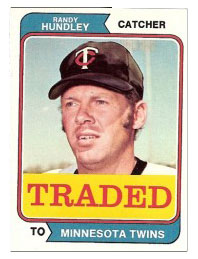
By the way, if you haven't noticed, my images have been getting worse lately (my computer died and took my scanner with it). That's why today's post features a nice scan of Randy Hundley from Blake Meyer's TwinsCards.com , and that great 'Card That Never Was' of Satchel Paige is from Dan Austin's Virtual Card Collection, which can be found here.


More Set Countdown Coming Soon After Christmas

September 01, 2015

The $10,000 Question

Here's what I've been thinking about these last few weeks...

A reader sent me an e-mail last week looking for advice. He wanted to spend about $10,000 but only purchase four or five cards. Here were the other parameters: At least one of them should be a T206, all should be from earlier than 1970, and all should have solid PSA grades. Which should he buy? I told him he couldn't go wrong with popular hobby stalwarts like Clemente, Koufax, Aaron, and Rose. As for the tobacco card, I have no experience buying or selling T206's, and couldn't give him a recommendation. But this got me thinking: What cards would I have chosen for myself? Buying cards as investments goes against my outlook and reasons for collecting, but it would be nice to have that kind of dough to play with. Which cards would you choose?...

...I've been searching for a new set to collect. I thought 2015 Allen & Ginter would be that set, but right now the price tag is steep. I might have to wait a year for things to settle. One set I've always enjoyed is the Archives line from 2001 and 2002. I had dipped into it as part of the mega master sets I've put together for 1976, 1978, 1986, 1987, and 1988 Topps, but never for its own sake as a set. A few weeks ago I purchased a group from 2001 series one and I'm digging it. This may be my new set. That said, there are a few players who seem to be missing, or maybe I've just overlooked them? Guys like <b>Jeff Burroughs, Dave Stewart, Charlie Hough</b>, and <b>Manny Trillo</b>. Burroughs was the 1974 AL MVP, Stewart won 20 games in four straight seasons, Hough was a knuckleball workhorse, and Trillo was one of the best second basemen of his generation. Additionally, all four had retired before 2001, and each had a rookie and last card issued by Topps. Granted, none was elected to the Hall of Fame, but neither was <b>Wilbur Wood, Jim Maloney, Johnny Antonelli</b>, or <b>Bucky Dent</b>, and all four of them are in Archives. Maybe I'll do some custom Archives...

...There are two questions I think about when I'm falling asleep: 1) If we projected today's salaries on players from the past, who would've been paid what? For example, someone like Bobby Shantz. Would he have been a max-contract guy? And 2), are there any players today who will make the Hall of Fame? Besides Alex Rodriguez's steroid-fueled sideshow, I can identify 10 players who are legitimate Hall of Famers: <b>Miguel Cabrera, Clayton Kershaw, Felix Hernandez, Ichiro, CC Sabathia, David Ortiz, Albert Pujols, Yadier Molina,</b> and <b>Mike Trout</b>. But which of these players will be remembered by Hall of Fame voters in 10 to 20 years when they're up for election?

You may scoff at the insinuation that an otherworldly talent like Albert Pujols would be forgotten in 10 years, but look at the example of <b>Duke Snider</b>. The Duke of Flatbush was elected in his 11th year on the Hall of Fame ballot, which means he had been retired for 17 years before election. Or how about someone like <b>Jim Bunning</b>? Over 200 wins, author of a perfect game (as well as another no-hitter), All-Star in each league. Seems like a shoo-in for the Hall. Instead he was on the ballot for 15 years, always a bridesmaid, never a bride. Twenty-five years after he retired he was elected by the Veterans Committee. A situation like that seems unthinkable today, but could it be possible for someone like Sabathia, or even <b>Roy Halladay</b>? It seems today that if a player's not elected on the first ballot, then they're not true Hall of Famers. I hope someone like <b>Graham Womack</b> will tackle this question...

...I feel like a dolt. A few weeks ago I purchased a large stack of exclusive Target Topps coupons on eBay for a couple bucks. Now my local Target has stopped carrying Topps products. Not sure what to do with these coupons...

February 15, 2012

The Multi-Tasking Shortstop


Alan Trammell, 1989 Fleer All Star Team

Hello, Alan Trammell, and congratulations on making the ’89FLEERALLSTARTEAM! I’m sure this has significantly lessened the blow of being omitted from ‘89’s AL All-Star team, which is like, whatever. Please enjoy this 3-karat cartoon gold-outlined medallion featuring your face. Wear it with pride wherever you go, except out in public.


Over the past eleven seasons, Detroit’s Alan Trammell has quietly emerged as one of the best all-around players in baseball.

Quietly emerging as something over an 11-year span seems like the most exciting thing I can possibly imagine. I hate when things emerge rapidly and loudly, like fireworks and Dwight Gooden.

Many teams are satisfied with shortstops who simply provide good defense.


Scout
: Ronald, hear me out. Got a guy down in Tucson. Shortstop. Great defense. Also, raking it. Want me to put out some feelers?

G.M.: First of all, Dave, “put out some feelers?” Please don’t say that. You look like a guy who wants to put out feelers, you dirtbag. Secondly, you sure he's a shortstop? Shortstops can't hit.

Scout: Yes, I am quite certain of his whereabouts on the baseball field.

G.M.: Thirdly, no. I mean, we got what’s-his-face now playing great defense based on our rudimentary defensive statistics like “scrappiness.” Guy’s scrappiness ratio thingee is off the charts.

Scout: Okay, yeah, but Ronald—what I’m trying to say is that this guy plays great defense and hits really well. I’m not sure how scrappy he is, but he hit five run home runs yesterday.

G.M.
: That is the opposite of scrappy. Listen, Dave—it’s the 80s. The game is changing. Gone are the days of 4-foot tall Italian immigrants playing shortstop and batting eighth and hitting like .213. Nowadays it’s all about 5-foot-11, third-generation Italians playing shortstop and hitting like .247 and maybe hitting a home run every now and then. We have that. If it ain’t broken …

Scout: We were 71-91 last year. How is that not broken?

G.M.: Sorry, satisfied. Why don’t you go talk to another team. What about the Bears?

Scout: That’s a football team.

G.M.: Tigers?

The Tigers are fortunate.

Scout: The Tigers already have Trammell.

G.M.: Oh yeah. They’re pretty fortunate.

Scout: How do you compromise being satisfied with not having a thing while simultaneously acknowledging another team’s good fortune at having that same thing?

G.M.: Tie caught in pencil sharpener …

What say you, Wikipedia?

Trammell and Whitaker also made a cameo appearance on the television show Magnum, P.I. starring Tom Selleck during the 1983 season.

They sure did.

Wait a minute! There’s no seats between first and third …

How does a private investigator say something like that out loud? I'm beginning to think Magnum P.I. and Alan Trammell weren't even real.

June 01, 2011

Mattingly Month ... Go

When I began doing the “classic card” write-ups for my blog many years ago, I, quite obviously, was using “classic” in the sarcastic sense. The point was to highlight the silliness and oftentimes bizarre nature of the cards that occupied shoeboxes as opposed to binders, and featured the more obscure players of the 80s and early 90s. This, for what it's worth, has been revealed as my life’s calling.

The reason I own of all these crappy cards is because once upon a time, like many still valiantly do, I took my baseball card-collecting very, very seriously, and the acquisition of these cards was a mere byproduct of my search for greater ones, of which I valued with my heart and soul. I remember in those dark, mysterious hours when I would imagine worst-case scenarios, the loss of my card-collection was prominently involved. Our house is on fire? Grab my cards! Who cares about my sister?! She has legs!

My quest, however, was not to have the best, most diverse, or even most expensive collection. No. My quest was only: Don Mattingly cards.

I differ from exactly no Yankee fan of my generation in my undying love for Mattingly, which continues unabashedly to this day, although with a sprinkle of realism and perspective that was absent from my youth. My favorite player from my favorite team, who encompassed every quality we value as baseball fans and as young men, I couldn’t have been prouder or more certain that Don Mattingly was the best player in the game.

Thusly, I wanted all of his baseball cards. Mostly I wanted the obscure ones—’88 Topps All-Star? Bit#%, please; I have 39 of those—which I often found at card shows. I remember my dad’s friend warning me in those years not to put all of my eggs in one basket, as if Mattingly wasn’t so obviously on an uninterrupted collision course with G.O.A.T. status. My friends, as friends do, were happy to take advantage of my soft spot for Donnie Baseball during trades. None of this bothered me because, remember—my quest was only Don Mattingly cards. Diversifying my portfolio was of no concern, and cost, relatively speaking for a boy who made $7-10 per lawn, was not an issue, and so what if Mattingly, through some unforeseen accident or ailment that had nothing to do with his work ethic or God-given talent, did not achieve a Ruthian level of greatness. My love was unconditional, and all of this was irrelevant.

With that in mind, may I proudly introduce you to the first installment of “Mattingly Month”—my humble quest to present to you several pieces of my priceless collection. Now, with regards to my penchant for a light-hearted and faux-cynical take on baseball cards and the players featured on them, I must tread carefully here, lest I offend my greatest baseball hero, who totally, I firmly believe, reads this blog.

I start at the most logical place: our nation’s most popular chocolate-production company.


Don Mattingly, 1988 Nestle Foods Corporation

The “we cannot show the actual team logo due to copyright standards” will never, ever, ever fail to amuse the heck out of me. (It’s especially awesome during commercials.) I mean, really? Nestle and Major League Baseball can’t sit down at a table and iron something out that doesn’t witness Don Mattingly playing for “the blue team?” It says right there he plays for the Yankees. Everybody knows he plays for the Yankees. You wouldn’t be printing this card if he didn’t achieve some level of notoriety with some organization—why are you pretending that organization doesn’t exist? THE YANKEES ARE NOT GENERIC AND YOU MADE MATTINGLY LOOK LIKE A FREAKIN’ UMPIRE!!! I am not upset, really. Deep breath … I am fine.

Also, look at how handsome he is! He is so handsome.


Regarded by many as the finest player in the game,

“Many” implies that several people do not acknowledge this indisputable fact. Who are these people? I would like to speak with them. Do they work at Nestle? Figures. Why don’t you stick to knowing about chocolate, you worthless sons of bit—I’m good, I’m cool.

Don continues annually to add to laurels


I remember when I was a kid, and I would watch Mattingly do something great, seemingly daily, and I would think to myself, “There goes Don, adding to his laurels again. How many laurels does he have now? A million?” In actuality, he had infinite laurels. “Infinite Laurels,” by the way, will be the name of my Don Mattingly-themed alternative rock band that I will be starting soon. The drummer from Band of Horses is in, as are like, eight dudes from Arcade Fire. I only need a lead singer who looks exactly like Don Mattingly and who is the greatest singer ever. Know him? Are him? Call me.

that will put him on a Cooperstown pedestal.

As improbable as it seems that the Nestle Chocolate-Production Company was inaccurate in forecasting future greatness for a baseball player, it is unlikely that Mattingly will gain entrance into the Hall of Fame. As much of a Mattingly fan as I am—and I am the greatest one, I humbly submit—I am first and foremost a rational baseball fan, and I don’t believe that Mattingly, unfortunately, achieved the longevity, by the Hall’s subjective and ever-changing standards, needed to get on that pedestal (I thought it was a bust?).

That said, I take great comfort in that Mattingly’s stretch of 1984-through-1987, considering his era and the very poor Yankee teams for which he played and the fact that he remained an excellent defensive first baseman, can, I believe, stand up with the best four-year stretch of any offensive player ever. And, if we judge him by fame—that elusive of criteria for which the hall in question is defined—his status as the hero of virtually every modern-day major leaguer can attest that he had it in laurels.

Don Mattingly transcends the Hall of Fame. The Hall of Fame should want inclusion into Don Mattingly. Not into his butt—DON’T MAKE A JOKE!—I mean theoretically or something.

Until next week …

March 24, 2006

The Perfect Pack Transforms Itself into More of a Legend and Less of a Myth

Gather ’round, for I have seen it. Sometime in the fall of 1988, in Bannockburn, Illinois, a pack left the Donruss packaging plant in a box that was destined not to see the light of day for almost twenty years. And while thousands of children and teens and some older guys (longing to relive the joy of finding a Lowell Palmer card in their pack of 1970 Topps when they were a kid) soldiered forward opening pack after pack of the worthless and generally disappointing fare from Donruss that year, receiving nothing for their devotion except fifteen Mike Bieleckis and enough Candy Maldonados to seriously consider opening a savings account and not buying any more cards, this pack—the closest I’ve come to a Perfect Pack—sat harmlessly in a warehouse or perhaps the basement of Mr. Mint’s lesser-known adversary Mr. Excellent (and I really wish there had been a Mr. Excellent; I would’ve paid to get a Polaroid of him and me at a card show autographed in sharpie).

I really didn’t think I’d get this good a pack. Hell, even the puzzle piece is worthwhile (though not the whites of Spahn’s eyes, which I think is the piece de resistance of this puzzle). Now I’ll shut up about how great The Pack is and tell you (lovingly) about each card.

6 Pack Analysis: 1989 Donruss
Pack 5


Bryan Harvey There was a time when Bryan Harvey was the shit. I think that time lasted roughly 25 minutes. No really, there was a time when being a rookie and getting nearly 20 saves in a season was, if not outright sensational, then at least front-page news (even if the front page was the only page, the newspaper was a crudely mimeographed sheet you printed in your basement, and the name of the paper was The Official Bryan Harvey Fan Club Newsletter).
Jeff Russell While Bryan Harvey was a big deal for a little while, Jeff Russell was a big deal for a longer while. He was a great closer, no doubt about it. Also, if you pictured him without facial hair, he looked a lot like Howie Mandel (and, as a sidebar digression, why hasn’t NBC had Mandel blow up a rubber glove with his nose yet on Deal or No Deal? I’m serious. It would make the show about twenty thousand times more enjoyable). But really, the big news here is the photo. Minus a little fat around the cheeks and swap out the Rangers jersey for a white unitard and you’ve got Freddie Mercury. I can even picture Jeff Russell pitching this way, gesticulating wildly after each pitch, strutting around the mound after striking out a batter, and pointing to Brian May at first, (who the Rangers would get in a three-way trade in 1988 that would send Pete O’Brien to the Pirates and a young John Smiley and a curly black wig to England to join Queen half-way through recording a farewell album).
Ryne Sandberg What can you say about him that hasn’t already been said: he was the 2B of the Eighties, and another ‘loser’ the Phillies got rid of in favor of the future Hall of Famer Ivan DeJesus. Man, who was running the Phils in the Eighties, anyway? Presumably it was someone who knew nothing about baseball. Or it could just as easily have been the work of a fictional character, like Mayor McCheese. Yes, that’s who I’m going to refer to whenever I talk about a bonehead move by the Philadelphia front office.
Barry Lyons Okay, now if this was truly a Perfect Pack, Barry Lyons would be Roberto Alomar or even Sandy Alomar, Jr. But, instead, it’s Barry Lyons: Mets back-up catcher extraordinaire.
Mike Moore What makes a baseball player successful in the eyes of those who follow the game? Is it consistent greatness or do you just need to have a flash-in-the-pan brilliance about you that convinces others to see something that may or may not really be there? Take Mike Moore for example. The guy had one good year, where he won 17 games. Every other year (up until this card was printed) he was a lousy pitcher on a perennially lousy second-division team. So why do I think of him as a good player? Is it because I think he looks like a Punch and Judy puppet? Or is it the Chris Bosio Theory, that he’s considered a success but wasn’t ever really one? I’m full of questions today.
Mike Flanagan By this time Flanagan wasn’t very good. But that’s all right. He had already proved he would always be viewed as a successful major league pitcher. A definite plus to an already halfway-decent pack.
Steve Lombardozzi His inclusion doesn’t hurt the overall rating of the pack because of his name (and because he was a World Series hero, but mostly because of his name). I understand how shallow that sounds, but it isn’t every day that you get a card of Lombardozzi. Especially growing up in Massachusetts, where the Boston Globe sportswriters like to beat it over your head when a player makes the majors who happens to be from a town in the state. Lombardozzi’s from Malden, and if you’ve never been to Malden then you haven’t lived. Actually, the last part of that’s not really true.
Carlton Fisk Diamond King Yes, I actually got a Diamond King. Remember the year that Donruss pulled them from the regular set and made them a special insert? Jeez, they were hard enough to get, let alone as an insert…Gotta love the DK of Fisk. I think he may be one of the only players to be a DK in more than one year while he was on the same team. Nolan Ryan was a King in 1982 with the Astros, then King of Kings in 1990 when he was on the Rangers. And I think Tony Gwynn was a King twice with the Padres.
Fred McGriff He was, inexplicably, one of my favorite players. I think it originally had to do with the fact that he was one of the most underrated players of his generation, he usually got the accolades but never the national press that followed others, and he played in relative obscurity for most of his career (except for the parts with the Braves). Because of all these things, he was always included in the great subsets and insert sets that took over in the mid to late 1990s, and his cards were always cheap. He may be the first Hall of Famer with a rookie card valued at less than $8.
Kirby Puckett I think I may have started to cry when I found out he died. When I was a kid I thought he probably wore eye black all the time (even when he wasn’t playing baseball), because it made him look tougher. Really, everyone should wear eye black all the time, because, hell, it does make you look tougher.
Ozzie Guillen It’s amazing, but at one time in the late Eighties, there were at least four Ozzies playing in the major leagues: Ozzie Smith, Ozzie Guillen, Ozzie Virgil and Ozzie Canseco. That is incredible. I don’t think there’s anyone with that name playing today.
Wally Joyner Did you know that Wally Joyner has acted in not one but two Mormon-themed movies? It’s true. In fact, his role in the first film was a recurring role in the second one. What did he play, you ask? Wally was an angel. I know, I know, those kooky Mormons. Next thing you know they’ll have Shawn Bradley play a talking tree (like that creepy tree from the old Fun Fruits commercials, only really pale and 7’6” tall).
Ray Hayward I can’t tell you who this guy is or what he accomplished on the field, but I can tell you that he was traded from the Cubs with another nobody for a nobody apparently worth two nobodies. And all of it happened on St. Patrick’s Day, 1988, a day when many nobodies got drunk for no other reason than they were alive and they liked to drink. At least Ray Hayward had a reason to get wasted.
Rick Sutcliffe I like Rick Sutcliffe. Did you know that the Cubs gave up Joe Carter and Mel Hall for him and Ron Hassey? It’s like they were convinced that Sutcliffe had a couple more seasons in him and Hassey had another perfect game in that gigantic brain of his. Of course, they were right on both accounts, though Hassey’s second perfect game would come when he was with the Expos.
Kevin McReynolds Oh my God, I got Kevin McReynolds. I think his cards completed the holy triptych of Over-Hyped Met Rookies (Gregg Jeffries and Kevin Elster were the other two), though, now that I think about it, wasn’t he an Over-Hyped Padre Rookie? Along with the worthless-upon-impact #1 Draft Pick card of Shawn Abner from the 1985 set. Either way, I got excited when I got a card of him and I don’t think he was really that good to begin with. Isn’t it funny how card value and actual, statistical performance never seem to quite match?

Overall Analysis

It’s not every day that you get two bona fide superstars, a Diamond King worth something in a trade, your favorite player, four good to very good pitchers, and Wally Joyner and Ozzie Guillen all in the same pack. The success rate here is a mighty 73% (11 good to great cards out of a possible 15), so I’m not so far off-base to call this a Perfect Pack. In fact, it’s a very apt title. What would have made this an Über Pack would be the inclusion of at least one Red Sox player, preferably Ellis Burks. If I didn’t already know that Mayor McCheese was running the show down in Philly, I would’ve sworn he was behind the scenes in Boston when the Sox inexplicably dumped Burks to make room for the immortal Bob Zupcic (sidebar note: you know how Baseball Reference lists ten players the player in question is most like? Well, #9 on Zupcic’s list is the great Olympian Jim Thorpe (who was generally a horrible baseball player)).

Fight! Fight! Fight!

After watching the ’Stros roundly beat the tar out of the Cubs that afternoon, Hal Lanier and Jose Cruz decide to celebrate down under Michigan Avenue at the Billy Goat Tavern. Little did they suspect to find Carlton Fisk and Robin Ventura parked at the bar, well into their fifth round, after mistakenly dressing up in their early Twentieth century unis on the wrong day for the White Sox Old Timers Game. Lanier and Cruz take stools towards the end of the counter, but when Fisk notices Lanier across the crowded room, he lumbers over to him and after slinging an arm over Lanier’s and Cruz’s shoulders, loudly calls him ‘Bob,’ and goes on to boom out a story about he and Dewey Evans got to meet him in the dressing room after a well-fought game against the Celtics in the old Boston Garden. When Lanier can finally get a word in, he tells Fisk he’s got the wrong man. Fisk, now belligerent, demands an autograph from Lanier. Lanier refuses. Fisk calls him a name. Cruz stands up. Ventura rouses himself and jumps to back up Fisk. Fisk quickly strips to the waist and, raising his fists, calls Lanier out. Out of nowhere a ring is drawn on the floor in chalk. What follows is tag-team, stripped-to-the-waist, bare-knuckle fisticuffs, 1890s-style.

So who wins? Will Hal Lanier have to sign a basketball for Carlton Fisk? Will Jose Cruz get to try out those roundhouse leg sweeps he’s been practicing out in his garage late at night? Does Robin Ventura even know where he is?

You tell me.

May 27, 2006

Best Set Countdown: #10 – 1980 Topps

Well, as the guy with the guitar that was kind of off-key on the platform of the downtown F said slightly incoherently last Thursday while I was waiting for the uptown train back to Queens, ‘We’re knock knock knockin’ on Heaven’s door…’ Only in our case, you should probably replace ‘Heaven’s door’ with ‘The Top 10 Sets of the 1980s’.

Yes, to quote every single high school valedictorian speech and yearbook table of contents (and Bill Walton on more than one occasion), what a long, strange trip it’s been. I naively thought I’d be able to get through this list in about a week. But then I realized how deeply I cared for each and every set, and how important they figured into my formative years.

I promised myself I wouldn’t cry, so I’ll quit this premature eulogizing with another Walton quote: ‘This is just whore-able.’ Wait, that wasn’t the one I was thinking of… here it is: ‘Throw it down, big man. Throw it down!’

Consider it throwed-down.


10. 1980 Topps
When, in the course of baseball card set ranking related events, a person comes upon the 1980 Topps set, what does that person think? Does this set resonate or does the person even care? I, for one, never realized how much I cared until I spent a little quality time with it and now I realize that this set is one of the most underrated of the decade. It lacks the splash of later-decade Topps sets as it has very few subsets, the All-Star denotation is on regular cards and rookies (for the most part) are not announced. But it makes up for this lack of pageantry with a strong checklist, including the desirable 2nd year Ozzie Smith and third years of Molitor, Trammell and Murray, plus great cards of hobby powerhouses Nolan Ryan, George Brett, Yount, Winfield and a cache of others like Reggie Jackson, Pete Rose and Bench, Fisk and Yaz. And how could we forget: this set features the rookie of, according to Bill James, the fourth greatest left fielder to ever live, Mr. Rickey ‘Refers to Himself as Rickey’ Henderson.
But most importantly, this was Topps’ last year as the only major issue. 1980 was the last year of Topps’ 18-year run as a baseball card monopoly (beginning with Fleer’s 1963 issue and not counting SSPC’s attempts in 1975 and 1976). This is important in myriad ways. First, it was the last year that there was (obviously) only one set put out, so there is only one Nolan Ryan card that year, and only one version of the Henderson rookie. It was the last year before Topps began issuing yearly traded sets, so if there were going to be big rookies or guys on new teams, the company had to try extra hard in not screwing it up.

I think that these last two points are huge. I started collecting right in the thick of things: there were already three card companies going strong, an upstart was encroaching on valuable space (Sportflics) and it would be less than three years before there would be 5 major players vying for my baseball card dollar. If I pined for a Bo Jackson card, I was pining for as many as six Bo Jackson cards, all of them with a legitimate claim to being his rookie. But with Rickey, there was only one set, so there’s only one rookie. And for there to be only one rookie of Rickey Henderson seems fitting, as he broke every mold the game had to offer. (And by the way, when Rickey finally gives up the ghost and officially retires from showing up newbies at Spring Training, he should call up former SuperSonic Michael Cage and they should join the WWE circuit as the tag team Steal Cage, and the WWE scriptwriters could pit them against other tag teams and then at Wrestlemania Cage could turn on Rickey and Rickey would enlist Dave Henderson (who would be a plant in the audience, much like Hasselhoff was at the American Idol finale) and Hendu would come in the ring and rip off his tear-away warm up pants to reveal yellow and green wrestling tights and stomper boots, and thus Steal Cage would be dead and the Flying Hendersons born. I don’t know what would happen to Michael Cage…maybe he could get Old Man Larry Nance off the couch to tag team as Achilles Knees…You know, you could put together a formidable pro-wrestling circuit made up entirely of former legitimate sports figures. Tree Rollins and Jon Koncak would be Ebony & Ivory, Dan Majerle and Darryl Dawkins would be ‘Thunder Brothers’ and Kurt Rambis could wrestle on his own as Oculoptopussy, cause Rambis wore glasses and because I personally hate the Lakers. In fact, I might pay around $10 to watch a battle royale featuring Hot Plate Williams, The Refrigerator Perry, Stanley Roberts, Don Baylor, Gabe Kapler, the Phillie Phanatic, Kevin Duckworth, Leon Lett and Rickey Henderson. I would bet Rickey would win that one, even if he was scripted to lose. He’s just that good.)

Aside from the star quality and strong checklist, this set has a kick-ass design. You know, it’s funny that it’s so strong because really Topps was just riffing on itself: it took the bland, forgettable 1974 design (the one with the squarish pennants) and made it more dynamic, tilting the pennants 30 degrees, ballooning the picture (one of the largest photo spaces of any set from the 1980s, possibly the largest) and adding a facsimile signature. This last design element is really an added bonus because you got to see who had mastered the art of penmanship and who could barely scratch out an ‘X’ (my personal favorite is Willie Aikens). Topps did this on the fronts of a handful of sets before 1980: 1952, 1954, 1955, 1959, 1967, 1971, 1975 and 1977, and only once after 1980 (1982). They also had it on the back of cards in 1953 and 1974. It was a fun design element that added a personal touch to the cards, blurring the line between player and collector, like the player had held his card only moments before you got it in your pack. The fact that Topps didn’t use this feature on any design after 1982 (I can only think of the silver and gold signature cards in Upper Deck’s Collector’s Choice series and one or two of Leaf’s Studio sets in the mid-1990s that did) leads me to believe that autographed baseball cards sets are so ludicrously popular today because my generation didn’t know cards could feature facsimile autographs. Can you imagine a clunker like 1990 Topps with facsimile autographs? I would argue they’d be more desirable than the quick-fix mudroom insulation they’ve become.

While I’ve been doing this countdown, I’ve tried to elevate certain ‘iconic’ cards, ones that I think could do a fair job representing an entire set. Some have been obvious, like the Canseco Rated Rookie from the 1986 Donruss set, others not so much, like Dewey Evans’ 1981 Topps card. For 1980 Topps, you could make a pretty persuasive argument that the iconic representative should be the Rickey rookie—it is, after all, the most desirable and valuable card in the set. But for now, while I don’t necessarily disagree with the Rickey argument, I’m going to put forth Biff Pocoroba as the iconic card of this set. Here’s why. Have you ever gone through your cards looking for a weird photo or a weird name or a player that’s especially hairy or ugly? Of course you have (maybe it was the reason you started collecting in the first place, to feel better about yourself). Usually any given set will be split 50/50 between weird and normal players, but if you take a look at the Atlanta Braves team, it’s like there was something in the water down there. Pull out their cards the next time you’re going through your box of 1980 Topps and you’ll see what I mean—it’s like a lineup for a less-intimidating version of The Dirty Dozen. No wonder they finished in the basement (even though Phil Niekro won 21 games, he lost 20. Now that’s some Hall of Fame pitching!).

1980 Topps is underrated. There’s no doubt about it. And, in fact, I would argue that every set in the 1976 to 1980 corridor deserves more love, attention and support. Today a typical player who probably won’t accomplish very much in his career will have upwards of 15 to 20 rookie cards, each valued at some ridiculous and unwarranted price. But guys like Ozzie Smith, Dennis Eckersley, Rickey Henderson—certifiable Hall of Famers who changed the game itself—only have one rookie each, and they’re not worth as much as their accomplishments should demand.

March 18, 2006

Think You’re Special?

When I would choose to collect a new set, a deciding factor to go for it would be whether or not the set featured special cards. Topps pioneered the special card, starting with the O’Brien Brothers card in the 1954 set and the Mantle/Berra card that closed the 1957 set. The special became a staple in the Sixties, didn’t really hang around in the Seventies and then was brought back into the fold by Fleer in the Eighties. And for the most part, a special featured all-star caliber players. I can’t put into words the momentary excitement and longer-lasting disappointment of finding a special card in your pack and have it feature Howard goddamn Johnson.

Topps always made the special card relevant and topical. For the most part they featured at least one player anyone cared about, (and when Upper Deck came around in the Nineties they realized this and kept the tradition alive), but for a while there in the Eighties and early Nineties, it seemed like the hapless Fleer photographer went to a bunch of games and got random players to stand next to each other, then went back to his station wagon in the parking lot and wrote a couple sentences of how the two players might connect. Juan Samuel and Tim Raines? How about Doubles and Triples? It almost sounds like they’re on one of the teams in the Laff-a-Lympics. How about Dave Winfield and Kent Hrbek? They look like they’ve never met, but presumably Mr. Veteran and Mr. Rookie are best buds and only rivals in the press. Here’s how one of their conversations might have gone:

Hrbek: I enjoy hunting and fishing in the off-season.
Winfield: I once killed a bird on the field then crouched over its carcass and ate it raw.
Hrbek: Okay. I was actually going to ask you about playing in San Diego but now I don’t know if I want to.
Winfield: I liked the sea birds there ’cause it’s warmer. The meat isn’t as tough.
Hrbek: Uh-huh.
Winfield: I used to keep a hutch in my backyard and sometimes if the moon was full I’d go out there and just sit.
Hrbek: Oh yeah? You know, I’m pretty good at mimicking birdcalls.
Winfield: And then I’d bite the head off one of them if it made eyes at me. I can see pretty well in the dark, so it’d really have no chance of flying away and make me think it wasn’t them. But one got away once…
Hrbek (throwing his voice to make it sound like Twins Manager Billy Gardner): Hey Rook! Get in the cage!...Well, nice talking to you. See ya around.
Winfield (staring into space): I tracked it down, though. I killed it on the field and then crouched over its carcass and ate it raw.

And how about Robin Yount and Buddy Bell? First of all, implying that Bell is worthy of taking part in a Superstar Special (or really anyone on the 1982-3 Texas Rangers with the exception of Ferguson Jenkins) is an exaggeration, but it does allow us to see what Ric Flair looked like as a younger man. Are you kidding? The two must be brothers, if not the same person. Have you ever seen them in the same room together? And if you have, what kind of function were you at?

Donruss tried to get in on the action with one or two special cards per set, but never really knew how to finesse it. Take this card of Vince Coleman and Wille McGee from the 1986 set. No, Vince is not a ventriloquist’s dummy sitting on McGee’s lap, though it does seem that way. Donruss gets points for the topic and the players chosen, but just as promptly loses those same points for having one of their crack high school graphic designers make Coleman look tiny in comparison to the gargantuan McGee. Seriously, they’re on the same team; just make them stand next to each other. You could probably even convince them to hug or high-five and smile winningly at the camera, like an Olson Twins poster. It was probably for the best that Donruss didn’t waste their time with the special card (they had the incomparable Diamond King, after all); Fleer did make some beauties.

I remember buying the Gooden/Clemens card at a show. I think I paid a dollar for it, but it was totally worth it. I think that if I saw this at a show (if I went to shows today) I’d probably still pay a dollar for it, that’s just how awesome this card is. Think about it: two great pitchers at the top of their game, meeting in the World Series, from one of the best sets of the decade on one of the most desirable cards from the set. You’re goddamned right I’m gonna pay a dollar for that. One of the best cards ever (even if I don’t really care about either player, nor would I give either a dollar if I saw them on the street…unless I had a camera with a timer and we could recreate the photo on the card. Then I might consider giving Dwight Gooden a dollar, though the most I’d give Clemens is maybe twenty-five cents, and then only if he needed a quarter and I had one and he had two dimes and a nickel…but not if he only had nickels. I really don’t like getting so many nickels). And how cool is the Al Oliver/Tim Raines double special card from the 1984 set? Wicked cool. Look at their expressions: Raines wants to hurt someone; Oliver is just happy to have all his limbs intact and still be playing.

The last great Fleer superstar special is from the god-forsaken 1991 set (the one that made you barf when you opened the first pack of the year, and even though you tried to convince yourself that it was going to be okay and you kept buying packs, it wasn’t going to be okay. It was never going to be okay). ‘Second Generation Stars’ Ken Griffey, Jr., and Barry Bonds. What a card, and you know, it’s not very valuable (but only because Fleer sent a PO to the printer with a few extra zeroes in the quantity ordered). They both look normal in the picture, just like regular guys. If you took their picture together now, Griffey would look the same, maybe a little heavier with added weight from age and Bonds would look like he ate a still-inflated moonwalk.

In various ways in the early Nineties, Upper Deck tried to capture the same magic that Topps and Fleer were able to showcase. Some weren’t that great in the first couple of years, though by 1993 they hit a goldmine (if you ask me). With the Teammates subset, each team got a special card, and while some teams had questionable entries (who would you flank the immortal Brett with from the Kansas City Royals? Wally ‘The Mormon Ferris Bueller’ Joyner? Or maybe Gregg ‘Mickey Dolenz’ Jeffries? You tell me, because I’ve run out of ideas), most were good and a few were even fantastic. The Cleveland Indians card was fantastic, with Belle, Sandy Alomar, Jr., Thome, Baerga and Kenny Lofton. When this set came out, I thought four out of those five guys were going to the Hall of Fame. Okay, that’s a stretch, but Belle and Lofton for sure. The Yankees card and the Reds card were funny, if only because Roberto Kelly was on both of them. Gotta question the integrity of Kelly, don’t you? Or at least figure out who at Upper Deck was totally in love with him.

Fight! Fight! Fight!

Who would you pick in a fight?


Scenario:

Otis Nixon is waiting in line at a Luby’s Cafeteria, and all of a sudden Hall of Famer Robin Roberts cuts in front of him. Nixon’s pissed. I’m not sure if I’d provoke Robin Roberts if I were you, Otis. He may have cut in front of you, but you’re going to get your clock cleaned if you mess with him in his quest for the last piece of blueberry pie. Roberts goes for the piece of pie, Nixon bum-rushes him (still got speed, baby!), flips Roberts’ tray, Roberts reaches into his sock for his shiv and we got ourselves a fight!

Who’s going to win?

You tell me.