Let's say that you were assigned the job of putting together a baseball card time capsule, to be opened way in the future, presumably a time when it's normal for baseball cards to talk (not just
Topps' Talkin' Baseball, which I'm still looking for, by the way). If you were to put together a list of those cards that are most essential to the hobby, that best represent achievements in the baseball card (after WWII), which cards would you choose?
I've put together a list (it's relatively short) of 59 non-rookie cards (from 1948 to 1989), 97 rookies (1948 to present), and 24 sets (1948 to 1989). I've asked Chris Harris of
Stale Gum to provide a list from 1990 to the present. Here's what we came up with (in no particular order):
The Essentials (Post War)Rookies1. 1969 Topps Reggie Jackson (r)
2. 1960 Topps Carl Yastzremski (r)
3. 1978 Topps Eddie Murray (r)
4. 1980 Topps Rickey Henderson (r)
5. 1982 Topps Cal Ripken (r)
6. 1979 Topps Ozzie Smith (r)
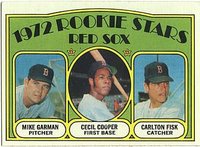
7. 1972 Topps Carlton Fisk/Cecil Cooper (r)
8. 1975 Topps Fred Lynn (r)
9. 1978 Topps Paul Molitor/Alan Trammell (r)
10. 1952 Topps Ed Mathews (r)
11. 1954 Topps Ernie Banks (r)
12. 1954 Topps Henry Aaron (r)
13. 1954 Topps Al Kaline (r)
14. 1955 Topps Sandy Koufax (r)
15. 1955 Topps Roberto Clemente (r)
16. 1984 Fleer Update Roger Clemens (r)
17. 1984 Fleer Update Kirby Puckett (r)
18. 1975 Topps George Brett (r)
19. 1968 Topps Nolan Ryan/Jerry Koosman (r)
20. 1968 Topps Johnny Bench (r)
21. 1967 Topps Tom Seaver (r)
22. 1965 Topps Steve Carlton (r)
23. 1963 Topps Pete Rose (r)
24. 1962 Topps Lou Brock (r)
25. 1960 Topps Willie McCovey (r)
26. 1957 Topps Frank Robinson (r)
27. 1957 Topps Brooks Robinson (r)
28. 1951 Bowman Mickey Mantle (r)
29. 1951 Bowman Willie Mays (r)
30. 1948 Bowman Stan Musial (r)
31. 1949 Bowman Satchel Paige (r)
32. 1989 Upper Deck Ken Griffey, Jr. (r)
33. 1967 Topps Rod Carew (r)
34. 1983 Topps Tony Gwynn (r)
35. 1983 Topps Wade Boggs (r)
36. 1983 Topps Ryne Sandberg (r)
37. 1984 Topps Traded Dwight Gooden (r)
38. 1984 Donruss Don Mattingly (r)
39. 1985 Topps Roger Clemens (r)
40. 1985 Topps Mark McGwire (r)
41. 1987 Fleer Will Clark (r)
42. 1987 Fleer Barry Bonds (r)
43. 1987 Topps Bo Jackson (r)
44. 1986 Donruss Jose Canseco (r)
45. 1985 Topps Kirby Puckett (r)
46. 1985 Topps Dwight Gooden (r)
47. 1989 Fleer Ken Griffey, Jr. (r)
48. 1989 Fleer Bill Ripken (r)
49. 1987 Donruss Greg Maddux (r)
50. 1966 Topps Jim Palmer (r)
51. 1963 Topps Willie Stargell (r)
52. 1970 Topps Thurman Munson (r)
53. 1959 Topps Bob Gibson (r)
54. 1972 Topps JR Richard (r)
55. 1991 Upper Deck Pedro Martinez (r)
56. 1994 SP Alex Rodriguez (r)
57. 1992 Bowman Mike Piazza (r)
58. 1975 Topps Robin Yount (r)
59. 1974 Topps Dave Winfield (r)
60. 1976 Topps Dennis Eckersley (r)
61. 1973 Topps Mike Schmidt (r)
62. 2001 Topps Ichiro (r)
63. 1990 Leaf Frank Thomas (r)
64. 1991 Stadium Club Jeff Bagwell (r)
65. 1992 Bowman Manny Ramirez (r)
66. 1993 SP Derek Jeter (r)
67. 1992 Topps Traded Nomar Garciaparra (r)
68. 1995 Bowman Vladimir Guerrero (r)
69. 1991 Bowman Chipper Jones (r)
70. 1965 Topps Jim Hunter (r)
71. 1965 Topps Joe Morgan (r)
72. 1970 Topps Vida Blue (r)
73. 1975 Topps Jim Rice (r)
74. 1975 Topps Gary Carter (r)
75. 1977 Topps Dale Murphy (r)
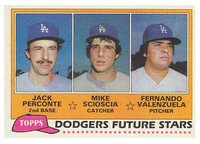
76. 1981 Topps Fernando Valenzuela (r)
77. 1992 Bowman Mariano Rivera (r)
78. 1990 Leaf Sammy Sosa (r)
79. 1965 Topps Tony Perez (r)
80. 1949 Leaf Jackie Robinson (r)
81. 1948 Bowman Yogi Berra (r)
82. 1948 Bowman Bob Feller (r)
83. 1948 Bowman Warren Spahn (r)
84. 1948 Bowman Phil Rizzuto (r)
85. 1951 Bowman Whitey Ford (r)
86. 1949 Bowman Roy Campanella (r)
87. 1955 Topps Harmon Killebrew (r)
88. 1961 Topps Juan Marichal (r)
89. 1955 Topps Harry Agganis (r)
90. 1962 Topps Gaylord Perry (r)
91. 1964 Topps Phil Niekro (r)
92. 1988 Fleer Tom Glavine (r)
93. 1988 Fleer Edgar Martinez (r)
94. 1988 Score Update Craig Biggio (r)
95. 1988 Score Update Roberto Alomar (r)
96. 2002 Bowman David Wright (r)
97. 2001 Bowman Albert Pujols (r)
Individual Cards (1948 – 1989)1. 1952 Topps Andy Pafko
2. 1954 Topps Ted Williams (#1)
3. 1954 Topps Ted Williams (#250)
4. 1959 Topps Symbol of Courage (Roy Campanella)
5. 1957 Topps Ted Williams
6. 1958 Topps Stan Musial All-Star
7. 1953 Topps Mickey Mantle
8. 1953 Topps Jackie Robinson
9. 1952 Topps Willie Mays
10. 1952 Topps Mickey Mantle
11. 1967 Topps Carl Yastzremski
12. 1975 Topps Joe Morgan
13. 1972 Topps Joe Morgan Traded
14. 1965 Topps Yogi Berra
15. 1951 Bowman Yogi Berra
16. 1951 Bowman Ted Williams
17. 1953 Topps Ed Mathews
18. 1988 Topps Wade Boggs
19. 1967 Topps Whitey Ford
20. 1954 Topps Warren Spahn
21. 1969 Topps Aurelio Rodriguez
22. 1971 Topps Thurman Munson
23. 1969 Topps Maury Wills
24. 1982 Topps Traded Ozzie Smith
25. 1981 Topps Traded Dave Winfield
26. 1984 Topps Traded Pete Rose
27. 1976 Topps Traded Oscar Gamble
28. 1976 Topps Bazooka Champion Kurt Bevacqua
29. 1977 Topps Big League Brothers (George & Ken Brett)
30. 1963 Topps Pride of the NL (Mays & Musial)
31. 1961 Topps Sandy Koufax
32. 1962 Topps Roger Maris
33. 1974 Topps Hank Aaron
34. 1970 Topps “Mets Whoop It Up”
35. 1972 Topps Roberto Clemente
36. 1973 Topps Roberto Clemente
37. 1978 Topps Jim Rice
38. 1985 Topps Pete Rose
39. 1987 Fleer “Dr. K Meets Super K” (Clemens & Gooden)
40. 1988 Topps “A’s Leaders” (Canseco & McGwire)
41. 1964 Topps NL Home Run Leaders (Aaron/Cepeda/Mays/McCovey)
42. 1963 Topps Brooks Robinson
43. 1963 Topps Casey Stengel
44. 1963 Topps NL Home Run Leaders (Aaron/Banks/Cepeda/Mays/F. Robinson)
45. 1962 Topps “Maris Blasts 61st”
46. 1962 Topps “The Switch Hitter Connects”
47. 1962 Topps Babe Ruth Story “Greatest Sports Hero”
48. 1962 Topps “Manager’s Dream” (Mantle & Mays)
49. 1954 Topps O’Brien Brothers
50. 1961 Topps “Brother Battery” (Larry & Norm Sherry)
51. 1961 Topps “Gehrig Benched After 2,130 Games”
52. 1958 Topps Don Mossi
53. 1957 Topps “Yankees Power Hitters” (Berra & Mantle)
54. 1955 Topps Dusty Rhodes
55. 1977 Topps Reggie Jackson
56. 1975 Topps Carlton Fisk
57. 1970 Topps Seattle Pilots Team
58. 1954 Bowman Ted Williams
59. 1964 Topps Ken Hubbs In Memoriam
Sets1. 1952 Topps
2. 1953 Topps
3. 1954 Topps
4. 1986 Topps Traded
5. 1959 Topps
6. 1965 Topps
7. 1963 Topps
8. 1972 Topps
9. 1975 Topps / Mini
10. 1984 Donruss
11. 1957 Topps
12. 1955 Topps
13. 1975 SSPC
14. 1986 Sportflics
15. 1949 Leaf
16. Complete run of Donruss Diamond Kings (1982 – 1989)
17. 1987 Topps
18. 1989 Upper Deck
19. 1978 Topps
20. 1971 Topps
21. 1951 Bowman
22. 1955 Bowman
23. 1963 Fleer
24. 1951 Topps Blue & Red
Chris Harris' List (1990 to present)1. 90 Upper Deck Reggie Jackson Baseball Heroes AU
2. 90 Score Bo Jackson "Black and White"
3. 90 Topps Frank Thomas NNOF
4. 91 Donruss Elite (set)
5. 91 Stadium Club (set)
6. 91 Upper Deck Michael Jordan
7. 92 Bowman (set)
8. 92 Fleer Rookie Sensations Frank Thomas
9. 92 Score The Franchise Mantle/Musial/Yastremzki AU
10. 92 Topps Gold Brien Taylor AU
11. 93 Finest Refractors (set)
12. 94 Leaf Limited Phenoms A-Rod
13. 94 Score Rookie/Traded Call-Up A-Rod
14. 94 SP Holoview FX (set)
15. 94 Upper Deck Michael Jordan
16. 94 Upper Deck Griffey/Mantle AU
17. 96 Leaf Signature (set)
18. 96 Select Certified Mirror Gold (set)
19. 96 SPx (set)
20. 97 Flair Showcase Legacy Masterpiece Ken Griffey, Jr.
21. 97 New Pinnacle Press Plates
22. 97 Upper Deck Game Jersey Ken Griffey, Jr. GU
23. 98 Upper Deck Retro Legedary Cuts Babe Ruth AU
24. 99 Upper Deck A Piece of Hostory Babe Ruth GU
25. 99 Upper Deck 10th Anniversary Buy-Back Ken Griffey, Jr. AU
26. 00 Fleer Tradition (set)
27. 00 Greats of the Game Autographs (set) AU
28. 00 Greats of the Game Yankee Clippings Mickey Mantle GU
29. 01 Donruss (set) -- If only for pure suckiness.
30. 01 SP Legendary Cuts (set) AU
31. 01 Sweet Spot Signatures Babe Ruth AU
32. 01 Topps Heritage (set)
33. 01 Ultimate Collection (set)
34. 02 Topps 206 Honus Wagner GU
35. 04 Diamond Kings (set)
36. 04 Donruss Fans of the Game James Gandolfini AU
37. 04 Leaf Certified Satchel Paige GU
38. 04 Topps American Treasures (set) AU
39. 06 Topps Allen & Ginter Danica Patrick AU
40. 07 Topps Derek Jeter
41. 07 Topps Allen & Ginter Ken Jennings
42. 07 Topps Allen & Ginter George Washington DNA
Please leave a comment on this post if you think we've left anything out.

 They just don't exist. You know, 1965 is probably my favorite design of the Topps 1960s, and yet for whatever the reason, it was the one year that didn't include combo cards. It also didn't include all-star cards, which made sense at the time, I guess.

 Over the past few days, I’ve been taking a nice break from baseball card writing. I took in a show at the Holy Cross [Abandoned Catholic] School on West 43rd Street yesterday, which was great. I stocked up on cheap star cards from 1977 – 1984, including a nice 1983 Fleer Sandberg rookie and that Aurelio Rodriguez from the 1969 set (you know, the one that’s really the bat boy). I also ordered some old packs from Burbank Sportscards, which arrived yesterday. But mostly I spent my time thinking about what the real difference is between the three update/rookie/traded sets from 1986.
 I would like to go on record and say that 1988 is one of the most underrated Topps sets of the 1980s, and you can base that decision on a great checklist, or those fantastic Team Leaders cards, or because it had one of the best All-Star card designs of the decade. Or you can base this decision purely on the photography. Crisp, dynamic; card after card featuring a great action shot or a clean headshot. Topps photography (hell, baseball card photography, regardless of manufacturer) sucked for many years, with maybe under 100 cards total that you could agree featured great photos (amassed from
 the random years along the timeline featuring good photography (that was straight-up photography, not colored over like in 1952, 53 or 55): 1954, 1957, 1960, 1961, 1965, 1968, 1971, 1972, 1974, 1985, 1986). But in the 1988 set there are literally hundreds of great photos. I can picture a few of them in my head without prompt: the iconic Mattingly (him looking skyward, following the arc of a sure hit (or at least a long fly)), the powerful Clemens at the end of a windup, Brett’s massive frame in smooth follow-through, the cocksure McGwire,
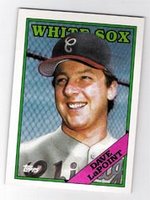
 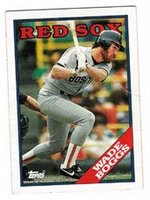 the pure hitting motion of Boggs, the hopeful Al Leiter (and pseudo-Leiter) in a shroud of deep blue dusk, the glory of Dave LaPoint, the King of the Airbrushed Card; even the chainlink fence behind him was airbrushed in (the background was probably originally the Oval Office, the photo taken on the day that outgoing President Reagan made it a priority to award Senior Superlatives and LaPoint somehow beat Meadowlark Lemon for Best Smile. And by the way, aren't the Globetrotters always turning up at the White House? It's odd, really...they should be made Ambassadors, and not just 'of the game', because that's lame, but real ambassadors to a country in Europe, like Belgium or somewhere). Anyway, the photography lends itself well to a lyrical wax.
  Okay, so photography aside you probably think this set is ranked way too high: you think it’s too bland a design (a mix of the 1967 team name dropped out over the background and the 1966 mini banner in a corner), that there are really no major rookies and practically no subsets. I would argue that, despite everything I’ve said in the past about the make-up of a strong set, 1988 Topps is the exception that proves the rule: it does have a weak rookie class. Tom Glavine, Ken Caminiti, Doug Jones—this is the definition of weak (did you notice that the third guy mentioned is Doug Jones? He of the Sam Elliott Cowboy Mustache?

 As to value, this set is worthless, and deservedly so. As stated before, there is no real rookie class to speak of and everybody knows that second-year cards do not hold a candle to rookies in terms of value. But all these things do not hinder the set’s worthiness as a fun, collectible set. 1981 nor 1984 have any real value. Hell, no Topps set after 1985 has enjoyed any real, lasting monetary value, but valueless cards do not a bad set make.


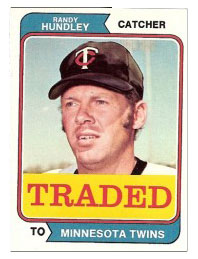 I'm not trying to say that this is the worst set--in the grand scheme of cards this set (series? subset of regular set? its own set?) is rather important. But 'grand scheme' symbolic strength and actual, measurable set strength are two very different things. This set is ugly. And ugliness matters. So does checklist strength. Despite a checklist of 40 cards (relatively big for a late-season subset), there are only seven big names: Marichal, Santo, Felipe Alou, Lou Piniella, Mike Marshall, Reggie Cleveland and Willie Davis. Then there's Nelson Briles, Tommie Agee, Steve Stone and Lindy McDaniel (of 'Lindy Shows Larry' fame). After that you're scraping the commons barrel (actually, you're scraping the commons barrel nowadays from Mike Marshall on, but for the sake of argument, let's forget that all but two or three of these cards can be had for less than a dime). Anyway, that line-up may have looked impressive as a launching checklist for Topps in 1974, but it translates to a success rate of just 28% for the set (success rate = # of good cards / total # of cards in set). Even when we factor in the coolness factor of getting a Traded card in your pack, well, it's still not that great. I can think of only one reason why Topps expanded the neat little Traded subset from 1972 into its own series: to sell more cards at the end of the summer, a time when kids have moved on to football cards, hockey cards, sniffing glue or whatever it is little kids do at the end of summers.
  How many more years can Topps do the Heritage line? You have to think they’ll do it as long as it makes them money, right? Or is it more of a question of design? I’d like to think it’s the latter, that at a certain point they’d stop (after the well of classic design runs dry). So how many more years? Well, they’re set for now, because this set is almost flawless, a huge improvement from last year’s Heritage ’57 (and I’ve always been a much bigger fan of the 1957 design than 1958). Topps had stellar design years in 1959, 1960 (to a certain degree), 1963, 1965, 1967, 1968, 1971, 1972, 1977, 1978…but Upper Deck compromised more than a few of those years with their own rip-off Vintage line, and do we really need or want Heritage ’78?
  This set—one of the strongest Heritage sets in years—represents Topps at the top of their design arc of the 1950s-1960s. Gone are the unneeded (and historically inaccurate) action poses. Instead: lots of close-ups and medium close-ups. Now I know beyond a doubt that not only does Jeff Weaver look exactly like Zach from Gilmore Girls, but he will probably fight you if you tell him. Gone is the washed-out photography that seriously marred last year’s Heritage ’57 set. Taking their places are strong colors: from the better-quality photography to the iconic solid color background; even the backs feel stronger than last year’s. The deep red may be a little hard to read in low light, but for some reason when I read them I get the strongest urge to learn how to chew tobacco. This is also odd, because I’ve always considered 1958’s design to be the most elemental Topps ever produced, almost to the flash-card degree. Like all great art, it’s all things to all people: elegant, abstract, simple, international, clean, crisp, modern, and yet I find it very pre-school (I think it would be fascinating to track down some of the old Topps designers and have them explain how they went from the almost no-design design of 1958 to the ultra modern, beatnik, jazz-record-and-advertising design of 1959. The two years couldn’t be more different. I almost expect the explanation to be that there was a change in art department leadership). Because today’s Topps designers didn’t muck around with the base card design (or any aspect thereof), it works.


 They should really do a design overhaul on this one, and while they’re at it, they should re-evaluate where they’re getting their images. This one of Kaline is obviously taken off his 1967 card. Not even the right decade! How dumb do they think we are?
  At least in the Mantle set’s defense, it commemorates his 1958 home run title and it’s printed on the same stock as the set, so it sort of fits. But the Rodriguez cards have nothing to do with anything, plus they are printed on thin glossy stock. They feel out of place in Heritage packs, like Topps got the target audience wrong. They’re as bad and feel as worthless as the Hobby Masters from last year’s Series 2 hobby packs.
  one thing holding me back from going for the master set (I’m 11 cards shy of the master Heritage ’54 set), and it’s this: in 1958, card #273 featured Hal Smith of the Cardinals. Smith, possibly to stem the tide of questions about who was who between the two Hal Smith’s, possibly because he was just having fun or was out of his mind, had his photo taken with his mask on. It’s one of the greatest cards ever. He’s even giving a sign, which to a little boy might look like he’s gesturing inappropriately. I don’t know, but I’m pretty sure he’s smiling, and it sure as hell is creepy. That’s why I’m crossing my fingers that there’s a card of Joe Mauer or Jason Varitek with their mask and pads on, hopefully giving an equally inappropriate-looking sign. Then I’ll know it’s okay to dive in head-first.
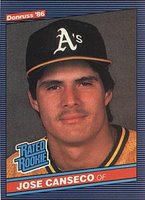 Jose Canseco’s 1986 Donruss Rated Rookie One of our readers has dubbed this ‘The Mona Lisa of 1980s Baseball Cards’ and they couldn’t be more spot on. Let’s see…if you shell out around $8 for the card (if even that), you still have $12 to spring for a tiny gold picture frame. Then lop off the stand on the back of the frame, put a hook in the wall, hang it up in your living room and aim a track light at it, set up a velvet rope two feet in front of it and put a piece of Tupperware over it. Nice. Just like the Louvre, only better.
 While the Museum’s suggested donation entry fee is high, it is ‘suggested’, so you can pay whatever you want. I went a few weeks ago and spent about ten minutes just standing in front of the Wagner. It’s part of the incomparable Jefferson Burdick Collection, the collection of cards that all others must be judged against. Whenever I see Alan Rosen’s full-page ads in Beckett and Krause Publications, I can’t help but think that he’s suffering from some sort of Burdick-envy. Anyway, the Wagner is right there on display, sort of tucked away on the mezzanine of the American Wing. So if you happen to be in New York for the holidays, or you live here, like me, you should visit.
  So I’ve put together nine cards I think would be great additions to any collection. One thing to keep in mind: I’m not going to talk about obvious, pillars-of-collections cards like the Schmidt or Brett rookies, or any early Ryans. Instead, here are nine cards I think would be a good place to start, to pick up from or to round out a collection.
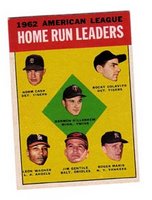 collection. It’s an inexpensive way to get cards with multiple Hall of Fame players, and if you’re on a very tight budget, leaders cards with one or no big name, Hall of Fame players can fall under a dollar. Some years did leaders cards better than others. 1961 (the first year of the subset) is great, as are 1962, 1963, 1965, 1967 and 1968. Perhaps the best year was 1963, as each card featured five or six stars to the other years’ two, three or (in rare instances) four. The 1963 Topps American League Home Run Leaders card features Cash, Colavito, Killebrew, Maris, Jim Gentile and Leon Wagner. I think I got this card, which is by no means in perfect condition, for one or two dollars. Leaders cards are a great way to get cards of Hall of Famers if you can’t afford their regular cards…
 it was done for fun by a high school student in their garage, and the card stock is a bit mealy. Also, it’s (appropriately) nearly impossible to put together a complete set—cards are hard to find, especially in decent condition, and when you do find them, you can’t afford them (the Satchel Paige card is worth $12,000 by itself in near-mint condition (good luck with that)). But just because you may have to forgo eating or paying rent shouldn’t deter you from getting one of these cards. The guy at the show yesterday wanted $50 for the Andy Pafko (in fair condition) and $35 for the common I had pulled out. I didn’t get either (I was hoping they’d be in such bad condition that their price would dip below $10. No luck.) But if you’re considering spending $35 to $50 on a box of relatively worthless crap made in 2006, why not spend it on a piece of baseball history? Besides, how many of your card-collecting friends have a card from the Forties? And if you decide to really go all-out (and by ‘all-out’ I mean spend over $100 on a single card), take a long look at the Ralph Kiner rookie. It’s a helluva card, and one of the cheaper Hall of Fame rookies…
 pontificated long and hard about the baseball card’s role to the student of the game, so I won’t bore you here, but Jensen’s is a career that deserves more attention. Take a look at his offensive stats; they’re staggering. Imagine: the guy is the AL’s MVP in 1958 and two years later he’s out of the league. If he were playing today team trainers would find a way to get him on the plane (though he’d probably end up addicted to Xanax). And if that didn’t work, he could buy one of John Madden’s old buses and revive big league barnstorming as he partied his way around the country…
 …You know, when I was writing about the 1985 Topps set, I totally forgot about Eric Davis and how his rookie card was worth nearly $30 for years. Wow, what a slip-up. If you’re looking for a card to add, this has to be on the list. You can probably get it for under $4 today. That reminds me, I should do a list of all the guys from the Eighties that you totally wanted their card and now they’re not worth shit. That would be some kind of list, I bet. Canseco would be on there, Strawberry, Gooden, Will Clark’s ’87 Fleer card, the Gregg Jeffries Topps card from 1989, Kevin Seitzer from 1987 Fleer…and definitely Eric Davis. Was there a bigger guy in 1985 than Eric Davis? Maybe Dwight Gooden had him beat, but shit, man, Eric Davis! You have to get a card of him. You know your collection has been begging you for literally years for a card of this guy…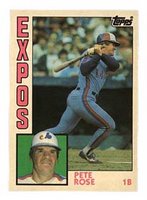

 1974 is a classic example of ‘the strongly designed set’, or a set where the main graphical element is present on every card. In ’74’s case, it’s the streamlined pennant (stolen and reconfigured from the classic design of 1965) on nearly every card. Those goddamn pennants…they’re ugly as hell, and you sure do get sick of them after about 20 cards, but you have to hand it to those Topps designers, because six years later in 1980 they take the same tired pennants, skew them 45 degrees and somehow make everything seem pleasing and fresh.
 series Traded series and then put out a special hero-worship subset in the 1975 set. That would’ve catapulted 1975 into the top ten sets ever made. Can you imagine? Cards 653-659 could’ve been ‘Hank Aaron Years’ cards, with card #660—his penultimate regular card, with maybe a photo of him at his car lot down in Atlanta, or smoking a cigar at home plate, or pushing away shaggy Braves fans as he rounded third, or, wait for it, a photo of him as a young call up for the Boston Braves in ’53? How about that?), which is just too bad, because there are a number of signs that this set is the quintessential one-step-away-from-greatness set, the ‘Biding Our Time’ set, the ‘Wait Til Next Year’ set…really, besides the Hank Aaron cards and the Winfield rookie, this set is a load of garbage.
 Let me back that wild claim up with some rockhard facts. Not too many subsets, and these Seventies sets almost live or die on their subset inventiveness. 1972 had a late-series ‘Traded’ subset, 1975 had the MVPs through the years, 1977 had ‘Big League Brothers’ featuring the shell-shocked Reuschels. 1976 had the All-Time Team. 1972 had ‘In Action’ and a few ‘Boyhood Photos of the Stars’. 1973 had some more Boyhood Photos, including one of Catfish Hunter clutching a farm animal. What did 1974 have besides the Aaron Hero-Worship to open the set? World Series cards, dual-league leaders, All-Stars and a team variation. I guess you have to also count the Traded series as a subset for this set, but since I’ve already counted it separately, let’s forget it. Also, forget the team variation as a legitimate subset. So that leaves us with three subsets that were by this time pretty tired. OK, next.
 awesome and big shots like Elliott Gould, Tom Seaver and Karen Black would come by, like, all the time, and the difference between my place and The Factory would be that instead of sitting around and trying to act all cool in front of each other, we’d sit around and make shit. Hell, we’d sit at long tables and make shit for hours, well, the celebrities would sit, and make stuff, like pot holders and fake designer handbags and leather boots, and I’d sit in my air conditioned office and talk with suppliers on the phone and then come out periodically to make sure that everybody was having a good time. And if they weren’t—and I’m talking big shots here, like Bud Harrelson and Clyde Frazier, Harvey Keitel and Henry Kissinger—well, then I’d launch into a long-winded speech on why Gus Triandos was completely undeserving of a 2nd Tier number in the meritocracy of the Topps checklisting universe of the 1960s…and they'd snap right back to work, because I happen to feel strongly about that and can go on about it for a long time (and really nobody wants that)...
 Well, I was wrong. I would have to say that 1975 and dark horse 1971 are tied for strongest rookie class, though 1977 is by far my favorite. Any set boasting rookies of Barker, Templeton and The Bird—all three of which I can probably purchase for under a dollar combined—is a friend of mine. But anyway, you see what I mean about the Seventies: these sets don’t have more than one or two worthwhile rookies each, which is a shame. Especially in the case of 1974, since there aren’t many other reasons to collect it.
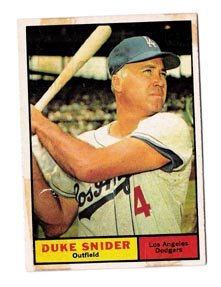 Last week, as I lazily moved from one destination to the next around Northern Vermont, I got to thinking: did Topps create Mickey Mantle, or did The Mick create Topps? (In the public consciousness, I mean). And if the former is true, couldn’t it also be said that Topps either created to help to mold the popularity (and possibly career) swings of every other baseball player since 1951? These questions got me (in a roundabout way) to the idea of the Topps checklist, the meritocracy theory behind each set’s checklist, and whether or not it would be possible—based on a few studious hours with an old Beckett and Microsoft Excel—for me to create a checklist for an ‘average’ Topps set.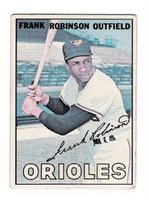
 Spahn and Koufax are interesting, because if you study the checklists from the Topps Sixties, it seems as though Koufax was Spahn’s heir to the Pitcher Hero Number—not Bob Gibson, who was just as deserving. Spahn and Koufax both had three years as a Hero Number, with Koufax ending his career as #100 in the 1966 set (Spahn ended his as #205, a 3rd Tier, in 1965). I gave Koufax #200 because it seems like Topps was positioning him to be the next full-set hero (to take over for the bad-kneed Mantle). Instead, Koufax retired and Topps elevated Gibson and Frank Robinson to take The Mick’s place. Spahn I gave #450.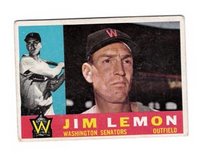
 Other Things to keep in mind:
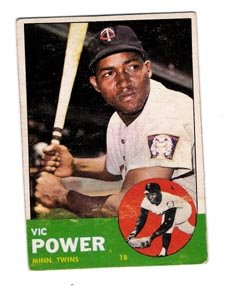 If anyone has an idea for what the design of this average Topps 1960s set would look like, send it to me by email and I’ll post the best three. I’d like to see fronts and backs, as well as League Leaders and All-Star card designs.


