April 27, 2006

Best Set Countdown: 33 – 31

I’ve been putting the rest of the countdown off for the past few days, if only because, as I was thinking on the subway going in to work yesterday, now is where things get difficult. The sets become more iconic, pitfalls become less obvious and the merits of each deserve more attention.

Invariably the countdown will step on collectors’ toes: I am aware that from now on there will be people out there who think I’m full of shit for listing ’83 Fleer over ’81 Topps, or ’89 Topps Traded in the top 33 at all. I’m prepared that every set will be somebody’s favorite; maybe someone’s first set was ’84 Topps, someone else’s last set ’86 Donruss or ’83 Fleer and therefore that set is firmly planted at the top of their own Best Set list. I guess all I can say is that I’m not letting nostalgia cloud my review and ranking of the remaining sets. If there was a Canseco rookie in a given set (for example), and mostly everybody spent their youth pining for it and saving up the $35 to buy it, you bet I’m going to take that into consideration. But no way in hell does that make that set better—especially if it was just Canseco and a pile of commons—than one with a wider selection of quality rookies, stars and cards in general.

By the way, I would like to thank everyone for noting that I can’t add or do simple multiplication. And now, nearly every night, I wake up in a cold sweat…the number 132 haunting my every dream.

Right. Enough explaining.

33. 1986 Fleer
Not exactly a Canseco and a pile of commons, but pretty close. Okay, that’s not a fair assessment, but this Fleer set is so uninspiring. And this was right in the middle of the Fleer/Donruss golden years from 1984 to 1987, so why so many goddamn headshots? I mean, c’mon. You’ve got second years of Puckett, Clemens, Gooden; you’ve got a Coleman rookie, a Canseco rookie—on one of those awesome rookie doubleheaders found at the back of the set, no less (Fleer’s neat but ultimately pathetic stab at the Donruss monopoly on rookie-cool)—and a sleeper rookie in Cecil Fielder (also on one of the rookie doubleheaders at the end of the set).

But this set lacks charisma. It doesn’t have any recognizable style, or maybe more accurately, it extends the ‘boring non-border’ sets of 1983 and 1985. But while those designs were decidedly non-busy to counteract the classic Topps designs and the ‘hey-look-I’m-a-baseball-card’ Donruss front of 1983 and the über-technological, Kit voice LED equalizer, Knightrider-esque Donruss design from 1985, it was old and over-extended by the time the blue non-border ’86 Fleer set rolled out.

So while this set gets negative points for design, it does get back a few of those points when it comes to graded cards. I can imagine that, like with the ’86 Donruss set, it must be hard to successfully slab a card from this set at 9.5 (or even at 8.5). Those blue borders were a bitch to keep sharp.

Here are the positives: the special cards, the rookies and the player selection. Again, here’s where the Canseco helps and hurts this set. It helps because it firmly sets itself apart from Topps (Topps waited until the 1986 Traded set to unveil Canseco), and in the company of Donruss, it’s true arch-nemesis. It gave collectors something to buy packs towards finding, and if I remember correctly, the card was worth more than the entire ’86 Topps set at one point. Finding a card worth over $30 in a pack was a life-changing event, one that others would reverentially discuss in hushed tones. But for me, and I would gather many others then under the age of ten, that experience was never going to happen because packs were out of our price range.
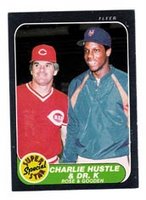
So unless you got a pack of from this set as a birthday present, you never saw these cards until later in life. That’s why this set is mired at #33.

32. 1989 Topps Traded
I would argue that Topps never really went away in the 1980s. They never put out a forgettable design, nor did they ever really miss the boat on players (and if they did on some, then they didn’t on others, or had others that Fleer or Donruss didn’t have. Future Star Pat Dodson, anyone?). So I don’t think that it’s a stretch to have the ’89 Traded set on the cusp of the top 30. And yes, I would rate it higher (and thus more deserving) than ’86 Fleer, for a couple of reasons.

First, this set is helped by the Griffey Factor, and not at the expense of the regular 1989 Topps set, which is a great set without a Griffey rookie. In contrast, I would argue that the 1989 Score Rookie/Traded benefited from the Griffey Factor at the expense of the regular Score set, because 1989 Score needed all the help it could get. I’ll admit, the logic is a bit confusing, but I would say that because of a strong regular Topps set, the Griffey Factor is doubly beneficial to the Traded set.
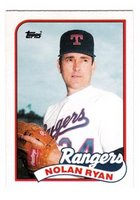
I would also argue that 1989 Topps Traded benefits as the last set that qualifies for ‘pre-Upper Deck’ status (even though, because it came out in 1989, that’s technically not true). This set is the last set pre-UD to showcase ‘event cards’, like the Griffey and the Nolan Ryan wearing his Rangers cap like a trucker (or a model train engineer). I think you could say that Upper Deck redefined the event card, making it more difficult for cards to attain this status.

As a definition, an ‘event card’ was a card that, at one point or another, could represent an entire set. It could’ve been from a subset (like an All-Star or a Future Star), or a special card, but it had to transcend its status as subset or special card. 1989 Topps was full of event cards (one reason why it’s a great set), most notably the Gregg Jefferies.

Within the 1989 Topps Traded set, the Griffey rookie was the obvious event card, because it was in every set that year. The less obvious event card was the Nolan Ryan. (For some reason—and this is something I’ve never quite understood—Nolan Ryan is a hobby god. I won’t get really deep into this tangent right now, but if some of Dave Stieb’s one-hitters had been no-hitters, would he have been a hobby god too? I doubt it; there must be more to the Ryan Mystique…) Seeing Ryan in his new Texas Ranger duds was shocking, especially for someone who didn’t really have a good grasp on what free-agency was at the time. And besides, that’s a really white uniform he’s got on and it’s a little disconcerting in combination with his pasty white skin. Another less obvious event card was the Eddie Murray-as-a-Dodger card. When I first saw this card I totally thought Murray had sold out. He had always been one of my favorite players and had made it acceptable to silently root for the Orioles, even as a diehard Red Sox fan. For him to go to the Dodgers was blasphemous. Not only did he desert his lifelong team, he deserted me. Whenever I think of 1989 Topps Traded I think of that Murray card, more so than the Griffey.

Lastly, this set is worthy of its position because it had the two things that generally decent sets have in common: good player selection and a serviceable if not great design. It’s missing a Belle, but the set doesn’t suffer because he’s not included.

31. 1981 Topps
1981 Topps was the last set to denote an All-Star on his regular card. That changed in 1982, when All-Stars were given their own subset for the first time since 1974. 1981 was also the first set to include team rookie cards since 1972, and the first to split the cards up (not put them all together at the end of the set) since that same year, 1972. As for design, it was one of the best
of the decade (if you ask me). The fronts were colorful, the team name displayed on a cap in the lower left corner and a big photo surrounded by a color border. The cap was cool, and doubly cool when it was an Expos player, because then the cap was multicolored.

Other neat things about this set:
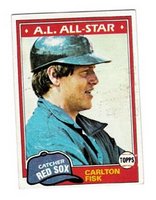
• I had about five or six of the Carlton Fisk card, even though I never bought packs of this set (I started collecting in 1986). I got the team set as a birthday present one year, got one in a trade, bought one at a card show, and then, left alone in a box, they had sex with each other and multiplied like rabbits from there.
• This set is better than the 1986 Fleer set because of the rookies. Canseco, Fielder and Coleman cannot go head-to-head with the Valenzuela/Gibson/Baines/Tony Pena/Bruce Hurst/Tim Raines/Lloyd Moseby combination and expect to come out victorious. It’s just too strong.

• The set featured a lot of guys sitting on the bench, doing nothing. One of the best shots of a guy doing nothing is Dwight Evans’ card. He looks genuinely pissed that there was a strike, if only because he was on his way to a career year with 22 home runs when the season ended after 108 games. It’s as if Nostradamus had been working for Topps that year:

Topps Executive 1“Hey, Nostradamus! What did you think of the photographer’s presentation earlier?”
Nostradamus “Should’ve had more shots of guys doing nothing, if you ask me.”
Topps Executive 1 “Why’s that?”
Nostradamus “There’s gonna be a strike this season.”
Topps Executive 1 “Oh yeah? Where’d you hear that?”
Nostradamus “Heard it in a dream.”
Topps Executive 1 “Heard it in a dream, huh?”
Nostradamus “That’s right.”
Topps Executive 1 “You hear that, Jack, old Nostradamus had a dream that there’s gonna be a strike this season.”
Topps Executive 2 “A strike, huh?”
Nostradamus “That’s right.”
Topps Executive 2 “Well, I guess we should’ve had those photographers show more shots of guys doing nothing.”


Coming Soon: Sets 30 - 28

April 22, 2006

Best Set Countdown: 38 – 34

Where were we? Oh yeah...the countdown...

38. 1988 Fleer Update
This has four things going for it: it has Alomar, Biggio and Smoltz rookies and it has the clean, 1988 Fleer design. That’s it. This is one of those sets that was just uncalled for. There was no reason to buy this, except for those three cards.

Has anyone else noticed that Roberto Alomar’s cards haven’t aged well? Their value hasn’t really done much in the last 10 years or so, and his rookie card values have sort of slid away into oblivion. Too bad he had to spit in that umpire’s face—he might be the first Hall of Famer with legitimate rookie cards valued at less than $5.00.

37. 1987 Donruss Rookies
This, like the 1989 Rookies set, is totally unnecessary—especially because it’s an obvious attempt to cash in on the popularity of Mark McGwire (he’s card #1; that’s the Donruss brand of subtlety). Unlike the 1989 Rookies, however, this set features a pretty outstanding lineup, despite sporting only one or two true rookie cards in the whole set: Matt Williams, who did the best Babe Ruth trot impression anywhere, Ellis Burks and Kevin Seitzer (both of whom I don’t think were included in the regular-issue Donruss, though I could be wrong). Therefore I’m torn about how to feel about it.

Donruss was the Bowman of the 1980s: obsessed with getting rookies out there before Topps and Fleer. And most of the time it worked: Joe Carter in ’84 and Fred McGriff in ’86 are two notable examples. Rookies are part of Donruss’ DNA, yet the company exploited it so much during the 1980s that while the ’86 Rookies set felt right, by ’87 it wasn’t original anymore (and for the most part unnecessary) and then by ’88 and into ’89 it was a forced death march where you knew the sets were inevitable but were also predictable, weak and unnecessary (the worst combination).

36. 1988 Fleer
I forgot that Fleer always put all the players from each team together in its sets. I always thought that was helpful, because then you knew if you were missing a player. But now that I’m looking back on it, this system was totally, unequivocally stupid. OK, that’s a little harsh, but there’s no joy of intermingling in the Fleer sets; everything’s grouped. Orioles, Red Sox, Angels, Dodgers…that’s lame. I’ve soliloquized long and hard on the ingeniousness of the Topps merit-based numerical system because a) there’s a definitive hierarchy to their numbering (unless I’m reading way too far into it, which could very well be the case) which allows the novice and expert to know and understand who the good players are and to feel an extra sense of accomplishment upon obtaining one of these cards (using a base of 10, for example the player on card #300 is more important than the player on #150, who in turn is more important than the player on #17, though of course there are exceptions, especially in the earlier years) , b) it mixes the players up to mimic how you would receive the cards in packs and in sorting, and c), when subsets occur in the set, they are placed together, making them special.

But with Fleer, there’s nothing special about how the set is put together. It’s almost like an afterthought. And that’s a real bummer. 1988 in general has become sort of an afterthought to many collectors, and to Beckett, because 1987 and 1989 had hobby-changing rookies (Bo Jackson, Will Clark, Barry Bonds in ’87, Ken Griffey Jr, Gary Sheffield in ’89). But 1988 did have some good sets, and I’ll always consider this Fleer set a good one: clean design, good photography and player selection. It was actually the last good set that Fleer made until 1994 (one of my favorite designs of the 1990s).

35. 1987 Topps Traded
Unlike ’87 Donruss Rookies, the Topps Traded from 1987 was necessary, if only because by 1987 Topps Traded was an institution and because Topps (routinely) missed the boat on a number of rookies in the regular-issue set. I think the Fleer Update from 1987 is the best of the lot of u/r/t sets from ’87, but it doesn’t beat Topps by much. Legitimate rookies in ’87 TT: Maddux, Burks, Matt Williams, McGriff, the list goes on. But it’s the others that are included that makes this set better than just a Rookies set: Eckersley’s first card on the A’s, Reggie Jackson’s last Topps card. A hey-that’s-kind-of-neat-but-what-the-fuck card of Cal Ripken, Sr., who is, appropriately, looking old. Plus, this set benefits from the wood paneled look, but a much-cleaner-strangely-crisp wood panel look, like they were wiped down with a rag and Lemon Pledge.

34. 1989 Fleer
Let’s get one thing straight: without two very important cards, this set would be at the bottom rung, right down there with ’89 Bowman. These cards are god-awful to look at, like they could possibly be made of recycled papier maché. I remember packs of this set were expensive, and not for any other reason but that there were two cards that you wanted to get and if you didn’t you were stuck with hundreds of cards you didn’t want and about a zillion little team logo stickers that lost their stick after about ten minutes. And really, this was a bad set to collect because the likelihood of getting either of the two important cards in a pack were slim to none. Of course, I’m talking about the Griffey rookie and the Ripken ‘Fuck Face’ card.

There were three cards made in the 1980s that posed a significant counterfeit problem: the 86-87 Fleer Jordan rookie, the ’89 Upper Deck Griffey rookie and the ’89 ‘Fuck Face’ Billy Ripken. Can you imagine being that desperate to cash in on something that you’d be willing to go to jail making counterfeit Billy Ripken cards? Are you kidding? Or how about the poor sap who bought one? That’s pretty lame. And really, Fleer’s response (or jumbled-up lack of definitive response) to this card was ridiculous, a response I would’ve reserved for Donruss, to be honest.

How did they not see the card before it went to press? If you ask me, it’s like they wanted the card in the set, like they thought it would garner them popularity and success. They were right about the popularity part, but success? Last time I checked, 1989 Fleer was kind of a loser set, 1990 was bad and 1991 one of the worst sets of all-time. All this controversy did was stave off the inevitable decline of Fleer by maybe six months (and give us not one but five versions of the error, including my favorite, the ‘scribble over vulgarity’ version).

But perhaps the greatest thing it gave us was something to call Billy Ripken if we were to run into him at a bar, in holding down at the precinct or found ourselves alone with him in an elevator.

Coming Soon: #33 – 28

Best Set Countdown: 44 – 39

Let’s get right to it, shall we?

44. 1989 Fleer Update
If you’re like me, you poured a ton of your money as a kid (and teenager…and perhaps adult) into buying baseball cards. But not only the cards themselves—you bought pages and top loaders and other supplies and, more importantly, you bought into the idea that your cards may actually be worth something. So you read Beckett Baseball Card Monthly. And you read it religiously. I still have a couple of them from 1987, when they listed practically every card (and still had room for a thriving classified ads section in the back), and they’re still enjoyable to read. Which brings up my point: when a set like the 1989 Fleer Update came out, it was an important issue because it had some legitimate rookies that weren’t in the (I believe overrated) regular issue set: Abbott, Belle and Omar Vizquel. And Fleer was smart (or dumb) enough not to include another Griffey card in the Update set, which wins points with me, since it would have sort of devalued his regular issue rookie card (which was the best card in my collection at one point).

But if you read a Beckett now, it barely mentions this set (or any from the 1980s, for that matter) and I think it has to do with the fact that Griffey’s not included. Call it the Griffey Factor (or the Griffey Curse), but the success of your set hinged on whether or not you included a card of him. Regular-issue Topps did not, but they were Topps, and thus smart enough to reach back into their cavalcade of fantastic subsets and put in as many as they could (including the revival of the Draft Pick idea, which I would argue was the second-biggest introduction to the hobby in 1989; inaugural Upper Deck being biggest). Regular-issue Fleer did include Griffey, elevating a borderline awful, corrugated cardboard design and briefly making it desirable. And because the regular-issue included him, the Update set thus did not. And while it did include other rookies (Belle the giant among them), this set was forgotten almost as soon as it was released.

43. 1989 Score Rookie/Traded
I think you could make a very convincing argument that this one is the best of the update/rookie/traded sets from 1989. OK, mostly everyone agrees that the regular issue of 1989 Score was a clunker. The Rookie/Traded set was only less so, but it really didn’t take much to be the best u/r/t set this year. I mean, how hard is it to screw up? You put in a Griffey, Jr., you put in a Randy Johnson on the Mariners, you put in a Ryan on the Rangers and, if you’re smart, you out-maneuver Topps and put in an Albert Belle.

If the design was crappy to begin with, Score used better colors in this set: purple and green anybody? I know, it sounds bad, but that combination gave life to a design that was dead on arrival. And good thing it did, too, because at least it gave a little momentum to the blockbuster, 300,000+ card set that was 1990 Score. ’89 R/T also saved a relatively new card company from the embarrassment of having its head up its ass with the regular-issue set. So, I guess you could say that this set was the re-animated, undead corpse of 1989: slowly, menacingly marching with its mouth slightly open, oozing a little bit of bluish blood, onwards to the bright lights of 1990, 1991 and 1992.

42. 1989 Donruss
What can I say about 1989 Donruss that I haven’t already said? Of the six major-issue sets from 1989, this one is kind-of-okay-not-so-great. It does have a Griffey—as a Rated Rookie, no less. And you could argue that each year of Donruss had a desirable, buy-packs-until-you-got-one RR, but I would say that Griffey was the most highly regarded RR since McGwire or Bo Jackson in 1987. In fact, here’s how I think Griffey stacks amongst other 1980s Rated Rookies:


Top 10 Rated Rookies: 1980s
1. Joe Carter, 1984
2. Ken Griffey, Jr., 1989
3. Jose Canseco, 1986
4. Mark McGwire, 1987
5. Bo Jackson, 1987
6. Fred McGriff, 1986
7. Mark Grace, 1988
8. Roberto Alomar, 1988
9. Randy Johnson, 1989
10. Gary Sheffield, 1989

Hon. Mentions: Danny Tartabull, 1985; Devon White, 1987; Rafael Palmeiro, 1987; BJ Surhoff, 1987; Ron Darling, 1984; Kevin McReynolds, 1984; Tony Fernandez, 1984

41. 1983 Topps Traded
Remember when the Darryl Strawberry card was worth $20? Yeah, me too. This was the last Topps Traded set where Topps owned the traded set market (which I would argue they only had started to counteract the re-introduction of Fleer and the inaugural Donruss set in 1981). One thing that I always liked about collecting cards was that you knew how many cards were in a set—it never changed. Topps: 792. Fleer: 660. Donruss: 660. Score changed it around a lot, but they don’t really count anyway, since you only bought packs of Score when you got sick of buying Topps, Fleer and Donruss (Score was more like a pageant and less like a set you took seriously, especially from 1990-1992).

Topps Traded was always 132 cards. 132 was always a number that baffled me. It’s not divisible by 3, so the set never ended on a full page (when you put the set into pages in a binder), or even on a full row. 792 is divisible by 3, so there was always a nice clean break at the end. You could say that Topps Traded ceased to matter after the 1984 set, but I would argue that it stopped mattering with Reggie Smith at card #110 of the 1982 Traded set. He was the next card after Ozzie Smith (the first card of him as a Cardinal). After that Topps was an also-ran in terms of traded sets until 1988 (with the Olympic cards).

40. 1988 Score
Yellow-orange barf. For a long time, this is how I characterized 1988 Score. Then I entered a phase where I looked past that and started to appreciate the balls Score had to enter a market in a weak year and actually put out a decent set. My friend was all about this set for a long time and only later did I see why: pretty good photography, an attractive, clean front and back, and perhaps the biggest thing of all…drumroll…color on the back. And not just color, but a color headshot. Fleer experimented with color on the back in 1982, and with black and white headshots on the back in 1983, 84 and 85, but a color headshot? I don’t think so.

I would argue that the headshot on the back of 88 Score was the most memorable thing about the set. In fact, any time a company put a headshot on the back of a card and it was big enough to tell who that player was without squinting was a big deal. That’s one of the reasons that Upper Deck blew everyone else away in 1989: color photography was woven into the front and back of each card. Correct me if I’m wrong, but pre-1992, the last time Topps tried photos on the front and backs of cards was 1971. I would say we have Score to thank for this modern innovation in card design. Too bad the fronts were yellow-orange barf.

39. 1981 Topps Traded
Is this set really anything more than Malibu Stacy with a new hat? Maybe not. But it least it showed that Topps wasn’t gonna let two snot-nosed little punks crowd it out of the baseball card racket. I would argue that without Donruss and Fleer, Topps would’ve continued to do a traded series every couple of years, basically whenever it felt like putting in the effort. It probably would never have been its own set, more like a couple cards tacked on like in ’72, ’74 and maybe a full-fledged series like in ’76. But that would’ve been it. Collectors would just have to wait until next year if a big star got traded during the season, so then Topps could do a big flourish and showcase the card with some snazzy photo of the player in his new uniform (like the A-Rod card of him in the 2001 set in his new Rangers duds).

And because it was the first set of its kind (though it was number 727 – 858, thus making it seem like another series in the regular-issue set), Topps made a choice that I would say can be classified as update/rookie/traded set no-no: including cards of Raines and Valenzuela, two guys with rookie cards in the regular-issue set. Why are they included in this set, except to stick it to Donruss and Fleer? It may have lent this set a little weight, but not in the long run. Now it just makes them look desperate.

Coming Soon: #38 – 34

April 18, 2006

Best Set Countdown: 49 - 45

Don’t ask me how, but I’m on the Baltimore Orioles Official His’n’Hers Sportswear mailing list. I was never an Orioles fan (though a lifelong Eddie Murray fan), so I’ve always found it odd that I keep getting these catalogues. I got one in the mail today and they have an item called ‘Fan Jersey’, where you can get any name and any number on the back of a black Orioles t-shirt. I’ve always been a fan of these, not because it allows you to put your own name on a shirt, but because it allows to put any name on a shirt…like a Mets shirt with ‘Fernandez 50’ on the back or a Phillies ‘Thon 21’ shirt. It’s really the shirt that allows true holier-than-thous to set themselves apart from the fair weather fan. Personally, I want an Orioles shirt with ‘McGraw’ across the back, but they didn’t wear numbers back then (plus, John McGraw despised them).

49. 1989 Score

As I’ve noted before, this was a crappy sophomore effort. I mean, c’mon, polybagging packs was so 1988. The one good thing about this set was the card back: large headshot, comprehensive stats, color team logo, room for a few lines of copy. Just overall nice. What was that Fleer set in the mid-1990s? 1995? You know, the one where the fronts were made to look ‘hip’ and ‘now’ and ‘with-it’ when really they looked like the graphic designer had an epiphany after vomiting on a kaleidoscope. Anyway, I think that set was a roundabout homage to the back of the 1989 Score set.

Too bad Score was so obsessed with the subtle geometric baseball motif. I personally thought it worked in ’88. But coupled with the futuristic type on the front, not to mention the lame ‘Score’ name logo, it was just a bad combination. Also, let’s talk about color for a second. Now, I’m no color theory scholar, but when I see the Brett from this set, I’m not really drawn to it; it doesn’t make me want to buy more (unlike the Kirby Puckett from the 1987 Fleer set; one of the best cards of the decade). And you can’t tell me that the Score execs didn’t have hundreds of focus groups about card design. I’m sure by 1989 Topps, Fleer and Donruss were basically farming out the creative design part of the process to junior colleges around the country, but Score, it really looks like a lot of thought went into it and because so much time and energy went in the end product just sort of, well, sucked.

48. 1988 Donruss Rookies

I would like to see a show of hands of who bought this set. Keep your hands raised if you thought you’d be able to sell it later on and be able to put your kids through college. Now keep’em raised if you can tell me the point of including a rookie in the regular issue set and the traded/rookies/update set of the same year. It was totally awesome that Wally Joyner was in the 1986 Topps Traded set and a rookie in the 1987 regular set. But it’s totally lame to have Roberto Alomar as a Rated Rookie in the regular set and included in the end of year Rookies set. He was a goddamned Rated Rookie, the upper echelon of rookiedom. Alomar, Grace, Leiter; they were all RR’s. They had no place in the Rookies set. Also, 1988 Rookies sucked because of the variation on a theme design, there was never any value associated with it and the basic fact that it wasn’t 1987 anymore (no matter how hard the card companies tried to get us to believe). Also, explain this one: how did Score, of all companies, make such a killer 1988 Rookie/Traded set? Topps succeeded that year because it convinced USA Baseball to let it make cards again (a la 1985) of future stars Ty Griffin and Joe Slusarski (who was also immortalized on a three-photo Upper Deck card (I forget which year). This is also a subject I want to get into more, because it really was awesome; for all the shit Upper Deck has laid on the hobby over the years, the three-photo card remains totally awesome). Donruss and Fleer? Stuck with Rookies and Update. Man, here’s the real reason this set is ranked #48: this was the first year that if you got the Rookies set for your birthday or for Christmas or something you actually felt a little disappointed, and a little embarrassed for your parents or friends who got it for you, because you just knew that there was a moment right after they left the card shop where they bought it, where they thought they’d score major points for being hip to buying you baseball cards because that was your thing and that the term ‘rookie’ equates awesomeness within collectors’ circles, thus elevating other collectors view of you (when really all it did was make you look like either a complete card novice or a completist, and who the hell knew what a ‘completist’ was when you were 9 years old).

47. 1985 Topps Traded

The only reason that this set ranks higher than the 1985 Fleer Update is because it uses the fantastic 1985 regular issue design. Not that the ’85 Fleer Update set didn’t look like the regular issue Fleer set, but it’s just something about that ’85 Topps set that makes me feel warm inside.

46. 1989 Donruss Rookies

Wow. Another useless Rookies set from Donruss. Seriously, Donruss should have just stopped making sets after 1987. They would’ve looked pretty stupid at the time, but they wouldn’t have churned out so much crap, personally saving me hundreds of dollars, money that could be put to good use purchasing those ridiculous Comic Ball series that Upper Deck put out with Looney Tunes characters and few major leaguers as well. Was that Jim Abbott I remember in that set? Man, that’s fucked up…but I did like the hologram cards they included in that set. There were only two true rookies from the 1989 Rookies set: ‘Neon’ Deion Sanders and Joe Girardi. Did you know that Sanders apparently hated that nickname? I think that’s hilarious. Someone should prank call Greg Gumbel and tell him that Deion just loves being called ‘Neon’. Then it might actually be fun to watch a CBS pregame show. Also, and more importantly, who cares if you hate your nickname? It’s not you who decides what it is. Do you think Mordecai Brown liked being called ‘Three Finger’?

Briefly, in defense of this Rookies set, 1989 was a banner year: Griffey, Sheffield, Randy Johnson, John Smoltz, Gregg Jeffries, Ricky Jordan…I practically know the whole list by heart. But again: why make a set of rookies if most of the rookies appeared in the regular issue set? The only one that Donruss could’ve legitimately put in this set would’ve been Albert Belle, but they didn’t even think to include him. It’s like their crack team of researchers weren’t allowed to go to games if they didn’t finish their homework.

45. 1981 Donruss
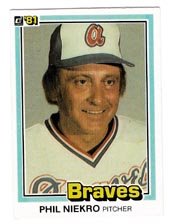
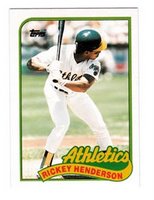
Here’s where the torture cycle starts: 1981 Donruss. Did you know it’s cheaper to buy packs of this set today than many suggested retail prices on packs from this year? It’s true. But then again, why the hell would you want to buy packs of 1981 Donruss? It was printed from scraps from the Dixie Cup factory, right? Ugly, ugly cards. The backs even say ‘First Edition Collector Series’ across the top, like they’re trying to save their own asses ’cause they know the set’s crap. Take this Phil Niekro card: it almost looks like they decided against using their own photographer and instead waited until the Braves’ press secretary went out to the dumpster to throw away the bad takes from the PR photo shoot from that year. Niekro looks borderline psychotic in this photo, like he was the model for the crotchety old man who ran the amusement park and was always trying to murder Scooby Doo. Seriously, what would’ve happened if that guy ever caught Velma and the gang? I bet he would have carried them over his shoulder to his lair in the back of the funhouse and cooked them dinner and maybe taught them how to throw a knuckleball. There are serious issues here that have not been addressed.

Another bad thing about the ’81 Donruss set: besides flimsy stock and bad photos, the colors are all messed up. Did some unlucky printer’s intern leave the still-wet cards out to dry in the sun too long? Also, who chose the typeface for the team name on the front? Was it the only one the printer had left? Or was it the only one that Mr. Donruss had programmed on his Commodore 64?

And now, briefly, in its defense, the Rickey Henderson is one of the best cards from the set, or any set pre-1985. That green and yellow uniform, with the red border (if I remember it correctly); it makes for a nice front. Much better than the front of his ’81 Topps card, where I believe he has his eyes closed.

Coming Soon: Sets 44 – 40

April 13, 2006

Card Critic’s Countdown to the Best Set of the 1980s

After watching a few too many hours of VH1 over the past week, I’ve decided to make my own ‘best of’ list, one that I think is truly needed (although ‘best celebrity beefs’ was pretty great, even though it didn’t include a showdown of celebrity-inspired hamburgers; just one would’ve made the show DVR-worthy).

I’m basing this list on a few criteria: design, short and long-term impact of key cards (including rookies) and how I feel about the set. There were seriously tons of sets made in the 1980s. I thought about maybe limiting the list to just the major issues from the big card companies, then I contemplated adding in all the Kmart issues and other little guys that you could buy like a deck of playing cards, and then those other ones that you had to cut out of the backs of macaroni and cheese (I also think I ate more Drake’s cakes than humanly possible when cards were on the backs of the boxes), but I had no idea where you’d find a comprehensive list of these sets. Enter the Sports Collectors Digest 2006 Standard Catalog of Baseball Cards, which lists every goddamn set ever made (though I thought I had it stumped when I went looking for the Topps Kids issue from 1992, but really it was there). I decided there can be no middle ground in this kind of list.

So for now I’m just going to do major issues by the big companies. By my count there were 53 different major issue sets released in the 1980s. This includes regular base sets as well as Topps Traded, Donruss Rookies, Fleer Update and Score Rookie/Traded. I’m not counting Tiffany or other parallel sets, like the 1984 Nestle Topps set, or O Pee Chee or the late Eighties Leaf sets. Basically, none of the major Canadian sets are counted, just because I’m not convinced that there was enough of a difference between these sets and their Donruss/Topps counterparts (except logos, card numbering, the presence of French text, the ‘Canadian Greats’ subset in the Leaf sets and the peculiar “Now with new team” text on certain traded players’ cards in the O Pee Chee sets). I also didn’t include Sportflics in the list, because my emotions would’ve gotten the better of me and we’d end up with a Sportflics set in the top 20 based purely on sentimentality of the mind-blowing technology used to get Pete Rose, Mike Schmidt and Steve Garvey on one card…truly amazing. But I also didn’t include Sportflics because all their sets kind of looked the same. Ah, fuck it, I’ll include the 1986 set, if only for the fact that I thought they were so goddamn awesome when I was 7 years old.

I’m going to count down from #53, though you should take into mind that sets will be kind of random until about the top fifteen, so you may not agree that 1989 Score is around #45, and on another day I might see it your way, but for now it’s somewhere around #45 because while it’s got an okay design, it’s riddled with statistical errors and it really was kind of a lame sophomore effort from Score, especially coming off a hot Traded set in 1988, not to mention a great inaugural set (setting the tone with different colors, as well as not being afraid of mixing it up at the end of a set with the Reggie through the years hero-worship a la Topps).


53. 1989 Bowman
The last major-issue set the Bowman arm of Topps released was in 1955, with the TV set border—a classic set in terms of design. Just as memorable was its re-entry set in 1989, but for all the wrong reasons. The card size was bigger than the modern standard size. And while this may have seemed quaint and perhaps even necessary in the board room when they decided to make the ‘new’ Bowman remind collectors of the ‘old’ Bowman, it was a disaster for collectors (and when I say ‘collectors’, I mean ‘me’). I hated 1989 Bowman. Hated it so much that I bought one pack and then quit. Hated it so much that even when that one pack had the Griffey Jr./Sr. card in it, I still didn’t care. The stats were totally illogical to my 10 year-old mind; who cares how a batter did against one specific team? I mean really, what kind of shit is that? Also, and I don’t know if I already mentioned this, but the cards were too big to fit into pages, boxes, top loaders or plastic sleeves.

When Fleer came out with Extra Bases in the Nineties, I thought Goddammitt, here we go again, and even though I bought more packs of that set than I did ’89 Bowman, making cards bigger may have made the set stand out, but would never guarantee the company any kind of widespread appeal. 1989 Bowman is the Betamax tape in a VHS world. Maybe someday someone will write his or her dissertation on how the 1989 Bowman set was of superior quality to the other sets on the market at the time. Too bad that person will be confusing 1989 Bowman with 1989 Upper Deck, and will thus receive a D+ on said dissertation (they’ll get a ‘D’ because the topic’s not accurate nor defensible, and a ‘+’ because the judges will have a soft spot in their hearts for Jimmy Piersall, good ol’#66b).

52. 1988 Donruss
You know, there is something to be said for he who comes in next-to-last. Coming in last is pretty easy (I come in last in my fantasy baseball teams nearly every season), but coming in next-to-last is not so easy: you give it your all (or at least half of your all) and still you suck pretty hard. Coming in last almost always means you suffered some spectacular failure and pretty much everyone who’s following knows that you’re in last (just ask Larry Brown). But next-to-last—that’s an anonymous spot. You’re unmemorable. Maybe there were expectations but people knew enough not to expect anything stupendous. It’s here that we find 1988 Donruss.

Let’s see: lame card design? Check. Poor rookie class? Check. Overabundance of cards? Check. Dale Murphy on the box? Check. I have to admit that I had certain expectations for 1988: I knew it wasn’t going to be ’87 redux, but I prayed it wasn’t going to suck. ’87 Donruss was a helluva set: so many great rookies, the thrill of opening a pack you really couldn’t afford but bought anyway…but then ’88 came out and it was crap. You know that first time you saw a new card design it was either hard to swallow or love at first sight? Well, 1988 Donruss remains hard to swallow.

51. 1982 Fleer
This set has a great thing going for it that only 3 other sets can claim: it has a Ripken rookie in it. Without this card, 1982 Fleer would probably be the worst set of the decade. I’ve already written extensively about why this set is horrible, but I’ll hit the key points again here. The cards were printed onstage during Amateur Night at the Apollo, and they were going to be great but the guy got booed off the stage halfway through the process. An 8 year-old kid took the photos on the one day during spring vacation when her parents didn’t take her to Disney World. Not even Fleer’s first foray into the special card subset helps. Just a real shitty set. You know, I see star cards from this set at shows and stuff and I almost can’t bear to pay the asking price for them because the set just envelops you in its aura of poor quality and overall cheapness.

50. 1985 Fleer Update
Why did they even make this set? I ask myself this every day when I get up and look in the mirror. What drugs were they taking at Fleer when they came up with the idea of making a hundred times more of these sets than the one from ’84, putting almost no desirable rookies in it (besides Vince Coleman) and almost no stars (besides Rickey Henderson)? Why? I think the Topps Traded from this year is valued at $2 for the whole set. This one is currently at $4, and that’s because Fleer was right at the height of its higher standards, higher quality, higher price days from 1984 – 1987. A comparison of bona fide, national stars included in the 1984 and 1985 Fleer Update sets:

1984 Update
Dusty Baker
Roger Clemens
Ron Darling
Alvin Davis
Dennis Eckersley
John Franco
Dwight Gooden
Goose Gossage
Mark Gubicza
Jimmy Key
Dave Kingman
Mark Langston
Joe Morgan
Graig Nettles
Phil Niekro
Tony Perez
Kirby Puckett
Jose Rijo
Pete Rose
Bret Saberhagen
Tom Seaver
Rick Sutcliffe
22/132 = 16.67% Success Rate
8/22 CFS* = 36.37% *Clutching For Straws kind of stars (i.e. Dusty Baker)


1985 Update
Dusty Baker
Tom Browning
Gary Carter
Jack Clark
Vince Coleman
Darren Daulton
Ozzie Guillen
Rickey Henderson
Teddy Higuera
Howard Johnson
Fred Lynn
Don Sutton
Mickey Tettleton
13/132 = 9.85% Success Rate
7/13 CFS = 53.85% Clutching For Straws kind of stars (i.e. Dusty Baker)


See what I mean? When you make a list of all the big names that moved or got called up from the farm that year and the fifth name on your list is Fred Lynn, you may just want to hedge your bets and make a four card insert set to your factory set; don’t bother with an Update set that nobody’s going to buy.

Coming Soon: Sets 49-46

April 09, 2006

Card Critic: 2006 Topps Heritage

Any card collector can agree that there is really nothing more exciting than a big find when and where you least expect it. I remember a friend of mine was going through some stuff at a yard sale and came upon a few vintage rookies: Brooks Robinson, Frank Robinson, Roberto Clemente and Reggie Jackson, which he then purchased for a dollar each. That’s a gigantic score right where you least (or maybe most) expect it. I was totally jealous for years about that, even after I was given a box of old books and maps from a family friend and happened to find a perfect copy of the Ozzie Smith rookie (at least NM-MT, 60/40 on the front at the time).

Likewise, there’s nothing more disappointing than having high hopes for a set that doesn’t invoke excitement and could be, in fact, a real dud. 1991 Donruss comes to mind, as does 1991 Fleer…actually almost every set from 1991 fits into this category. That’s why it brings me great pains to say that the Topps Heritage set (with the 1957 design) is a real dud.

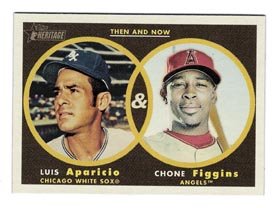
Now, don’t get me wrong. I’m not so one-sided in this opinion not to overlook the great Venn-diagram design they’ve got going with the Then & Now insert set. It’s a clean-looking card, upbeat in the way that the original cover of Kerouac’s On The Road is upbeat: kind of jazzy, kind of hip, kind of modern. But Then & Now is an insert set, and as a collector I’m not really buying packs to build the T&N set; it’s the base set that I have to be into.

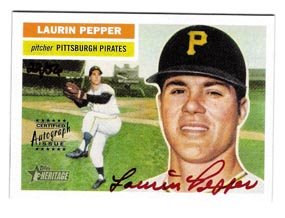
Topps fails (and failed in the 2005 Heritage set as well) because they are not true enough to the original look of the set. They lucked out that for most of the 1954 set, real photos were used. That’s why the 2003 Heritage set is so utterly fantastic: even though the Heritage cards are smaller today than the original set, you get the impression that you could have opened a 5¢ pack in ’54 and found this card of Alfonso Soriano. The same can be said of the 1955/2004 sets: real photos were used, and truthfully, headshots are hard to screw up. But screw up they did in 2005 and now here in 2006. The 1956 set had a colored pencil look to the images: the cheeks are rosier and the backgrounds look like faithful artist renditions of their photographic counterparts. Its Heritage design counterpart doesn’t employ the same dramatic-line approach and thus loses its credibility. It’s almost like the cards are too clean. I’m also not a fan of denoting anywhere on a card that something is a trademark symbol of Major League Baseball. I get it, but it ruins the overall aesthetic of the card. I would even recommend that Topps removes its own logo from the front of the Heritage cards: die-hard collectors (whom I would guess makes up the core audience for these sets) can recognize the design by just one element of the design. For example, if you showed just the black box and white lettering of a card, any collector worth their salt can tell you it’s from the ’51 Bowman set. We don’t need to be reminded who makes the cards: the designs themselves are the cornerstones of the hobby. Maybe in twenty-two years when they come out with Heritage ’79 then Topps can put their logo on the card fronts and it will make sense.

You’d think that because Topps chose to use real photos in 1957 (as well as move to the modern standard card size) then its Heritage homage would be a smashing success because there would be very little the designers could do to screw it up, right? Well, they manage to find a way.

In 1957 there were basically two front photos: the close-up (of which there are varying degrees) and the pose. In 57 Heritage, there are three basic fronts (from what I’ve seen): the close-up (of which there are varying degrees), the pose and the action shot. Why are there action shots? Frankly, what made the 57 Williams and Mantle cards so iconic (and boring and lousy photos) was that they were posed on the sidelines. Off the top of my head, I can’t think of one even posed action shot in the 1957 set. Therefore, to be true to the original design there should not be action shots anywhere in 57 Heritage. Topps has the option of using action shots in the insert sets, and in fact that would make a compelling insert set: the best action shots from the Sporting News from 1957 and 2005.

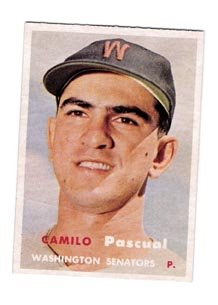
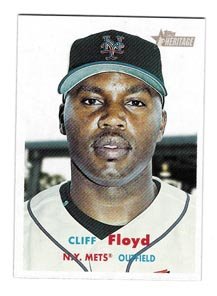
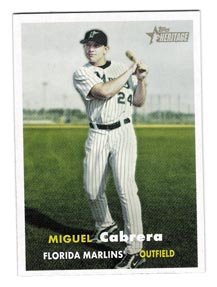
Let’s look at two pairs of cards for comparison. Starting with the Camilo Pascual from the original 1957 set, the first thing you notice is that the colors are rich; his skin tone looks natural. Also, there is one point of light in the photo: off-frame to the right from the sun. In comparison, this Cliff Floyd from the 57 Heritage set looks like there are a few different sources of light: behind him, to the right of him, and a very strong flash from the photographer’s camera directly in front of him. Floyd looks washed-out (this is really my biggest critique of the 57 Heritage set: there seems to be an aversion to color at Topps HQ; every color from the 57 Heritage base set is washed out. It’s a goddamn shame, too, because with richer color this set would have more credibility in its homage to the original), and his face looks flattened. There’s no depth to the photo. I think the issue of depth could’ve been addressed better if the background was more dynamic. Is that a highway overpass behind Floyd? And who chose to photograph him on an overcast afternoon? One of the great things about the original set was the play between the rich tones of the photos, the colorful typeface for the name, team and position and the clean white border on the front. This dynamic is rendered useless on Floyd’s card (and a lot of others in the 57 Heritage set as well). I mean, does Topps want me to get a migraine from looking at this set? Cause I’m almost there.

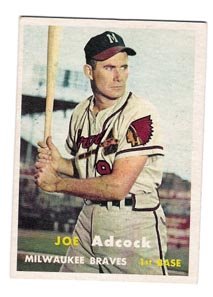
In the second comparison, let’s start with the Joe Adcock card from the original set. He looks like he just climbed out of a cigarette ad or at least down out the cab of his tractor-trailer. Now, maybe it’s just that he’s old when this photo was taken…wait a minute…it says on the back that he was born in ’27, so that means he was only 30 when this photo was taken! That’s crazy! He looks like he’s at least old enough to have weathered the Dust Bowl by barnstorming through the Rockies with other players with nicknames like ‘Crazy Legs’ and ‘Red’ in an old jalopy. Anyway, his jaw line is impressive, and his pose is dramatic. The background is recognizable as an actual ballpark, and the colors are deep, rich and warm. The lines are clean and there is no difficulty in telling where he ends and the background begins. Unfortunately, the same cannot be said of the Miguel Cabrera card from the 57 Heritage set.

And that’s another thing that really kills me about this set: there seems to be a fuzzy border separating the player from the background. What gives? Not only are the colors washed-out, the backgrounds almost the same value as the players and the action shots uncalled for, but who the hell made the decision for a weirdly fuzzy yellow border around the player? It makes the set look like an amateur assembled it in his basement. And if that amateur were me, I certainly would not have included that fuzzy border. I also would’ve unearthed an old camera and some old film and taken the photos so that they’d look like those of the original set.

On the backs, Topps has used a darker cardboard for the 57 Heritage set, cutting down on visibility. And because of the legalese fine print, the overall printed space on the back is smaller by at least 1/16th of an inch, which is a pretty big change when space is as limited as on the back of a baseball card.

Dear Topps, can’t you see how mad all of this makes me? You have all this money and the chance to make a great set that collectors will cherish for their whole lives and you don’t care enough to make it great! It’s one gigantic opportunity to waste, and that is just so disappointing.

April 05, 2006

Here's to you, Mr. Blankenship

Okay, so what could possibly be better than sorting baseball cards? Huh? And don’t say ‘having sex’, because that is really cliché, no matter how true. Also, don’t say ‘watching the Red Sox DVD where they win the World Series’ because I would also agree with you. Finally, don’t say ‘watching the Wrestlemania DVD box set, the one where Hulk Hogan miraculously comes back to beat Andre the Giant’, because that one match is at the very top of my favorite scripts of all time: unbelievable characters, a great plot, a great crowd, a great scene—just one of the best-written, most dramatic (if fake) scenes in sports history. Actually, all of these things could be made even better by sorting baseball cards while you did them…well, maybe not ‘having sex’…unless…

But seriously, neat little piles, divided by team or by make and year, not to mention the fun of seeing who you got doubles of (or even triples, quadruples, quintuples, the multiples go on until you reach Bordersuples and Chris Brownuples), there really isn’t anything better than sorting cards. Especially when you’re sorting after just breaking a box of Topps, and there’s just a hint of the fine white gum powder (that mean’s it’s fresh) or sugar from the gum sprinkled over the cards that makes your hands smell kind of good and makes you feel kind of good, the same feeling as lying in the yard on a summer morning and breathing in, just smelling the wet grass smell and running your fingers across the grass and feeling the dew (not to mention feeling around for dog poop, and if not feeling around, because that’s gross, then smelling around, just to make sure you didn’t lay down in it in your overzealous attempt to connect with nature (when you could’ve spent that time indoors sorting baseball cards, where there’s no rogue dog poop).

Sorting cards is exhilarating (because you’re not entirely sure what you’ll find), monotonous (because you have a pretty good idea of exactly what you’ll find) and sometimes dangerous. I bought a whole bunch of cards at a yard sale when I was a teenager and they all came in a big shoebox and when I got them home I noticed that there was a fine powder all over them and when I went to smell it on my fingers, it was definitely not the gum sugar you get on Topps cards before they outlawed gum. It was definitely foot powder.

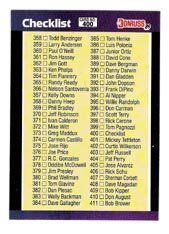
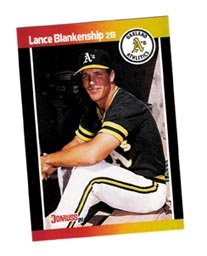
Going through the rest of the box of 1989 Donruss got me thinking about all kinds of stuff, like how I got six Willie Frasers and only four Orioles total (Rick Schu, Jeff Ballard, Eddie Murray and the Unknown Comic (I really can’t remember the fourth guy)). I got triples of Kirby Puckett and Chris Brownuples of Pat Borders and Bordersuples of Chris Brown. But perhaps the biggest surprise of all is that I only got one checklist. That, in and of itself, is the major score of the box. Everybody hates getting checklists. Unless we’re talking about the 1969 Topps set or the 1994 Collector’s Choice set or one of those sets from the Fifties when they didn’t number the checklists, or the sets where the lists were on the Team Cards and those Team Cards also happened to be in French and English (thank you 1973 O Pee Chee team cards…the ones with the signatures, right? Or was that 1972…), name me one person who enjoyed, in fact took pleasure in, finding a checklist in their pack. And I only got one. (Secretly, part of me wanted to get all of the checklists, you know, as part of an anthropological study, just to see what cards made up the population of 1989 Donruss. The fun-loving, pack-buying collector in me just shuddered after reading that last sentence.)

But by far the Best of Box Award goes to Lance Blankenship. Wow. I remember him, though I’m not entirely sure why, and the fact that I only got one of him (I got two McGwires and three Bo Jacksons) means that he must’ve been some kind of hot shit back in ’89 (the kind you wish you could find out in the yard on a cool summer morning, because you could probably trade it for a Jose Canseco or Roger Clemens).

My New Favorite Card Set: 2005 Bowman Heritage

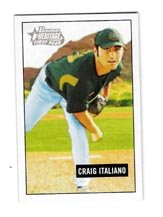
Yes, it’s official: after surveying the new 2006 Topps and Topps Heritage sets, I’ve decided my new favorite set is 2005 Bowman Heritage. I don’t think Topps got the new 2006 Heritage set right at all, but I’ll go into this in later posts. But they really did a great thing with 05 Bowman Heritage. Actually, it kicks ass. The only part of the set I don’t get is the darker, more cardboardy looking cards. Are they a parallel set? I’m guessing this is what they are, though sometimes you never know. Also, the fact that they made a parallel set of smaller cards is utterly fantastic. I really hope they didn’t make a Chrome parallel because I happen to think that Chrome blows (always has). The only way Topps could have made this Bowman Heritage set any better is if they had commissioned artists to paint from photos of players, instead of the weird (though effective) blurry Photoshop thing the set has got goin’ on now.

So hat’s off to you, 2005 Bowman Heritage. Way to go.