January 30, 2007

Countdown #43: 1976 Topps Traded

If I let my romantic tendencies get the best of me, this set would be in the top twenty. The limited vocabulary newspaper headlines on the back, the unbelievably bad airbrushing on the front, plus the original torn-from-the-headlines look on the front of the card—it all combines for a breathtaking card, a venerable feat of design that accurately captures an era of gap-toothed ballplayers with big glasses, bad unis and even worse hair.

But this is a straight-laced countdown, one where I’m not about to allow a deep-seated love of bad airbrushing let this little set slip by unnoticed. It’s a loser, but only because Topps, still new to the whole ‘traded series’ game, made it so.

Let’s put all design issues temporarily aside and focus instead on checklist because it’s here where I think Topps really screwed up (plus I’m a fan of the overall 1976 design, and think it was on the strong side of the 1970s). Topps’ policy, if I have this correctly, was to include only those players who were traded during a brief span of the 1975 off-season, as it was assumed that the company wouldn’t have time to get a new card of the player into the regular 1976 set. But even this idea is problematic, as it kept Topps at least a step behind actual, real-time baseball personnel moves.

The classic example is Reggie Jackson. Jackson’s 1975 card has him on the A’s (correct), 1976 also has him on the A’s (incorrect), for some reason he’s not the main attraction of the 1976 Traded series, and then in 1977 he’s on the Yankees. So what happened to his year with Baltimore?

It was brief, but it did happen, and Topps had not one but two opportunities to show him in an Orioles uniform. Instead, there’s a ridiculous gap. What Topps should have been doing was extending production time until late June, keeping the presses out in Pennsylvania open at least a little while in the summer, and then releasing a true Traded series in late September. That way they would have players in the series who’d been traded anywhere from just before the season began to up to two months into the season. Sure, it’s a tall order to fill, but they owned their own press, so even if you factor in all the other jobs over the course of the year, from the other sports to non-sports to regionals to other small sets, I’m sure there was a couple days when they could’ve found the time.

Anyway, with all that backstory, here’s a list of players traded that would’ve made the 1976 Traded series a helluva lot more collectible. Those that are bolded were included in the real Traded series [team on actual Traded card]:

Willie McCovey, A’s
Nate Colbert, A’s
Don Baylor, A’s
Mike Torrez, A’s
Reggie Jackson, Orioles
Ken Holtzman, Orioles
Tommy Harper, Orioles
Rick Dempsey, Orioles
Rudy May, Orioles
Scott McGregor, Orioles
Tippy Martinez, Orioles
Darrell Evans, Giants
Gary Sutherland, Brewers
Bernie Carbo, Brewers
Bobby Darwin, Red Sox
Don Kessinger, Cardinals
Steve Renko, Cubs
Larry Biittner, Cubs
Larry Gura, Royals
Bill Sudakis, Royals
Tommy Davis, Royals
Fritz Peterson, Rangers
Bert Blyleven, Rangers
Terry Humphrey, Angels
Mike Easler, Angels*
Reggie Smith, Dodgers
Lee Lacy, Dodgers [Braves]
Andy Messersmith, Braves
Mike Marshall, Braves
Jim Dwyer, Mets
Andre Thornton, Expos
Del Unser, Expos
Cardell Camper, Indians
Rudy Meoli, Reds
Diego Segui, Padres
Pedro Garcia, Tigers
Roy Smalley, Twins
Blue Moon Odom, White Sox
Cleon Jones, White Sox
Ken Brett, White Sox [Yankees]
Carlos May, Yankees
Doyle Alexander, Yankees
Cesar Tovar, Yankees

*Easler’s first Topps card was in the 1978 set, featuring him on the Pirates. This would’ve been his rookie card.

Now, let’s get back to the design. I touched briefly on the idea of airbrushing, or more appropriately, bad airbrushing, and I don’t think I can stress this enough. There were sets put out at various times over Topps’ long and distinguished record with examples of bad airbrushing. Jose Cardenal comes to mind more than once. I think Eddie Mathews’ ear got lopped off on a managerial card. But this Traded series takes bad airbrushing to another level.

Let me put it this way: if you got into a drunken argument at a bachelor party where you were for some reason forced to equate baseball cards with their rightful mythological legend counterparts, you could win easily by saying that any twelve cards and Oscar Gamble would be the equivalent of King Arthur and the Knights of the Round Table, simply on bad airbrushing alone. That’s not a claim—it’s a fact. There is simply no set that features more—and a higher degree of—badly airbrushed cards. Even those cards featuring players without hats are bad: Ken Brett’s pinstripes have been painted on.

I got an email from a reader that I reprinted on the blog not too long ago stating that because the 1982 Fleer was so bad, it was therefore great. It seems that the case could be made for this set as well, so to pre-empt this idea, I think that in this instance checklist and formulation of checklist greatly outweighs the unintentional comedy of the design and photography (and the fact that the Topps’ poor sap headline writer managed a minor victory by working ‘Le Grande Orange’ onto the Rusty Staub card). Especially for a 44-card set.

Why was it released at all? To scare the bejesus out of SSPC (or was it TCMA by now?)? The reasons behind releasing the set (besides selling more cards of a by-now stale set) are missing, and the cards included boil down to nothing more than Willie Randolph, Ferguson Jenkins, Rusty Staub, 41 others who could pass for commons and an unnumbered checklist.

I like this set as much as the next guy, but you could find more searching through Oscar Gamble’s hair.

January 26, 2007

The Baseball Card Blog Factory Store

Yes, it's true. Now you can own a piece of the Blog! With Volume 2 of magnets just around the corner, I thought it might be fun to launch a factory store over on CafePress.com. We've got mugs, we've got shirts, we've got stickahs for yah bumpah--all factory direct to you! With new stuff added all the time (read: whenever I have time), be the first on your block to show off these new duds.

Take The Baseball Card Blog Factory Store Tour

January 22, 2007

Countdown: #44 1953 Bowman Black & White

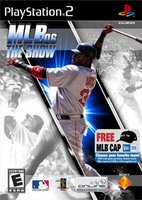
I don’t know what it is about MLB 2006: The Show, but I’m beyond addicted to it. And while almost every other part of my life has suffered because of it, one facet hasn’t.

Let me take a step back and tell you what I love most about this game. It most certainly isn’t the music, or the commentating, or the lag time after a few hours of game play. No, it’s the fact that when you’re twelve years into Franchise mode, nearly all of the players are made up—concocted from a random list of names, a random list of abilities, and a random list of numbers. And they all look tend to look the same, they all tend to run the same, field the same, swing the same, et cetera et cetera ad nauseam.

So what’s so great about that? It’s great because it mimics real life. If you stopped paying attention to the game (no matter what game you follow) for maybe five years, and you suddenly started paying attention again, you wouldn’t know who was good, who was bad, or really, who was who. You’d be screwed. Which brings me back to my first point: while this game, with its TV-like graphics and real-time statistical tallies (by the way, I’ve got Travis Hafner up to 208 hits, and we’re only just ten games after the All-Star break, in, uh, the 2012 season), has pretty much turned me into a recluse, I’ve figured out one very important thing: the nameless player is at the heart of the Bowman Mystique.

Think about it. Before the age of endless extreme close-ups, there were only a few places you’d see a ballplayer’s face: in the paper, on a print advertisement, in person (if you met them at the train station, airport, or knew where they worked in the off-season) and on a baseball card. You knew their names, their stats; those items were obvious from newspaper boxscores and radio broadcasts. But putting a face with a name…aye, there’s the rub.


So then why is this Bowman set ranked so low? A number of reasons, including (though not limited to) generally bad photography, poor player choice and thus a weak checklist, no real rookies to speak of, and did I mention bad photography? I was thinking of giving Dan Austin’s (stellar) Virtual Card Collection a break for a little while from my image pillaging, so I decided to bid on a lot of four cards from this set. But when it came right down to it, I was outbid and didn’t care enough about the set—based on what looked like an out-of-focus Bill Rigney—to remain in the bidding. It lead to me to wonder: why would a collector want this set?

Reason #1: It’s one of a handful of original Bowman sets.
Reason #2: The cards are relatively hard to find (especially in good condition).
Reason #3: It’s the other half of the fantastic 1953 Bowman Color set, so if you’re a completist, of course you collect it
Reason #4: You’re a fan of black & white photography on baseball cards (not too many sets used black & white photos)
Reason #5: You’re trying to spend $30 million in 30 days so you can inherit your uncle’s fortune, though you don’t quite understand the rules that you’re not allowed to have any possessions at the end of the 30 days

Reason #5 is the plot of Brewster’s Millions, and when you’re searching for reasons to collect this set after naming only four, well, that’s a bad sign. Let’s talk frankly here for a moment, all bullshitting aside: this set stinks. There’s no reason for you to collect it. But you know what? That’s okay. It’s okay that Bowman put out a clunker, and really, if they were going to put out a crap set, at least they made it almost an afterthought, bookending it to one of their best ever (its color counterpart from the same year).


So what of the Bowman Mystique? The Nameless Ballplayer? The whole buildup for this column? This tactic—the facsimile-signature-free/name-free front—while it’s what makes the color set so beautiful, it leaves the black & white set feeling more than a little bored. The Bowman Mystique hurts this set; it’s a negative here, leaving us with nothing more than posed wire photos without captions.

Baseball Card Magnets Vol. 1 (Update)

Hurry! Vol. 1 is selling fast!

Remember, there's only one of each card, so make sure that you email me if you want it.

Magnets are $3 each, no matter the quantity
There will be a surchage for shipping, depending on how many you order
Email me for all the info!

January 15, 2007

Countdown #45: 1960 Leaf

In a brilliant move, Leaf sold these—in the same wrapper—with marbles. It’s a miracle any of these cards survived even the first trip from the factory to the drugstore. Packaging aside, this is a neat little set, with overly candid black and white photos probably taken by a high school yearbook photographer on his lunchbreak. I’m serious—if one of the players included in this set ever ended up on the lam, post offices around the country could just tack that player’s card from this set to their wall. This set is an open textbook on the art of proper mug shot photography.
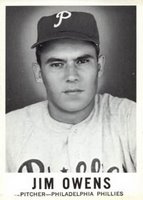
It’s as if Leaf was a decrepit scientist in a faraway castle tower, surrounded by stacks upon teetering stacks of media guides, flipping through each one until deciding upon the 144 ugliest ballplayers in the majors. What other possible explanation is there for the inclusion of this particular group of players? Were they all on the same prison bus? It’s amazing that Don Mossi and Wally Moon weren’t invited to this dance.

Of course, the photography is what makes this set memorable. Because it sure as hell ain’t the checklist. The checklist is weak, and understandably so. You don’t just go up against Topps and get away with it so easily. Leaf was lucky to get Brooks Robinson and Duke Snider, Orlando Cepeda, Curt Flood, Jim Bunning and the ten or so second and third-tier guys. And at 144 that translates into a pretty decent success rate (it’s just the quality of the success rate that is questionable).


So, despite the fun fotos (which almost look like they could’ve been early Polaroids), this set finds itself way the hell down at #45 for a number of reasons. First, as I mentioned, despite the heroics associated with the act of going up against the Topps monopoly, the checklist suffers from lack of star power.

Second, the design stinks. It was an obvious rip-off/update of the classic 1949 design (one of the best-looking sets ever, post-war or pre-, and one of the most universal in its design (look at Japanese cards through the Twentieth Century and you’ll see what I mean)), but it lacks the necessary oomph to make it work. Say what you will about thin black lettering and kitchen linoleum white backgrounds, but when you combine those with creepy, In-Cold-Blood-mugshot photography, the design really doesn’t do it. Then again, I might be alone in this opinion. Wasn’t there a gigantic tribute set in the Seventies made by Renata Gallasso in a sort of homage to this design? I think there was. But if memory serves me correct, they didn’t use stark, straight-on headshots. If I remember correctly, there were a lot of posed action shots.


Lastly, this set didn’t exactly inspire collectors, entice players to sign with Leaf for 1961 and beyond or intimidate Topps to buy them out. It was the only baseball set Leaf put out in the Sixties, and the last baseball set they’d put out until 1985, when Leaf was re-introduced as the Canadian Donruss imprint. Still, it’s a fun little set…as long as your idea of fun includes Steve Korcheck.

January 08, 2007

A Valuable/Valueless Argument

Who was the greatest center fielder in New York in the Fifties? What is the best baseball card set ever—before the war and after? Who had the funniest name? The largest head? And how about the ugliest mug only a mother could love? There are a few topics that will be debated forever, and the one that I keep hearing about lately is the idea of value, and more specifically, the appropriateness of assigning a value to a card produced after a certain date, and whether or not it's worth buying.

Some people might tell you that no card made after 1969 has any significant value, and that it’s a waste of time to even consider otherwise. Others believe that value in cards ends with 1989 and that the last card to have any worthwhile value is the Griffey rookie in that year’s Upper Deck set. And then there are others still who eat up what the Becketts and the Krauses feed them about inserts, low production runs, high-end product and other mid-Nineties innovations that have since become standard hobby practice: that the high pack prices they pay and their perceived or actual scarcity ensures their value. And the truth of the matter is, all three groups are right. And none of them are right. I know my conclusion is a little vague. Let me explain.

The collectors who insist on 1969 and before have it right because it’s pretty easy to walk into a hobby store and ask for and receive boatloads of commons and star cards from the Seventies through the present. It’s much harder to walk into the same hobby store and ask to see 1953 Bowman Color and be presented with more than two or three examples. Of course that’s just an example, and I would venture to say that if you make the rounds of the major paper and ephemera shows (like Allentown, Hartford, etc.), you’d have a better shot of finding older cards than new. They also have it right because not only is it harder to find specimen (if you don’t where to look), it’s harder still to find specimen in decent condition. So this argument has a double dose of scarcity: actual, physical scarcity in terms of number of cards, and scarcity pertaining to those in decent condition within that universe.
But vintage collectors have it wrong when they pull up their tree house ladder and alienate the rest of the hobby, especially novice collectors who don’t know where to start or what to believe. If anything, the first image a new collector sees in a book, magazine, on the internet or in a museum is invariably the 1952 Mantle or the T206 Wagner (though if it’s a lucky kid who just got a book of Dover reprints, he or she might see the 1912 Cracker Jack Shoeless Joe first). Point is, impressionable minds are confronted with the unimaginable riches of old baseball cards every day—why do we need to shoo them away from those that they can actually afford? There were plenty of cards made between 1969 and 1989 that are suitable for investment, perfect for younger novice collectors looking to get a foothold in the hobby. And with the relatively new idea of professional grading, cards from this time period are enjoying a second life.

Yet like the first group, there are holes in this argument. Not all of the cards made between 1969 and 1989 (and really I should extend this time period to 1995 or so) are worth investing in, where as most to all of the cards made in the first hundred or so years of cards are (even if in relatively poor condition). In fact, you could say that when I said there were plenty made between 1969 and 1989 that were suitable for investment, I should have said that there were a handful made that were suitable for investment—a short stack from nearly twenty-five years of cards. Truthfully, many of the cards made in the Eighties and early Nineties (and you could write a whole book about this, and maybe someday I will) are completely worthless today. It’s a hard fact to face and it pains me to write this…tears clouding vision…Kleenex accumulating next to keyboard…but it’s true. The reason? Well, let’s just say that scarcity will never be a problem for most to all of the cards made in this time period. Of course there are other factors, and exceptions to the rule, but for the most part if a card is still readily available everywhere, nearly thirty years after it was made, it’s just not worth very much (at all).

And now for one quick sidebar I want to get off my chest about the 1983 Topps set: Despite what I’ve just said about overabundance and relatively little demand and the collapse of the baseball card economy way back when, I still stand by what I wrote about the 1983 set. It is undervalued at $75.00. Beckett and Krause do this thing where they value the complete set at a much higher value than the sum of its parts for sets made between certain years, and then flip flop that policy for the Eighties (sum of parts higher than set price). Granted, the cards are worth a lot less in the Eighties, but still. I think this is one of the few sets that you could judge on the merits of the previous category (1984 Donruss, 1984 Fleer Update and 1985 Topps being the other three from the decade). Mark my words: there will be three hot vintage 1980s sets this summer: 1982 Topps, 1982 Topps Traded and 1983 Topps. You’ll be lucky to get the 1983 for $75. There, I’m done digressing.

So that just leaves us with one last category of collectors: the new stuff guys and girls. And really, this is where the idea of ‘significant investment’ gets the trickiest to navigate. Even with the respective demises of Fleer and Pinnacle and the proverbial denial of the car keys to Donruss by Major League Baseball, there have been so many different sets made in the last ten years that it’s kind of ridiculous. Still, those companies that do still make cards (Topps and Upper Deck) have figured out a formula that seems to work for them: a fleet of sets and brand imprints aimed at different collectors (with different budgets) all offering sort of the same thing.

On average, a set will have less than 500 base cards, at least one limited-run parallel set, a number of separate insert sets and a lot of jersey, bat, seat and other memorabilia and autograph chase cards. So where are the cards worth the time and money? Well, it’s probably not the base set—which is a total shame, and probably the first sign that the end of the hobby is near—though short-printed base cards are making a comeback (sort of like an insert set within the base set). And it’s probably not the low-end insert sets either.

No, the real spot for investment-level cards is the memorabilia or ‘relic’ and autograph chase cards. Of course this is a no-brainer, seeing as how before the card companies chopped up the bats, gloves, bases, seats and jerseys to fit neatly onto cards they were real pieces of sports memorabilia with real scarcity and real value.

But you’re not getting the whole bat or the whole jersey—just a little swatch of it. And because there have been so many sets, with so many different inserts and relic and autograph cards, is there really a market for all of this stuff?

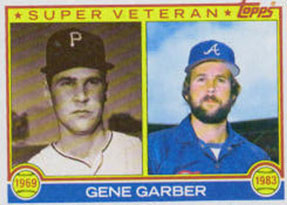
I don’t know. And I don’t think anyone will really know for sure for another ten or fifteen years. By that time I’ll be up in my tree house, yelling down to anyone who’ll listen that you shoulda got that 1983 Topps set back when it was $75—the last set with rookies of three bona fide Hall of Famers, two retiring legends and a Super Veterans card of Gene Garber. Now that’s a real investment.


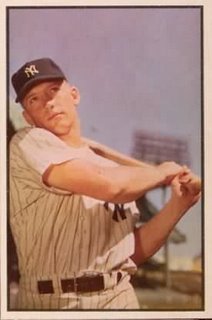
Photo credits: 1953 Bowman Color Mickey Mantle, 1983 Topps Gene Garber Super Veteran. More 1948 - 1979 Set Countdown to come next week. I promise.

January 04, 2007

Ask Ben a Question (Volume 3)

I don’t know what’s up…maybe it’s global warming, maybe it’s that the holidays just passed and a whole bunch of people discovered their parents were using their old cards as insulation, birdcage lining and however else parents re-purpose their grown children’s priceless/worthless belongings…but in the past few weeks I’ve got an unreal amount of email. I picked a few at random for Ask Ben a Question (Volume 3), so if I didn’t answer your question here, I will answer it soon by email.

Dear Ben,

I loved what you said about the 1982 Fleer set. My question to you though is that because the 1982 set is so bad, wouldn't it mean that it should somehow be higher? Sort of like it's so bad that it's the best? Not that it's the best, but do you ever get the feeling that the 1982 set isn't that bad only because it's so horrible? Maybe I'm just having fond memories of my first cards, but that set was horrendous and yet somehow I think it's a great set!

David


David, I know what you mean—if only punk rock post-modern hipsters had figured out a way to break into Fleer HQ in the summer of 1981 (22 years before the publication of The Hipster Handbook), got high and masqueraded as the Fleer executives in charge of the 1982 strategy. That’s the only way this set could’ve been more unintentionally funny. But the same could be said about many sets from this time period, like 1981 Donruss, 1979 Topps and 1982 Topps.


Hello baseball card guy.....I've now come to a point in my life to appreciate a guy like you... I have some Leaf Studio ball cards, one is a complete binder (Studio 91) and the others are boxed/shrink wrapped. All are from the early 90's. Of course I am wondering of their value at this time, if any(?)

It's been a while but seems like I paid about thirty bucks or so for each box. I worked for Leaf at the time, which originally was Heath Toffee, and now The Hershey Company. They were supposed to be an "employee special price offer." Any advice you can give me will be very much appreciated indeed!!

Toni


Toni, I need more information to help you completely, but here’s what I’ll guess from your email: if it was the early 1990s, then the Leaf boxes could be from one of four years, 1990, 1991, 1992 or 1993. All four years had two series, so that would be a total of eight different boxes to choose from. Leaf Studio premiered in 1991, and offered strong attractive sets in 1992 and 1993 as well. I’m guessing your shrinkwrapped box is not from the 1991 Studio set, as that’s the one you have in the binder. So here’s my final guess on the boxes, complete with somewhat nonsensical Holmes-esque explanation. Drum roll please…

The fact that there was an “employee special price offer” suggests that the boxes are 1991 Leaf boxes (the company trying to spread the love and capitalize on its from-outta-nowhere super success in 1990) and the fact that you say that you paid about $30 each sounds about right for this set. So I’m going with 1991 Leaf.

Unfortunately, both sets don’t really have high monetary value. The 1991 Studio set, though, while we’re on the subject of unintentional comedy, is rife with it. It really makes me happy that you have this set in a binder. I bought this set a few years back for about $12 (around its current value) and immediately put it in a binder. The charcoal gray canvas background, the feathered hair on the white guys and the flat tops on the black and latino guys—the photography is just really funny.
The 1991 Leaf boxes are really not worth anything (if that’s what they are). Leaf let the presses fly on this set (you would know if you worked there during this time), and really that’s the reason it’s so worthless. Well, that and the fact that there are no significant rookies. I’m straying from the question here, but you get the point.


I saw your blog when I was looking for information on my 1983 Topps set of baseball cards I found in my old closet at my parents house over the holidays. The set is complete and all cards are, in my opinion, mint. I have been out of the baseball card collecting since I was a kid (I'm 38 now) and am not familiar with prices. I also have an additional half a set from 1983.

Could you maybe give me a ballpark figure on what this might be worth? I enjoyed your blog and thanks in advance if you can help!

Matt, Indianapolis


Matt, 1983 Topps is a great set (I ranked it #8 in the 1980s). The current Tuff Stuff (you know, I used to subscribe to Tuff Stuff in the early Nineties when each issue, I swear this is true, was over 200 pages…what happened? How does this publication compete with Beckett? They’re owned by Krause, which owns a ton of other hobby publications, though they mostly go head to head with Beckett across the board. I don’t understand how the hobby is big enough for the both of them. I mean, don’t get me wrong, I’m happy there’s both of them. In fact, the only reason I buy Tuff Stuff is for the ads. It seems like Beckett has an aversion to small space ads with 5-point text in large blocks. Remember Sports Card Digest? Or Baseball Card Monthly? Those were great, with great ads. That’s really how I learned about the hobby…reading small space ads in now-defunct hobby magazines…anyways…)

The current Tuff Stuff lists 1983 Topps at $75.00 for the full set, though in my humble opinion this seems vastly undervalued. You have rookies of three bona fide Hall of Famers, probably one of only two or three sets where this will be true in the 1980s (1987 and maybe 1989 the other years, further down the road). And in today’s world of having your cards professionally graded (where you send your raw specimen to a faraway laboratory and they give the card a grade based on a number of specifications like ‘centering,’ ‘corners’ and whether or not the card’s got creases or gum stains), $75 is a steal.

As to your half a set, I can’t assign a value mostly because I don’t know which half you have. If you were like a lot of other kids, you collected the set, you ended up with a ton of doubles and then you didn’t know what to do with the doubles. You told yourself you’d trade them, but then you didn’t. So the value depends on the individual cards. If you’re interested in figuring out the individual values, I recommend purchasing a monthly or yearly price guide (like a Beckett or Tuff Stuff, as mentioned above).


Hey Ben,

I collected baseball cards when I was young and I really didn’t put too much stock into them. Now that I've grown up a little bit, I'm more interested in the sport as a whole and I think I'd really love to get into the hobby once again for it's informational value, the aesthetics, and everything else. I was hoping that you would be able to share with me the things I need to know, or should know, before I jump in.

I love the layouts and designs and I love stories and interesting statistics. Any links would be helpful or anything of that nature. Any advice that you have would be immensely helpful. Any tips on starting a collection, links, tricks, any unique things to watch for, great kits or folders, or holders and anything of that nature. Also keep in mind I'm a poor college student and a starving art student at that.

Jason, Pittsburgh


Jason, It’s invigorating, yes? To come across something old that speaks to you in a new way. I really want to give you a full and detailed answer, but it’s getting late and I’ve written a lot about the stuff you’re interested in. So I don’t really want to draw attention to myself (or draw you off the site), but I address a lot of what you’re asking about in the interview I did with Marty Weil’s Ephemera Blog, which can be read by following this link. And, no, my head is not really that big—it’s just an enormous headshot.


Ben-

Just found your site and I've been staying up hours past bedtime for the past two nights in a row just reading your stuff. It's great. I can't even explain to you how excited I was when you picked the 87 Topps set as the #1 set of the 80's. I know exactly what you're talking about [with] Frank DiPino's lips. What about John Henry Johnson's hair? Or Chris Codiroli? How about Ron Cey walking around like a pissed off penguin in his Cubs uniform?

Anyway, I read the Jay Baller post from this past October....how do I get a baseball card magnet?

Best,
Drew


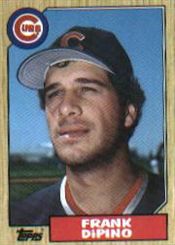
Drew, very astute of you on the Ron Cey citation. When people ask me how the hell I chose 1987 Topps over other, more respectable sets from the decade, it always comes back to Frank DiPino’s lips. It’s something that Topps capitalized on that the other card companies never understood: the art of the airbrush, or more specifically, the art of bad airbrushing. It’s a characteristic that instead of alienating in fact made the set more likable, because it was like we as collectors were in on the joke. You know?
As for baseball card magnets, yes, you too can have a baseball card magnet to call your very own! All you have to do is email me and I’ll send you the details.


Well, that’s enough questions for now. If you’ve sent me an email and I didn’t answer it here, I will answer it eventually. Just give me time. And if you have a question, have a look around the site or drop me a line. Again, time for photo credits. The Butera is from Twinscards.com, the Cedeno is from Astroland.net and the DiPino is from The Baseball Card Project. Visit their sites if you have a chance.

January 01, 2007

Countdown #46. 1960 Fleer Baseball Greats

If you're not familiar with this set, Fleer put out a flurry of small competitor sets to Topps in the late 1950s and early 1960s in baseball, football and basketball (actually, basketball is a special case, as sets from this time period are few and far between: Bowman put out a set in 1948, Topps put out a set for the 1957-58 season, and then Fleer came out with a set for 1961-62. So to call them competitors in this particular sport is not exactly accurate. But Topps and Fleer were competitors in baseball, so let's not discuss basketball, if that's okay).

Anyway, as mentioned in a previous post, Fleer put out a mega-hero-worship set in tribute to Ted Williams' retirement in 1959. Then, to capitalize on the idea of hero worship, they put out two sets of 'baseball greats' (including the newly retired Williams in both years) in 1960 and 1961. You might think that because the players depicted were not active when the sets were made, these two sets should be grouped under one ranking. I beg to differ. The two series differ greatly, and yes, the difference is enough that would warrant one set finding itself at the bottom of this countdown (1960) and the other somewhere in the middle (1961). There's just that much of a difference.

First, the 1960 design is lacking a, well, a design. If you examine it against the 1961 set, and even its contemporaries (most of which are no prize pigs themselves), it sucks. Four small colored triangles pushed to the edges like sticky photo album corners, framing mostly colorized black and white photos of players posed as if they were wax figures in a poorly lit tableau at a roadside attraction. The back is rather plain, but it does feature a nice clean typeface and a good amount of copy about each player.

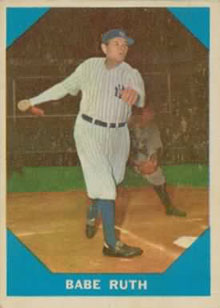
Second, when you examine the checklist, it’s really not bad. I mean, as far as a set of old timers goes. It’s got Ruth, Gehrig, Cobb, Mathewson, Speaker, Hubbell, the freshly minted old timer Ted Williams and the ridiculous but seemingly mandatory inclusion of league presidents Frick and Giles (it’s like they were included to remind everyone that old spooks never die). There’s also Jimmie Foxx (spelled ‘Jimmy’), Bob Feller, Honus Wagner, Walter Johnson and Hal Newhouser. But no Monte Irvin. And no Jackie Robinson. You’d of thought that armed with just an 80 card checklist and going against a powerhouse competitor in Topps, Fleer would’ve made more splashes than just the Williams signing in 1959.

The question of Robinson aside, when you think about it today it seems so innocent, if not uncanny: it was Fleer’s second stab at a real, honest-to-goodness baseball card set, coming on the heels of the ‘Williams in ‘59’ campaign (a relatively clean, sharp and to the point set (if over the top in its hero worship)). Flash ahead twenty years to 1982 and you’ve got the same deal playing out (if different circumstances): the company celebrates a court victory and a return to cards with a clean and simple inaugural set in 1981, then gets completely wasted over winter break and hits the sophomore slump with a crappy set in 1982. So, stepping back to 1960, should history be a little kinder to this set?

I don’t think so. It was a major coup to get Williams away from Topps. But after the hoopla died down from his own set, why did Fleer bury him at card #72? Everybody knew how good he was. Shouldn’t the set have confirmed it and placed him in the pantheon of greats in the first ten cards? Or put him as a tacky #1?

In today’s mindset, the idea of doing an old timers’ set isn’t that big of a deal. TCMA made their money doing them in the Seventies, there were plenty of one-offs in the 1990s (The Conlon Collection and The Ted Williams Card Company come to mind) and Topps has done plenty of them since launching the Archives brand in 1991. But it seems like Fleer was really going out on a limb to do this in 1960, and even though the set was kind of lousy, it set the table for a much better set in 1961.

Card scans from Dan Austin's Virtual Card Collection.

What do you mean, you're 'sold out'?


Sorry about that. It seems I've sold out of the 'Casey at the Bat' poster. But don't worry, I'll be getting more printed soon! Send me an email and I'll let you know when more are ready!