
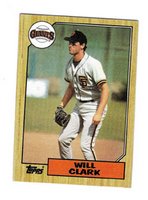
 If you had asked me a week ago which set would end up on top, I would not have known what to tell you. I had four potential Number One contenders (see sets two through four for the others), and if you thought ’87 Topps was a clear-cut choice for the top spot, I would've said that you’d be doing a disservice to the competition. So how did it end up here, and not at number 2, 3, 4? My approach to this set changed. When I talked with my friends or got an email from a reader or fellow collector, everything seemed to revolve around this set. Simply put, it was the set that launched a million collections, the set that made little kids care about baseball and little league, and it was the first set that I could afford that Beckett proclaimed would make me very, very rich as long as I held onto those $5 Will Clarks and Mike Greenwells.
  This set had more iconic cards than all of the 1986 sets combined, more than the other two 1987 sets combined, and more than all of the 1988 sets combined. I’ve already touched upon the tremendous, league-defining rookie class from 1986-7, but I think I’m not alone when I say that nobody cared if you got a Fleer Ruben Sierra or Bobby Bonilla, but it was everybody’s business when you pulled one of these guys out of your pack of Topps. Hell, even the commons were iconic. Guys like Jeff Reed on the Twins, Steve Crawford on the Red Sox, Luis Quinones on the Giants, Rob Wilfong on the Angels and the electric green of Donnie Hill on the A’s. And speaking of green, how about those flippin’ sweet green packs? When I was 8 I could spot packs of ’87 Topps at 300 yards, thanks to my superpowerful coke bottle glasses (that’s not a joke; those lenses were painfully thick) and my 1987 Topps radar set to ‘Green’ (I wanted to coin a new term just now for ‘baseball card radar’, but all I could think of was ‘cardadar’, and it sounded too much like a seldom-used Spanish verb).
Personally, this set was always my second personal favorite, after 1986 Topps. I’ve always felt 1986 had the better design, because when it came out I thought that the wood grain seemed a little cheap, like a wood-paneled basement (which always seemed cool until the day your Dad had it installed and you realized you couldn’t get a good return bounce from that pink rubber ball you used to bounce against the cement basement wall). But for the purpose of the countdown, personal favorites weren’t a deciding factor in terms of rank. 1986 Topps never had the strongest checklist. 1987 Topps had one of the strongest—if not the strongest—of the decade.
 You know, it’s funny. Look at the other sets that feature some kind of border designed to emulate items in the home: 1955 Bowman (the color TV set series), 1962 Topps (the original wood-grain) and 1968 Topps (I always thought the border was supposed to look like a TV set, or at least mimic the cloth screen cover of a hi-fi stereo speaker). All three are among the most memorable sets in their respective decades, so certainly the wood-grain of ’87 was no design fluke (1987 was also the 25th anniversary of the 1962 set).
 But the really cool thing about this set is that it’s the pinnacle of baseball cards. Not just the 1980s, but the whole damned history, from the 1880s to today. This set is the bona fide Everest summit of cards: every set leading up to this one was building towards it: the strongest checklist with the most rookies featured in the most different kind of ways, with great All-Stars (including a fat Keith Hernandez and Dave Parker with his warm-up jacket on), inspiring Record Breakers (that Clemens RB, card no. 1, no less made me want to break records, too (something we may yet accomplish at The Baseball Card Blog…)), semi-lame-semi-awesome Turn Back the
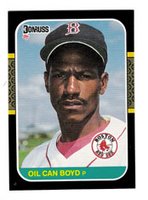
 Clocks, plus cards of Pete Incaviglia, a thoughtful John Kruk, Dave Righetti with his eyes closed again, those scripty Manager cards, Future Stars of guys you knew even at 8 years old would never pan out, Frank Tanana with his mouth closed, seventeen cards per pack!, getting Team Leaders cards of lousy teams with no real leaders (hello Seattle Mariners), Jorge Orta: living member of the Mexican Baseball Hall of Fame, Terry Kennedy bitching out an unseen Padre, Frank DiPino’s wicked bizarre lips, Todd Worrell flying a kite and guys with names like Cliff Speck and Rod Scurry, guys who look like Otis Nixon and Oil Can Boyd, and finally, Gary Redus’ card where he reveals his kids are named Lakesha, Manesha and Nakosha. Sure, every set had fun stuff like this, but this set had 792 cards like this. It is the set every other set should be measured against before it can take a place in the pantheon of baseball card sets. It even gives Mike Schmidt a hard-on. Tell me, what more do you want?
For a long time, this set was my get-rich-quick scheme. I thought I would ride that wave of McGwires and Clarks and Cansecos and Bonillas and Bondses and Greenwells and Larkins all the way to college, and that once I made it to college I would be able to afford a big house and a nice car and all the junk food I could ever hope to eat. And while I still have that fantasy from time to time, I know that it’s only just that: not a reality I so convincingly believed would happen. And you know, the more I think about it, what I really would’ve done if I had sold my cards would’ve been to buy more cards. So if you want to think about it differently, a little more menacingly, this set catapulted a million ‘occasional buyers’ to ‘hard-core regular buyers,’ kids who would normally save their allowance for a car you built out of a box would all of a sudden uncontrollably spend their life savings at CVS or some other drugstore, in the process cleaning out whatever packs the store had laying around. Ah, the good old days. That takes me back.

And while those days have subsided, this set still has meaning, though one that’s metamorphosed over the years. Like a great book or movie, I read it differently today. No longer am I concerned with what cards from this set are worth: it’s become my guilty pleasure, the set I can buy a box of for the same price as when it came out (only now I can afford it). It’s the set I have just about twenty times over but still want to put together another. The set that creeps into my thoughts nearly every day, though I oftentimes don’t consciously understand the connection between it and the world around me. I could go on and on for days about this, but a set this good doesn’t need a dissection. All it needs are three cheers and to be set off into the night, to be shared by all.
Look for answers to reader mail sometime over the weekend.


 This set is just about the greatest thing that could’ve happened to Topps. Especially after the fiasco of 1984. Think about it: you’re number one and you’ve been number one for nearly thirty years (since you bought out Bowman in 1955), and then all of a sudden, in a span of two or three years you lose your monopoly, you mail it in for a couple sets, and you lose your top spot because you fail to accurately read the competition. And then it turns out that the competition is fierce. Those other companies aren’t interested in paying homage to all the hard work you’ve done, they’re interested in showing you the door. So what do you do? Do you lie down and take it like you did in 1984 (despite one of your better designs of the decade)? Or do you roll up your sleeves and rethink your strategy, examine your roots and see just what worked before you decided to forgo a stellar product and half-ass it through the late 1970s?
 Record Breakers from weaker ones like In Action and Super Veterans. They took into account how rookie-driven Fleer and Donruss had become as those two companies tried to differentiate themselves as forward-thinking (rookies were the driving factor in the 1984 Update set and 1984 Donruss), compared with the Topps institution (I can’t think of a better synonym for ‘old’).
  So then, with sleeves up, Topps decided that if they could no longer beat the competition, they could at least join them in the rookie bonanza. And while they didn’t resurrect their rookie cup (that wouldn’t happen until 1987), they did unveil two awesome subsets: #1 Draft Picks and Team USA. #1 Draft Picks actually only featured three rookies out of the twelve guys in the subset, and most of the guys featured were kind of C- and D-List stars (like Jeff Burroughs and Floyd Bannister), but that’s not the point. And for the record, this subset also featured Harold Baines, Bob Horner, Shawon Dunston and Darryl Strawberry. The real point of this subset was that it gave Topps one more way the other companies hadn’t thought of in recognizing merit in players and denoting rookies (though it wouldn’t be until 1989 that Topps would make the previous year’s first-round draft picks a yearly set cornerstone (and even later for other companies)).
  Then you take a break, you get up to use the can and when you get back, Fleer and Donruss are sharing a joke. Then Donruss asks if you’d ‘Like to make it a little more interesting’. All night you’ve had this guy eating out of the palm of your hand, so you say sure, what the hell; you’ll mop the floor with him. Bets are placed and you draw a weak hand, though you’ve got a Mattingly in the hole. The pot gets bigger, everybody’s making bluffs and going higher and you think you got them right where you want them—you got a plan on how you’ll pull this one out. So Donruss calls and he’s got a Mattingly (just like you). Shit. And he’s got some other guys you didn’t know about, including McReynolds and Joe Carter and a pair of Fernandezezez. That’s when you reveal you’ve got a pair of aces: Gooden and Saberhagen, not to mention a Mattingly. You know you’ve got Donruss beat and now you think Fleer won’t stand a chance against this hand. Unfortunately for you, not only does Fleer have the Mattingly and the Gooden (your one-two punch), but they can out-do Donruss with a second one-two of Clemens and Puckett. Yikes. Well, now you’re down and out and might as well get out of the business with your legacy intact.
 When you look at who’s in a rookie class any given year, the players’ positions usually favor hitters or pitchers; rarely is it perfectly balanced. 1981-84, 1986 and 1987 were hitters’ years. 1985 and 1989 were pitchers’ years. I would say that only in 1988 was there a balance. Look at the lineup of rookie pitchers in 1985 Topps: Mark Langston, Jimmy Key, Dwight Gooden, Bret Saberhagen, Roger Clemens, Orel Hershiser. Between them they pitched 10 seasons with 20 or more wins, and combined they have 1,271 career wins (and counting). And they all had their regular-issue rookies in the same set. That’s amazing. Of course this set also features the rookie of Kirby Puckett, but, and not to discount Puckett in any way, this set was never about the rookie hitter. These pitchers had pop right out of the gate. Gooden was on fire, Clemens not far behind and the other four would be superstars in their own right in less than two or three years.
  It had strong All-Star lineups. I can’t stress the importance of this enough. Sure, they may have mirrored the previous season’s actual All-Star starting lineups, but that doesn’t lessen the anger of receiving a Damaso Garcia All-Star card (unless you’re a Blue Jay fan, I suppose. But then again, if you were a Blue Jay fan and you were buying Topps, there was probably something wrong; you should’ve been buying O-Pee-Chee, where they seeded Blue Jays and Expos more frequently).

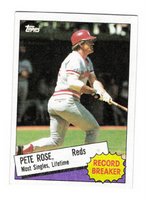 and awkwardly confronted them in the parking lot or lobby: ‘You can’t tell us what this hobby’s about! We’re Topps! We fucking made this hobby!’ This of course would be followed by a series of half-hearted punches and a mumbled string of ‘We made this hobby!...we made this hobby…’ Then Topps would collapse and blubber until Monsieur O-Pee-Chee would pick him up and help him back into the elevator or curbside handsome cab. Moral of the story: sets should never have more than seven Record Breakers.
  First thoughts: right on the front cover it has the tag line the Real one!, like they wanted to incite fear into the minds of little kids that those Fleer and Donruss cards weren’t ‘real’. This is some heavy shit.
 Jeff Leonard One of the greatest lines of Mel Brooks’ original film of The Producers happens when Zero Mostel’s Max Bialystock is standing by his office window and, upon seeing a white Rolls limo pull up across the street, yells ‘When you got it, flaunt it, baby! Flaunt it!’ He, of course, is on skid row (with his cardboard belt). So this is relevant because Jeff Leonard was an All Star in 1984 (and the game was played in San Francisco), so he got an All-Star card in the 1985 set. So what I’m trying to say is that Leonard should be pimped out in furs and diamonds on this card, his fingers blinding the camera with studded rings and he should be shown using an elephant tusk shoehorn to help him into his bedazzled loafers. Not much to ask for, if you ask me.
 How many sets can seriously lay claim to being a ‘standard bearer’? Seriously, can you name me five or six sets more monumental than this one? If we’re talking about the Eighties, I can only think of a couple, and none of them came out before this. This set was the biggest thing to happen to baseball cards since Topps lost the backroom poker game in 1981 to those two mangy upstarts, Fleer and Donruss.
 Can it be that it was ’86 Donruss Redux (or is it Pre-Dux?), and little kids psyched themselves out trying to go for the Mattingly and so never actually purchased any of the cards? Or do we have Mr. Mint to thank for a tightly controlled supply? So many theories…I guess because I don’t really know what the deal was, I’m going with ’86 Predux because I know that that’s what I would’ve done if I had been old enough to make pack-buying decisions in 1984: pined away, chickened out and bought Topps.
 • The strongest checklist of the early Eighties, and by far the strongest of the year. And here’s the kicker: it wasn’t hard for Donruss to accomplish this, thanks to Diamond Kings and the first year of the Rated Rookie as a subset with front-of-card denotation. Look at who they got their DK on: Yount, Boggs, Murray, Schmidt, Guerrero, Le Grand Orange, Bruce Sutter and a handful of others. The success rate is 50%, plus all those error cards (not one but two chances to get a Matt Young Diamond King! Yikes!). As for the Rated Rookies, Mike Fuentes was in some pretty good company: Carter, Darling, Sid ‘Ask Me Why I Put 50 On The Back Of My Uniform And I’ll Tell You An Awfully Long Story About Hawaii’ Fernandez, Tony Fernandez and Kevin McReynolds. That’s a pretty great Rated Rookie class to launch a set with. Then Donruss did a funny thing that they never really did up until that point: they put most of their star cards all in a clump at the beginning of the set. So it’s kind of a bummer when you get a good long stretch of crap cards (see #428 to #503 for example) right in the middle there, but it’s interesting too, because it’s like someone at Donruss saw just how strong the first fifty cards were and got the
 idea to ride the wave to 100 or so, then found out at card 70 that they didn’t have enough stars and sort of just stopped it mid-stream. Plus, it started another instance of Donruss being spectacularly lazy, just like they were in 1983 when they made minor changes to their 1982 design: if you look at the star clump at the beginning of the 1984 set and the one at the start of the 1985 set, it’s almost the same checklist.
 follow suit, ranging anywhere from $10 to $25 apiece. Naturally, the prize of the set—the Mattingly rookie—is still top dog, usually somewhere around $40, making it only one of a handful of cards worth nearly as much today as when it debuted. Does this surprise anybody besides me? The next set where this is true (and the cards have retained their value) is the Topps Finest set from 1993. Seriously, nearly every major rookie from the Eighties has gone through a meteoric rise and crash (and in some cases rise again), but there are very few cases of a value holding firm for over 20 years. I mean, that’s crazy. That’s like some set from the Sixties. It’s astonishing.
 little on the grey side (the tell-tale sign of bulimia, right? I heard La Russa was tough, but jeez…), but check out the reflection of the photographer in his aviation-style glasses…actually, ‘aviation-style’ is too cool a term for Kittle, so let’s call them ‘IBM-style’…the photo is just that crisp. In fact, I would go so far as to say that this set is a lesson in the art of the crisp headshot (even Dave Kingman looks like a real human being, though they couldn’t make Scotty Garrelts look like a young rookie on his rookie card). But the real masterpieces of this set are
 the action shots. And not even really the action in the action shots—the real hero is the ubiquitous out-of-focus background. Look at this one of a spry Robin Yount. It’s really not an action shot, as there’s not so much ‘action’ as there is ‘anticipation of action’, which, like unrequited sexual tension, is much more electric. Apparently nobody ever told Mr. Donruss baseball cards are the antithesis of sexy.
 Living Legends: Gaylord Perry & Rollie Fingers I think it’s fair to say that Perry and Fingers are two of my favorite old-school Seventies players. Did you know that Fingers only grew his mustache because Charlie O’Finley paid him $500 to do so? It’s true, though I can’t remember where I read it. Also, did you know that Gaylord Perry was created in a laboratory in an old Bavarian castle and terrorized the citizens of the surrounding small boondock town with his incessant nightly howls, but all was forgotten when he was enlisted—against his will by the town PTA—to play the neighboring boondock town in a much-anticipated and much-heated game of fast-pitch softball? The PTA wanted to see him lose badly, so they could pin him with the inevitable loss (they even brought pitchforks and torches) but to their surprise they found out that Frankenperry pitched lights-out. Actually, I don’t think that’s true, but I wish it was.
 For them to be brothers, their parents would have to be lunatics, like George Foreman, for naming their kids all the same.
 Sometimes, when I was a kid, I would try helping myself fall asleep by reciting my personal all-star team (by league). Then I would recite all-time teams, usually falling asleep when I came to figuring out who the back-up catcher should be (I naturally chose Fisk as my all-time catcher, though for the record this was before I knew who Josh Gibson was, and really, how can you deny Gibson? I think Fisk would be proud to be the back-up for him and if not proud, then willing to go twelve rounds with him in a bare-knuckle fisticuffs or Greco-roman wrestling for the starters’ job). Anyway, when it came time to reciting the National League team (and we’re talking 1987 through 1990) I always started with Will Clark at first and I always thought of two cards of him immediately: his puke purple 1988 Score card and his ’87 Fleer rookie (the gleaming white teeth, that pose that makes you want to smack him—he knows he’s hot shit).
  inside front and back covers? And remember how they were nearly always of some hot-shit rookie like Todd Zeile? I never really bought the magazine on a regular basis, but I distinctly remember one issue, from 1990 I think, with a beached Robin Yount on the cover and a ridiculous hero-worship charcoal drawing of Todd Zeile on the inside. Really, all that was missing from the artwork was a wolf on a mountaintop howling at the moon or a solemn Native American warrior and it would’ve been complete), it would be the Clark card that was worth $35, not the Bonds, because really nobody gave two shits about Bonds until later.
  bought a lot of the star cards at shows and occasionally I still find one or two of them in the ten-cent bins (I have a deep-seated love for ten-cent bins), but the biggest stars I ever got in packs were George Bell and Lou Whitaker. And yet I love this set. I loved it when it came out, and I love it today. I just fuckin’ love this set. But, like everything else about this countdown, my own personal love for it didn’t influence its standing. In other words, I have my reasons for putting it this far to the top. Here are a few of them.
 • The SuperStar Specials. I’ve written about the Dr. K/Super K card before, but it remains one of the best cards of this set (or any of the decade). It was the icing on the cake, because it came at just the right time to signal the end of an era. I’ve always felt that 1987 was the SuperStar Specials’ last hurrah. From 1983 to 1987, each year Fleer did something new, had interesting arrangements of stars. By 1988 it was old, predictable, and, inevitably, lame. Because how do you follow Dr. K/Super K? How do you top AL Pitcher’s Nightmare? You don’t. And really the best way they could’ve followed it up would have been to not even bother.
  • The insert sets. I’ve also written how if you wanted to point fingers at who energized the insert movement and decline of the hobby, you could either start with Topps in the Sixties or with Fleer and Donruss in the late 1980s. But I have to admit, the insert sets from this set are fucking sweet. Headliners was nice (kind of like the kind of stupid yearly 56-card set from Donruss called Highlights) but it was really the All Stars that kicked ass (especially thanks to the Star Wars text). I remember saving up to buy a pack when they came out and getting this Roger Clemens All Star. To this day I can’t stand Roger Clemens, but can’t get over my undying love for this card.
 I’ll admit it: that last sentence sounds kind of fucked up, especially to someone who’s not or never was a baseball card collector (or just a collector in general). But it’s at the root of what makes a set great. People can love a card or a set (with the same intensity usually reserved for a childhood pet), for any number of different reasons. They will agree that something just clicks when they see the set or card, and they feel better about themselves when they have it near them. Actually, maybe nobody will admit that last part (even if it is true).
 This is the most overrated set of the decade. I know all that crap I wrote the other day about ‘rating things fairly.’ Well, is it just me, or has anyone ever rated this set fairly? All I’ve ever seen or read is how great this set is. Am I in the minority who thinks this set embodies everything that’s wrong with baseball cards and card collecting?
  didn’t really get their acts together until 1984, so they weren’t really an immediate threat to Topps, and Sportflics was more of a novelty than anything else (I’d be really surprised to read that Sportflics cut into any major part of the Topps profit for the handful of years that they put out sets). No, the real threat surfaced the very first moment a dealer opened a pack of Upper Deck for the first time and the first time he or she compared the Upper Deck product against any other set that year. At least Score got a color headshot on the back; when it came to the combination of color and card backs, Topps, Fleer and Donruss were kind of pathetic. In hindsight, the Upper Deck design wasn’t all that great, but it was a hell of a lot more attractive than any other set put out that year. A chalked foul line, a clean white border, crisp photography, triple-exposed photos, plus a full-color back, with a full-color photo.
  This is a lot to do in your first year. And I think this is really what set Upper Deck apart from the other companies: they got it right the first time. They were so professional--right away--that there was no way you could root for them to succeed (or afford any product they put out). For all the shit we give Fleer and Donruss, we do it out of love, and not because we particularly love their sets, but because we love that they were brave enough (or dumb enough) to release sets that would suggest that someone with decision-making power was slightly incompetent. Or if not incompetent, then that the companies recognized that they would never be able to get everything perfect, so their sets were works-in-progress (you can’t tell me with a straight face that 1988 Donruss was their final choice on design).
 And yes, I think it’s fair to say that all of this started with this set. Here are some other ways this set got it right from the start:
 •A Tale in Two Series Before Upper Deck brought out its High Numbers Series (with cards you’d beg for, including that ridiculous card of Nolan Ryan with the goddamn football and rookies of Todd Zeile and Jerome Walton), no set had had two series of cards since the Seventies. I’m not counting the Topps Traded sets where they numbered the cards starting at #727, to simulate an extra series. This was another huge deal, because it was like the rookie/traded/update sets released around the same time, only you could buy it in packs, which is, although less cost-effective than buying a completed set, admittedly much more fun. Now it seems like every basic major-issue set has at least two series. I think after Upper Deck did this, the first of the other sets to do two series was 1991 Donruss, which was unfortunate, because both series were god-awful (I’ve said it: Donruss should’ve just quit after the 1987 set while they were ahead).

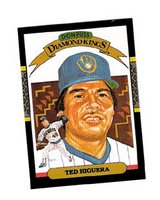 It really is incredible, but all three major issue sets from 1987 are remarkable, top 10 sets. Why is that? Seriously, there’s usually one lousy set per year, no matter how strong the potential ingredients (see 1985 Fleer or 1989 Score). But it’s like the planets aligned and somehow Donruss, Fleer and Topps each managed to turn out one of their better-designed, stronger-checklisted sets of the decade. It wasn’t exactly like the companies peaked in 1987 (each had a set as strong or stronger before ’87)—it was more like the swan song of the decade. By the time Upper Deck bowed in 1989, the hobby was their oyster.
 three-dimensional striping for a single thick stripe of gray baseballs, which could’ve been either an homage to the 1982 design, or just a design anomaly seeing as how it actually featured a symbol of the game; either way it was the third-most literal design of any Donruss set of the decade, behind the one-two punch of 1982 and 1983, the ‘Hey-I’m-a-fuckin’-baseball-card-here’s-


 Clemente and Snider and Ruth and Gehrig and Yaz? And you can’t figure her out cause you keep getting the same goddamn pieces every time you open a lousy pack of cards? Wait a minute—if your name was Mr. Donruss and you somehow got into McGill University and met Ms. Leaf and you two got married, would that make you Mr. & Mrs. Donruss-Leaf? And would your kids have dual citizenship? And would Mrs. Donruss-Leaf wake up every morning and look in the mirror and wish to God that she hadn’t danced with you at McGill’s annual Under-the-Sea Dance, but with Mr. Topps instead? And if one of your kids somehow met a down-and-out Mr. Score on the street and he convinced the kid to take a trip back in time to when you and Mr. Donruss first met, would Mr. Donruss disappear right in front of your eyes and Mr. Topps take his place? Or would Mr. Donruss be replaced by your own kid, so that you somehow got married and had kids with one of your own kids? Because that’s pretty fuckin’ sick, Mrs. Donruss-Leaf, if I may say so myself.)
