Well, I didn't exactly sell out, but my existence has been confirmed and validated: read my interview with Marty Weil, proprietor of the Ephemera Blog here.
Countdown to continue later this week.

December 27, 2006


December 22, 2006
Card Critic's Countdown: 1948 to 1979
It's time to start this countdown. And I know, I've been putting this off for a while. But I haven't exactly been sitting around doing nothing (though I have been doing plenty of that too). I've been doing a lot of thinking, thinking that needs to be done now before I'm knee-deep into this thing and I find myself having to defend a set that isn't generally regarded as a 'classic'. Here are a few things I've come up with and some ground rules for the listing and reasoning in general.
This is a post-war countdown. And the problem with comparing post-war sets is that there are three distinct eras: pre-Mantle, Mantle, and post-Mantle. When it comes to ranking the merits of a set, the most gut of gut reactions is to side with the Mantle and rank it higher than those sets without. To quote William Shatner in Airplane! II, he's the big man, the top dog, the big cheese--how can you even fairly assess and rank the 'star power' of a set like 1973 Topps against one like 1962 Topps? It's not fair. That is, unless we determine a value system to the players in the set, assess them by how they did the year before, the level of their regional influence, and whether or not they were national star quality. Luckily, we don't have to do all that extra work. We're talking about classic Topps here (mostly), and classic Topps sets have already done this for us with their numbering system.
For example, from 1948 to 1953 there wasn't a clear-cut Mantle equivalent. From 1954 to 1957 Topps' Mantle was Ted Williams, and from 1959 to 1969, Mantle was Mantle. 1970 and beyond it gets tricky again, with no one stand out, though in 1977, Topps christened George Brett it's Mantle for the year. Anyway, I'd rather not get too bogged down in this right now. Just remember that I have no qualms about ranking a set without a Mantle higher than one with if it's a stronger set.
In other words, the sets in this countdown (like the sets ranked in the 1980s countdown) are not seeded by personal likes or dislikes (with the exception of the design element). Also, and this is important, the sets listed here are not ranked by value. Card value will rarely be mentioned, and does not have any bearing on the ranking of a set. Case in point: I have not ranked the 1966 Topps set #38 (out of 47) because there are very few high-value cards (high value = over $400, Mantle era pricing). I have it ranked that low because the design is really very average, the rookie crop is less than stellar, and the rookie that the set is generally known for (the Palmer) was double-printed, so everybody and their brother had a copy. Also, when you review the checklist, the set borders on mundane. It's incredible that Topps didn't hit a home run with this set, as it was bookended by the pennant-raising design of 1965 and 1967, a set featuring the largest photo space on a card since 1957 Topps and 1953 Bowman.
I have the sets ranked on the strength of their checklist, the strength of design, the rookie crop, the subsets (generally falling under 'checklist'), and the historical importance of the set or an element essential to the hobby that the set was first to introduce (like the all-star card subset of 1958 Topps or the 4-headed rookie of 1963 Topps).
I've also been spending the last few days trying to poke holes in my top 10, and the only thing I can come with is that the years represented are not diverse enough. For all my thoughts on fair and balanced ranking, could it be that the best sets really were the ones that came first? I don't know. But I do know one thing: the best set was not Topps' 1974 Traded set. Cross that one off the list right now... Jeez, even with Juan Marichal and Ron 'This Old Cub' Santo, it's just depressing. Thankfully, it's only 40 cards.
Right. On to the countdown.
47. 1974 Topps Traded
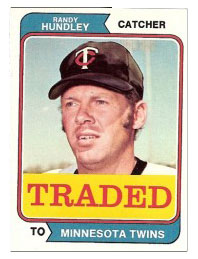 I'm not trying to say that this is the worst set--in the grand scheme of cards this set (series? subset of regular set? its own set?) is rather important. But 'grand scheme' symbolic strength and actual, measurable set strength are two very different things. This set is ugly. And ugliness matters. So does checklist strength. Despite a checklist of 40 cards (relatively big for a late-season subset), there are only seven big names: Marichal, Santo, Felipe Alou, Lou Piniella, Mike Marshall, Reggie Cleveland and Willie Davis. Then there's Nelson Briles, Tommie Agee, Steve Stone and Lindy McDaniel (of 'Lindy Shows Larry' fame). After that you're scraping the commons barrel (actually, you're scraping the commons barrel nowadays from Mike Marshall on, but for the sake of argument, let's forget that all but two or three of these cards can be had for less than a dime). Anyway, that line-up may have looked impressive as a launching checklist for Topps in 1974, but it translates to a success rate of just 28% for the set (success rate = # of good cards / total # of cards in set). Even when we factor in the coolness factor of getting a Traded card in your pack, well, it's still not that great. I can think of only one reason why Topps expanded the neat little Traded subset from 1972 into its own series: to sell more cards at the end of the summer, a time when kids have moved on to football cards, hockey cards, sniffing glue or whatever it is little kids do at the end of summers.
And yet, despite its weak star power, mine's not such a vast conspiracy that I think Topps had a deciding vote in who'd be traded. If anything, I think this set came about because of Marichal--and because it was time for an innovation, no matter how small. In retrospect this series can almost be viewed as a pre-emptive strike to SSPC and any other competitor Topps thought it might have had, like a one-sided, baseball card version of the Cold War arms race,a big old fuck you, let's see you balance a full year of cards and a traded series, you faceless bastards! kind of thing. Who knew that it would spawn a whole generation of Traded sets? Sure, you could make the argument that 1981 Traded was really the first, modern Traded set in the most traditional sense: 132 card sets that could only be purchased in those little color-coded boxes, but 1974 was the first time that Topps found a way to make commons desirable and to sell cards probably all the way through to November.
By the way, if you haven't noticed, my images have been getting worse lately (my computer died and took my scanner with it). That's why today's post features a nice scan of Randy Hundley from Blake Meyer's TwinsCards.com , and that great 'Card That Never Was' of Satchel Paige is from Dan Austin's Virtual Card Collection, which can be found here.
More Set Countdown Coming Soon After Christmas
This is a post-war countdown. And the problem with comparing post-war sets is that there are three distinct eras: pre-Mantle, Mantle, and post-Mantle. When it comes to ranking the merits of a set, the most gut of gut reactions is to side with the Mantle and rank it higher than those sets without. To quote William Shatner in Airplane! II, he's the big man, the top dog, the big cheese--how can you even fairly assess and rank the 'star power' of a set like 1973 Topps against one like 1962 Topps? It's not fair. That is, unless we determine a value system to the players in the set, assess them by how they did the year before, the level of their regional influence, and whether or not they were national star quality. Luckily, we don't have to do all that extra work. We're talking about classic Topps here (mostly), and classic Topps sets have already done this for us with their numbering system.
For example, from 1948 to 1953 there wasn't a clear-cut Mantle equivalent. From 1954 to 1957 Topps' Mantle was Ted Williams, and from 1959 to 1969, Mantle was Mantle. 1970 and beyond it gets tricky again, with no one stand out, though in 1977, Topps christened George Brett it's Mantle for the year. Anyway, I'd rather not get too bogged down in this right now. Just remember that I have no qualms about ranking a set without a Mantle higher than one with if it's a stronger set.

In other words, the sets in this countdown (like the sets ranked in the 1980s countdown) are not seeded by personal likes or dislikes (with the exception of the design element). Also, and this is important, the sets listed here are not ranked by value. Card value will rarely be mentioned, and does not have any bearing on the ranking of a set. Case in point: I have not ranked the 1966 Topps set #38 (out of 47) because there are very few high-value cards (high value = over $400, Mantle era pricing). I have it ranked that low because the design is really very average, the rookie crop is less than stellar, and the rookie that the set is generally known for (the Palmer) was double-printed, so everybody and their brother had a copy. Also, when you review the checklist, the set borders on mundane. It's incredible that Topps didn't hit a home run with this set, as it was bookended by the pennant-raising design of 1965 and 1967, a set featuring the largest photo space on a card since 1957 Topps and 1953 Bowman.
I have the sets ranked on the strength of their checklist, the strength of design, the rookie crop, the subsets (generally falling under 'checklist'), and the historical importance of the set or an element essential to the hobby that the set was first to introduce (like the all-star card subset of 1958 Topps or the 4-headed rookie of 1963 Topps).
I've also been spending the last few days trying to poke holes in my top 10, and the only thing I can come with is that the years represented are not diverse enough. For all my thoughts on fair and balanced ranking, could it be that the best sets really were the ones that came first? I don't know. But I do know one thing: the best set was not Topps' 1974 Traded set. Cross that one off the list right now... Jeez, even with Juan Marichal and Ron 'This Old Cub' Santo, it's just depressing. Thankfully, it's only 40 cards.
Right. On to the countdown.
47. 1974 Topps Traded
 I'm not trying to say that this is the worst set--in the grand scheme of cards this set (series? subset of regular set? its own set?) is rather important. But 'grand scheme' symbolic strength and actual, measurable set strength are two very different things. This set is ugly. And ugliness matters. So does checklist strength. Despite a checklist of 40 cards (relatively big for a late-season subset), there are only seven big names: Marichal, Santo, Felipe Alou, Lou Piniella, Mike Marshall, Reggie Cleveland and Willie Davis. Then there's Nelson Briles, Tommie Agee, Steve Stone and Lindy McDaniel (of 'Lindy Shows Larry' fame). After that you're scraping the commons barrel (actually, you're scraping the commons barrel nowadays from Mike Marshall on, but for the sake of argument, let's forget that all but two or three of these cards can be had for less than a dime). Anyway, that line-up may have looked impressive as a launching checklist for Topps in 1974, but it translates to a success rate of just 28% for the set (success rate = # of good cards / total # of cards in set). Even when we factor in the coolness factor of getting a Traded card in your pack, well, it's still not that great. I can think of only one reason why Topps expanded the neat little Traded subset from 1972 into its own series: to sell more cards at the end of the summer, a time when kids have moved on to football cards, hockey cards, sniffing glue or whatever it is little kids do at the end of summers.
 And yet, despite its weak star power, mine's not such a vast conspiracy that I think Topps had a deciding vote in who'd be traded. If anything, I think this set came about because of Marichal--and because it was time for an innovation, no matter how small. In retrospect this series can almost be viewed as a pre-emptive strike to SSPC and any other competitor Topps thought it might have had, like a one-sided, baseball card version of the Cold War arms race,a big old fuck you, let's see you balance a full year of cards and a traded series, you faceless bastards! kind of thing. Who knew that it would spawn a whole generation of Traded sets? Sure, you could make the argument that 1981 Traded was really the first, modern Traded set in the most traditional sense: 132 card sets that could only be purchased in those little color-coded boxes, but 1974 was the first time that Topps found a way to make commons desirable and to sell cards probably all the way through to November.
By the way, if you haven't noticed, my images have been getting worse lately (my computer died and took my scanner with it). That's why today's post features a nice scan of Randy Hundley from Blake Meyer's TwinsCards.com , and that great 'Card That Never Was' of Satchel Paige is from Dan Austin's Virtual Card Collection, which can be found here.
More Set Countdown Coming Soon After Christmas
December 14, 2006
Some Thoughts on the Seventies
 So I decided a few days ago that the next set I would collect would be 1975 Topps baseball. Here's why: I was putting together the Holiday Shopping Guide and was thinking of featuring the Carlton Fisk from that year...you know, the great one where it looks like he's either out in front of the team hotel or in the courtyard of a Le Corbusier housing project in Florida. Either way, he looks especially pissed off, like as soon as the photographer's done he's going to drop the bat and stop El Tiante from eating his lunch or perform some mind-and-afternoon-blowing Daniel Webster-esque filibuster on the proper way to chalk foul lines for the benefit of the spring training grounds crew.
 That card got me thinking: this set, like many of its 1970s counterparts, deserve more attention. And not just more attention from me, but more attention in general. Take 1975. The cards give off the same warm mid-1970s feeling that ViewMaster discs do. The rounded edges. The trippy two color scheme. The 3-D team name lettering. Even the faux signature--all of it adds up to a snapshot-from-a-foreign-land feel. It's weird and it's great. And it's not even my favorite set of the decade. I know, that's probably a blasphemous thing to say, but in terms of pure design I'd take 1971 or even 1976 over 1975 and in terms of checklist I don't think the decade gets any stronger than 1978 (don't try to argue that '78 shouldn't be eligible for a 'Strong Checklist' contest just because it's at the end of the decade, because that argument's garbage. 1987 had a stronger checklist than both 1988 and 1989, and 1985 had possibly the strongest checklist of the decade (and look at 1957 Topps for the strongest checklist of the Fifties, in comparison to 1959 and 1965 to even just a year later, 1966). This argument depends on a number of variables, the most important being strong rookies (a strong checklist needs to boast a handful) plus super stars on the cusp of or entering their prime years, complemented by a wide mix of veterans still in their prime and a few guys playing out their last contract before tottering off to the Hall)).
My last attempt at a Seventies set was 1979. I lucked out because I found an Ozzie Smith rookie on the bottom of a box of books that a family friend had given me, and I got doubles of the Molitor in a box of commons in a trade, so I had a good starting point, plus commons of that set are wicked cheap, so when I was putting it together you could get something like fifteen for a buck. Then I realized that I still needed the Ryan and I said the hell with it and quit. I think I'm still about thirty cards shy of the full set, and I'm sure that it'll take me about twenty years to put together the 1975 set, and once I realize that I can't afford the Brett and the Yount, then those twenty years may stretch into forty. Anyway, all this talk about the Seventies and where things stand has got me thinking I should do a Seventies countdown.
Problems With Doing a Seventies Countdown
If you went to a party in the Seventies, Topps would've been the guy who showed up in the stretch white limo, chest mane let loose, peace medallion in full bling, completely tweaked out on coke. In essence, Topps was living large with little to no competition. There were the SSPC sets in 1975 and 1976, but I'd be very surprised to learn that Topps was scared by SSPC. And before SSPC, the last time Topps had any competitor was 1963, when Fleer put out a little 83 card set of superstars (and it wasn't until late 1980 that Fleer came back with Donruss in tow saying gimme gimme, forcing Topps to share).
The reason I bring this up is because while it's interesting to see how the competitors played off each other with their 1980s offerings, there's very little of that in the Seventies. Topps came up with an idea for a design, shoved it down the throat of the collector and then did the same the next year, et cetera. Sure, they had a traded set here and there, but things were pretty much smooth sailing for just about the whole decade. So that makes a 1970s Set Countdown seem kind of like a cop out, coming in just over ten sets total.
So what if we open it up a little bit? If you think about it, the amount of individual cards produced in the 1980s alone outnumbered those produced between 1950 and 1979. Check out these numbers:
# of Individual Cards Produced (by decade)
1950s: 4,733
1960s: 7,431
1970s: 7,055
1980s: 31,217
Sure, Eighties sets were bigger, there were more of them and there were more manufacturers. But add up all the cards from the previous thirty years and the Eighties still outnumber them by 11,998. It's incredible. You hear commentators always talking about explosions in the hobby. Well, there it is. There's your fuckin' explosion.
OK, so if we can realistically parcel the history of the hobby into decades and further still into Eighties and pre-Eighties, then would it be fair to judge the sets from 1948 to 1979 against each other? In other words, is someone going to have a hissy fit if I rank Topps' 1976 set ahead of its set from 1962? And what about smaller sets like the three off-shoots from 1954 Topps (Dan Dee, Red Heart and Wilson Franks)?>

I don't think it's entirely fair to include off-shoots, though that would mean also leaving off the Jell-o and Post sets, and some of those were large enough--larger than many of the Fleer sets from the Sixties--to be considered full series of a Topps set. And what about the Fleer Ted Williams set from 1959? Talk about hero-worship...you know, it's almost fitting that Upper Deck picked up the Fleer name, seeing as UD and Fleer built their respective trading card businesses on the idea of hero-worship (much more than Topps until fairly recently).
 Fleer's Ted Williams set is a hallmark set, the first set from a company that would go on to be known more for its error cards than for its legitimate ones, but also for putting out a plethora of insert sets across the four sports in the early Nineties of just one player. Roger Clemens comes to mind, and Tony Gwynn, and Scottie Pippen of the Chicago Bulls and Jeremy Roenick of the Blackhawks; ten card insert sets (much like the artistic 'Baseball Heroes' insert series of Upper Deck) featuring just one player--pretty goddamn boring, but an idea good enough to bank your business on over and over and over and over again--in Fleer's case, for nearly fifty years...
 While you've been reading that last tangent, I've been thinking about this whole off-shoot set thing. Here's my ruling: no off-shoot sets, no third-party sets. So that means no Post sets, no Jell-o, no 3-D Kellogg's sets from the Seventies, no Salada Tea coins from 1964, no Wilson Franks, Dan Dee, Red Heart, or even that fold-out paper version of 1954 Topps (found in an early issue of Sports Illustrated). I'm still on the fence about the Fleer Ted Williams set, but it probably won't make it that high in the countdown anyway. But it also means yes to SSPC, yes to Leaf, yes to Bowman, yes to the Baseball Greats sets from Fleer, and of course, yes to partying like it's 1952 with our good friend The Topps Chewing Gum Company.

So I'll be damned, we're staring down the barrel of another set countdown. Well, what better way to celebrate one year of The Baseball Card Blog than with a list for all the post-war marbles? I think after I'm done with this list, some kind of master Top 20 is definitely in order, because you can't name your top 10 post-war card sets and not include at least three of the sets from the modern hobby's second-most pivotal decade (the 1950s being the first).
Coming Soon: Set Countdown 1948 - 1979
December 04, 2006
The Baseball Card Blog’s Holiday Gift Guide
If you’re like me, you don’t know what the hell anybody wants for the holidays. I always try to get people stuff they might like, even though it’s all stuff that I wish I could get. That’s why this year I’ve decided to give more than one person on my list a baseball or baseball card-related item, because I enjoy shopping for that kind of thing, I know how to spot a good deal, and that’s what I would want to receive as a gift. Plus, baseball and baseball card-related gifts are great for friends and relatives of any generation, and they work as both a straight and ironic gift.
I think more people should give baseball cards as gifts. They’re small, they don’t cost very much in the grand scheme of things (unless you’re giving someone a Ed Walsh T-206 or something), and for those who may not appreciate them on a sport or obsessive collector level—or even on a nostalgic childhood level—can appreciate them for what they are: little pieces of modern art.
Here are 10 ideas for your holiday shopping for collectors or not. I’ve used $20 as the max spending limit per item. (with links where appropriate)
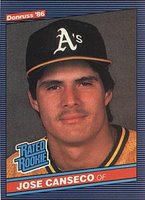 Jose Canseco’s 1986 Donruss Rated Rookie One of our readers has dubbed this ‘The Mona Lisa of 1980s Baseball Cards’ and they couldn’t be more spot on. Let’s see…if you shell out around $8 for the card (if even that), you still have $12 to spring for a tiny gold picture frame. Then lop off the stand on the back of the frame, put a hook in the wall, hang it up in your living room and aim a track light at it, set up a velvet rope two feet in front of it and put a piece of Tupperware over it. Nice. Just like the Louvre, only better.
Old Unopened Wax Packs & Boxes An old wax box from the 1980s is a great gift. Not only should it not cost you very much over the $20 spending limit, but it’ll give you a pretty good snapshot of baseball in that time period: the mullets, the mustaches, the bad skin, the bad teams, the bad uniforms, the bad names. A good time will be had by all—just don’t eat the gum. In fact, handle the gum with rubber gloves if possible.
A Stack of Worthless Mid-Nineties Fleer Inserts (Any Sport) It’s incredible, but it seems like Fleer had a corner on the foil-stamping business back in the mid-Nineties, didn’t it? There was a point there where they inserted one insert a pack, and sometimes there were whole packs of nothing but inserts (hot packs). It’s a wonder they bothered putting out a base set at all. Anyway, now you can find just about any hobby shop with heaps of this garbage, ready to sell it way under book value (hopefully). The cards are fun, but they’re worthless. They make nice bookmarks.
A Box of 200 Semi-Rigid Card Holders I’m pretty sure you’ll strike out with this gift if you’re not giving it to a collector. But if you know a collector, they’ll thank you for it. If there’s such a thing as the semi-rigid card holder bandwagon, well, I jumped on it a few months ago and I’m trying to get as many new converts from top loaders as possible. I can’t say enough good things about these little sheets of semi-rigid clear plastic. They’ve made it possible to house valuable cards in a shoebox without worrying about jostling and bent corners in the night. If you have no idea what a semi-rigid card holder is, visit this online retailer. Many places sell them, including probably your local hobby shop.
Little Sets There was a time when I looked down on glossy cards as cheap and not to be trusted. Then the major companies started giving their cards a thin sheen and I slowly forgot about my problems with gloss. But then the other day I found a big box of cards and after going through a few stacks I came across an old Kay-Bee Toys ‘Superstars of Baseball’ card and a wave of memory hit me: the thick front gloss to mask cheap, papery white cardboard backing. But then, after momentarily contemplating throwing it away, I pulled it aside and got as many of them together as I could.
Kay Bee Toys, Rite Aid, the various Fleer offshoots, Toys R Us—I had all these little sets. I even had most of the Topps Kmart set (you know, the one that looks like a Turn Back the Clock card on every card). You’d buy these sets complete in deck form, in their own box with a checklist on the back. Some would be cheaper than others, but none of them cost very much. I think you could find most of them today on eBay or in hobby shops for under $10.
High Series Commons This would work as a gift for collectors only. And really for those collectors trying to complete a vintage Topps set. Giving someone a common may not sound like a great present, but a high series common—especially to a set builder—is another matter entirely. If the collector isn’t looking to fill the set with near mint specimen, you can find a lot of lower grade cards under the $20 price limit. And if you know of a card show or convention coming to your town, that’s a perfect place to look.
A Trip To See The Best Kept Well-Known Secret in New York City Of course I’m talking about the Honus Wagner T-206 on permanent display at New York’s Metropolitan Museum of Art. While the Museum’s suggested donation entry fee is high, it is ‘suggested’, so you can pay whatever you want. I went a few weeks ago and spent about ten minutes just standing in front of the Wagner. It’s part of the incomparable Jefferson Burdick Collection, the collection of cards that all others must be judged against. Whenever I see Alan Rosen’s full-page ads in Beckett and Krause Publications, I can’t help but think that he’s suffering from some sort of Burdick-envy. Anyway, the Wagner is right there on display, sort of tucked away on the mezzanine of the American Wing. So if you happen to be in New York for the holidays, or you live here, like me, you should visit.
The 2007 SCD Standard Catalog Because of my own dumb rules for this list, this great book can’t be here. I think it costs somewhere around $40. Oh well. If you have kids, buy for them to share. If you want to teach yourself about the history of baseball cards, or admire the sheer breadth of what’s available to collect, I recommend purchasing the SCD Standard Catalog. I had an old copy from 1990 that I tore through in my youth, and I just purchased the 2006, so I don’t think I’ll be buying the 2007 anytime soon. But you should, especially if you know someone who has a penchant for reading the dictionary, an encyclopedia or the phone book. Available from Krause Publications.
Minor League Team Sets If you live in a town with a minor league baseball team, buy team sets for anyone and everyone you know. Minor league team sets are awesome. They aren’t very expensive, they’re usually sponsored by a regional product or business that nobody outside of your town or state has heard of, and the players on the team usually provide more entertaining characters than any major league team. I mean, if you live in Pawtucket, Rhode Island, and you’re a friend of mine, I would want you to give me a Pawtucket Red Sox team set with a card of Izzy Alcantara (you know, the wacko who karate-kicked the opposing catcher in the chest).
With minor league team sets there’s the possibility of up-and-comers, down-on-their-heels old timers, minor league lifers and a card of the mascot. Jeez, I could go on forever, and I haven’t even got to the very good possibility of the washed-up ex-major leaguer who’s now the manager.
Individual Star Cards If you’re a friend of mine, you’ll probably get a star card this year as a present (hello, Vince Coleman rookie card). Some cards are perennial favorites, like any of the all-star cards from 1958, 1960 and 1961, or older team rookies from the Sixties. If you’re looking for just one card (and you’re relatively new to baseball cards), you may want to stick to the big names. But if you don’t have big-name cash and want to dig a little deeper into the hobby, here are a few years when Topps produced great-looking star cards: 1959, 1965, 1967, 1971, 1975-78, 1981, 1985.
And if you really want to cheat, Topps Archives is a way to get the big names for under $20. You won’t be buying the real thing, but Archives has been a great addition to the hobby, and an especially good way to get younger collectors into older sets.
I think more people should give baseball cards as gifts. They’re small, they don’t cost very much in the grand scheme of things (unless you’re giving someone a Ed Walsh T-206 or something), and for those who may not appreciate them on a sport or obsessive collector level—or even on a nostalgic childhood level—can appreciate them for what they are: little pieces of modern art.
Here are 10 ideas for your holiday shopping for collectors or not. I’ve used $20 as the max spending limit per item. (with links where appropriate)
 Jose Canseco’s 1986 Donruss Rated Rookie One of our readers has dubbed this ‘The Mona Lisa of 1980s Baseball Cards’ and they couldn’t be more spot on. Let’s see…if you shell out around $8 for the card (if even that), you still have $12 to spring for a tiny gold picture frame. Then lop off the stand on the back of the frame, put a hook in the wall, hang it up in your living room and aim a track light at it, set up a velvet rope two feet in front of it and put a piece of Tupperware over it. Nice. Just like the Louvre, only better.
Old Unopened Wax Packs & Boxes An old wax box from the 1980s is a great gift. Not only should it not cost you very much over the $20 spending limit, but it’ll give you a pretty good snapshot of baseball in that time period: the mullets, the mustaches, the bad skin, the bad teams, the bad uniforms, the bad names. A good time will be had by all—just don’t eat the gum. In fact, handle the gum with rubber gloves if possible.
A Stack of Worthless Mid-Nineties Fleer Inserts (Any Sport) It’s incredible, but it seems like Fleer had a corner on the foil-stamping business back in the mid-Nineties, didn’t it? There was a point there where they inserted one insert a pack, and sometimes there were whole packs of nothing but inserts (hot packs). It’s a wonder they bothered putting out a base set at all. Anyway, now you can find just about any hobby shop with heaps of this garbage, ready to sell it way under book value (hopefully). The cards are fun, but they’re worthless. They make nice bookmarks.
A Box of 200 Semi-Rigid Card Holders I’m pretty sure you’ll strike out with this gift if you’re not giving it to a collector. But if you know a collector, they’ll thank you for it. If there’s such a thing as the semi-rigid card holder bandwagon, well, I jumped on it a few months ago and I’m trying to get as many new converts from top loaders as possible. I can’t say enough good things about these little sheets of semi-rigid clear plastic. They’ve made it possible to house valuable cards in a shoebox without worrying about jostling and bent corners in the night. If you have no idea what a semi-rigid card holder is, visit this online retailer. Many places sell them, including probably your local hobby shop.
Little Sets There was a time when I looked down on glossy cards as cheap and not to be trusted. Then the major companies started giving their cards a thin sheen and I slowly forgot about my problems with gloss. But then the other day I found a big box of cards and after going through a few stacks I came across an old Kay-Bee Toys ‘Superstars of Baseball’ card and a wave of memory hit me: the thick front gloss to mask cheap, papery white cardboard backing. But then, after momentarily contemplating throwing it away, I pulled it aside and got as many of them together as I could.
Kay Bee Toys, Rite Aid, the various Fleer offshoots, Toys R Us—I had all these little sets. I even had most of the Topps Kmart set (you know, the one that looks like a Turn Back the Clock card on every card). You’d buy these sets complete in deck form, in their own box with a checklist on the back. Some would be cheaper than others, but none of them cost very much. I think you could find most of them today on eBay or in hobby shops for under $10.
High Series Commons This would work as a gift for collectors only. And really for those collectors trying to complete a vintage Topps set. Giving someone a common may not sound like a great present, but a high series common—especially to a set builder—is another matter entirely. If the collector isn’t looking to fill the set with near mint specimen, you can find a lot of lower grade cards under the $20 price limit. And if you know of a card show or convention coming to your town, that’s a perfect place to look.
A Trip To See The Best Kept Well-Known Secret in New York City Of course I’m talking about the Honus Wagner T-206 on permanent display at New York’s Metropolitan Museum of Art.
 While the Museum’s suggested donation entry fee is high, it is ‘suggested’, so you can pay whatever you want. I went a few weeks ago and spent about ten minutes just standing in front of the Wagner. It’s part of the incomparable Jefferson Burdick Collection, the collection of cards that all others must be judged against. Whenever I see Alan Rosen’s full-page ads in Beckett and Krause Publications, I can’t help but think that he’s suffering from some sort of Burdick-envy. Anyway, the Wagner is right there on display, sort of tucked away on the mezzanine of the American Wing. So if you happen to be in New York for the holidays, or you live here, like me, you should visit.
 The 2007 SCD Standard Catalog Because of my own dumb rules for this list, this great book can’t be here. I think it costs somewhere around $40. Oh well. If you have kids, buy for them to share. If you want to teach yourself about the history of baseball cards, or admire the sheer breadth of what’s available to collect, I recommend purchasing the SCD Standard Catalog. I had an old copy from 1990 that I tore through in my youth, and I just purchased the 2006, so I don’t think I’ll be buying the 2007 anytime soon. But you should, especially if you know someone who has a penchant for reading the dictionary, an encyclopedia or the phone book. Available from Krause Publications.
Minor League Team Sets If you live in a town with a minor league baseball team, buy team sets for anyone and everyone you know. Minor league team sets are awesome. They aren’t very expensive, they’re usually sponsored by a regional product or business that nobody outside of your town or state has heard of, and the players on the team usually provide more entertaining characters than any major league team. I mean, if you live in Pawtucket, Rhode Island, and you’re a friend of mine, I would want you to give me a Pawtucket Red Sox team set with a card of Izzy Alcantara (you know, the wacko who karate-kicked the opposing catcher in the chest).
With minor league team sets there’s the possibility of up-and-comers, down-on-their-heels old timers, minor league lifers and a card of the mascot. Jeez, I could go on forever, and I haven’t even got to the very good possibility of the washed-up ex-major leaguer who’s now the manager.
Individual Star Cards If you’re a friend of mine, you’ll probably get a star card this year as a present (hello, Vince Coleman rookie card). Some cards are perennial favorites, like any of the all-star cards from 1958, 1960 and 1961, or older team rookies from the Sixties. If you’re looking for just one card (and you’re relatively new to baseball cards), you may want to stick to the big names. But if you don’t have big-name cash and want to dig a little deeper into the hobby, here are a few years when Topps produced great-looking star cards: 1959, 1965, 1967, 1971, 1975-78, 1981, 1985.
And if you really want to cheat, Topps Archives is a way to get the big names for under $20. You won’t be buying the real thing, but Archives has been a great addition to the hobby, and an especially good way to get younger collectors into older sets.
December 02, 2006
Card Critic: 2006-07 Topps Basketball
 Let me start by saying that I haven’t really collected basketball cards since 1993. I think my last major purchase of that era was a box of Upper Deck’s 93/94 Series I and I just wasn’t impressed enough to continue collecting the sport; Topps had just introduced Finest onto the scene and everything was headed towards the same mid-Nineties blah that engulfed baseball cards: too many sets, too many inserts, expensive packs, and one or two exciting rookies but mostly heaps of garbage.
 And yet while I lost touch with basketball cards, I never stopped following the game. It’s exciting in a way that the other major sports aren’t: a lot of things happen over the course of a game that can shift momentum to one side or the other, but it seems like in almost half of the games—whether through bad (or brilliant) coaching, poor refereeing or parity between teams—the winner is decided by what occurs in its final seconds or minutes. You rarely find that in the other three major American sports (baseball chief among them). And yet it’s funny that that aspect of the game is not really the one the NBA’s marketing team focuses on. They focus on the spectacular dunks, the fast breaks, the hip-hop personas of the stars; in essence, the individual who excels, who owns the game. Funny, isn’t that the Topps tag line?
 Topps seems to have had an inside man working for the NBA last year, because almost 95% of the base card photos feature a player skying for a rebound, slamming home a killer dunk, or in mid-flight somewhere around the basket. It’s obvious that Topps had access to a camera directly behind the backboard, though there are some other shots (Matt Harpring’s card comes to mind), where it wouldn’t surprise me if Ethan Hunt took the photos while suspended from a guy wire sixty feet above the court at the Delta Center.
 But before I get too deep into my Topps/NBA double-agent, 'I’ll Scratch Your Back If You Scratch Mine' conspiracies, I think I should probably say right here that I like this set. It’s hard not to. Topps gets a lot of things right, which I’ll get to in a minute, but there seem to have been a lot of questionable decisions made in both the base set and the inserts.
As an aside, a few months back, when I was deep into the Average Sixties set renumbering project, I put in a call to Clay Luraschi, a public relations representative at Topps in New York. To my surprise, he actually called me back. I told him my theory about Topps’ merit-based numbering system used in the past for baseball set checklists and asked why Topps had discontinued doing it. I don’t remember his answer for that question, but he told me that they’re going to go back to it for the 2007 Baseball set.
Which leads me to ask, why not start with this set? 2006-07 Basketball is only 265 cards, a very manageable checklist for player merit- or popularity-based numbering. Instead, the collector is left with a set hampered by a poorly designed checklist. There are a lot of stars up at the front, then filler from cards #202 to #215, then 50 cards of rookies. The merit system would’ve worked great: stars spaced out over the entire 265-card checklist with rookies interspersed throughout. Rookies wouldn’t have been given 2nd Tier numbers (you have to earn it) or really even 3rd Tier numbers (except in a few rare instances). You’d end up with a nice, full-body set that you’re not bored with halfway through. That’s why I’ve drawn up an example of how a renumbered set might checklist. I'll post it as soon as I find a place to host it.

The next questionable decision made has to do with who got left out. After a quick scan of the checklist, I can identify five glaring omissions of guys who were on a roster last season and thus available for picture-taking: Andris Biedrins, Mark Blount, Jeff Foster, Gary Payton and Luke Walton. Biedrins is already putting up great numbers for the Warriors, Payton has re-bonded with Dwyane Wade in Miami, Luke Walton is living it up in LA, Jeff Foster is still alive and Mark Blount is the starting center for the T-Wolves (and that’s the saddest thing I’ve ever heard; Blount is just one of the worst players in the last decade, and one of the worst to suit up for the Celtics and that’s including Eric Montross). Walton and Biedrins each deserve a card, Payton and Foster should have some kind of tribute card and Blount, despite not deserving a spot in a starting lineup (or even a spot on the roster of some playoff-bound teams), deserves his own basketball card. And to make matters all the more quintessentially Topps-esque in their complexity, other guys who are in no way deserving of cards have one. Guys like Chuck Hayes (who’s claim to fame is putting Shaq on the IL), Rasual ‘Don’t Call Me Caron’ Butler, Smush Parker, Brian Cook, Etan Thomas, the list goes on. Hell, they even gave Keith Van Horn a card and he made a concerted effort to stay out of the league this season. What kind of bullshit is that? I left Van Horn out of the renumber and replaced him with a special card for #1.
So what did they get right? Lots of stuff. First, the base card design. It’s tight, crisp and clean, with not a lot of foil (which is more than I can say for the disappointing insert sets). There’s a lot of space for the photo, and team name, player name, position and uniform number (a nice touch) are all prominent. The backs complement the front with full stat block, team logo, miniature headshot and biographical data. There’s even a little blip of Did You Know fun fact copy on those cards of guys who haven’t accumulated a lot of stats yet. Just a nicely designed card.
And despite the choice of photos used on the base cards (it seems nobody passes or takes a jump shot anymore), the level of photography is outstanding. The camera angles used are outstanding. The base set has a compact, refreshing one-series approach, with stars and rookies alike included. If I had one major complaint about the bloat of the early Nineties, it was that the two-series breakdown between stars and rookies was a little much. Collectors shouldn’t have to lay out twice as much cash to complete one set. If it turns out this 265-card set is a prelude for a Series II, it will be an error on Topps’ part.
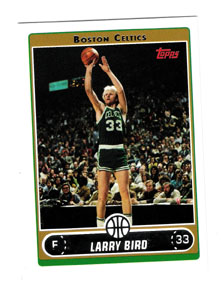
 Here’s another interesting thing about this set. Topps seems to need a father-figure/hero to worship. In baseball it’s Mickey Mantle. I don’t know who it is for football or hockey. For basketball it’s Larry Bird. This set features a great Larry Bird 'Missing Years' insert set where they take each year’s baseball design from 1982 to 1991 and give Bird a card. It’s a simple, winning idea, one that I hope they do for their hero worship player next year (it could work nicely for Magic or Dominique, who were both around for all of the 1980s). This insert set may actually be the sole reason for me to continue to buy packs of this set and may end up as my insert set of the year, regardless of sport. Plus, it's a nicer baseball/Bird tie-in insert idea than Bird's weird insert from the 1994 Ted Williams Baseball card set of Larry hunched over playing shortstop in what looks like either high school or college (or an early-Eighties Celtics charity softball game).
And if that’s not enough Bird for you, there’s another subset within the base set. Card #33 has 33 variations. I think this idea is garbage. Who wants or needs 33 variations of Bird taking a jumpshot? I opened a hobby wax box and a hobby rack box and got 9 of the 33 and 6 of those 9 were of him in jumpshot pose. Maybe it was a subconscious ploy on Topps’ part to provide balance to the literally scores of photos of guys going in for blocks, rebounds and highlight dunks.
And if we step back for a minute and analyze this, is Topps talking out of both sides of its mouth with this set? Is it paying lip service to NBA corporate and its younger fans with dunks, flashy inserts and autograph chase cards while offering commentary that the whole game has strayed too far from the heart and mind of the Hero of the game? Or is it the other way around—that it feels it has to include a Hero From Another Era on the cover of its box to get twenty- and thirtysomethings to buy into the product? I like Larry Bird as much (or maybe more) than the next guy, but I don’t understand his inclusion in this set at all. If Topps needed a hero to worship, the league hasn’t had this many likable, marketable players since the late 1980s. I’m sure Upper Deck hasn’t gobbled them all up yet.
If you’re going to buy these cards by the box, I would go for wax. The collation in the rack box I purchased was horrendous—out of 432 cards I don’t think I even completed one 265-card set. Plus, in each rack pack Topps throws in 3 ‘Vintage’ cards, which means one 1979-80 card of either Robert Reid or Doug Collins, one 1992-93 card of Doug Smith and one 1993-94 card of Eric Leckner. It’s a fun idea, but I swear I ended up with at least 5 Robert Reid cards. That’s just uncalled for. If you’re going to clean out your warehouse by inserting the cards into packs, call it by its name: ‘Randomly Inserted Cold Storage Commons.’
The collation in the wax box was much better (sans vintage cards): I completed one set, missing only 2 of the Draft Day variation rookies, plus there was even a good mix of inserts, though the insert sets themselves (besides the Missing Year Birds) were crap.
Subscribe to:
Posts (Atom)