January 27, 2011

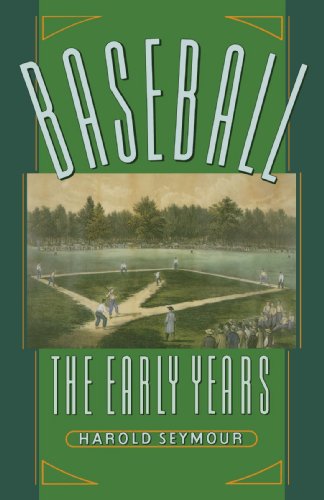
Baseball: The Early Years
by Harold Seymour
A Baseball Book Review

How much do you know about the history of the game of baseball? I thought I knew a lot, but after reading Baseball: The Early Years  by Harold Seymour (Oxford University Press 1960), it turns out that what I knew was just a lot of jumbled anecdotes, odd statistics, and answers to trivia questions. Reading Seymour's work, volume one in a series of three, is like sitting with a master of the history of the game.

As a game and as an idea, baseball is just about as American as you can get. In that, it's something (rounders) that already existed someplace else (England), that was adapted and tinkered with until it was different enough to be called an original creation. And though Organized Baseball (as the professional leagues came to be known) created and promoted the Abner Doubleday myth as a fictitious centennial in conjunction with the opening of the Hall of Fame in 1939, Seymour is completely thorough in researching the true creation of the game through its many eighteenth- and nineteenth-century incarnations: rounders, town ball, and base.


I had heard about this book because Zev Chafets mentions it as the de facto baseball history text for the library and research staff at the National Baseball Hall of Fame and Museum in his book Cooperstown Confidential: Heroes, Rogues, and the Inside Story of the Baseball Hall of Fame (Bloomsbury, 2010). Does it matter that Baseball was published in 1960, fifty-one years ago? Hardly. If anything, its age strengthens what it has to say. In 1960, the 1880s were only eighty years in the past; the history it describes was still relatively fresh.

It says on the dust jacket of my copy that "[Dr. Seymour] ... received a masters degree and Ph.D. from Cornell University, where he was the first to be awarded a doctorate for a thesis on the history of baseball." Though used mostly as a 'gee wilikers' nugget to help sell the book, this is an important point. Harold Seymour was not some ghost writer, some fly-by-night hack someone hired to write a book about baseball. He was a scholarly individual who happened to have firsthand experiences with professional baseball, and was interested in it and how it came to be the most-loved sport in the country.

I would recommend Seymour's Baseball not just because it's a thorough telling of the game's earliest days, but because it gives life to the men behind the history. It's a lively read, one full of characters each fully vested in the success of the sport. Men like the early amateur Knickerbockers, who were stubborn when faced with spreading the game across the country in a professional way, and power-wielding individuals like Al Spalding, Henry Chadwick, John M. Ward, and Bancroft Johnson. Or my new favorite nineteenth-century loose cannon, the Saint Louis Browns' Chris Von Der Ahe; he's well-deserving of his own biography.

There are very few baseball books that could be called 'definitive' without much argument. Harold Seymour's Baseball: The Early Years is on this very short list.

January 26, 2011

The Honorable Viola Presiding


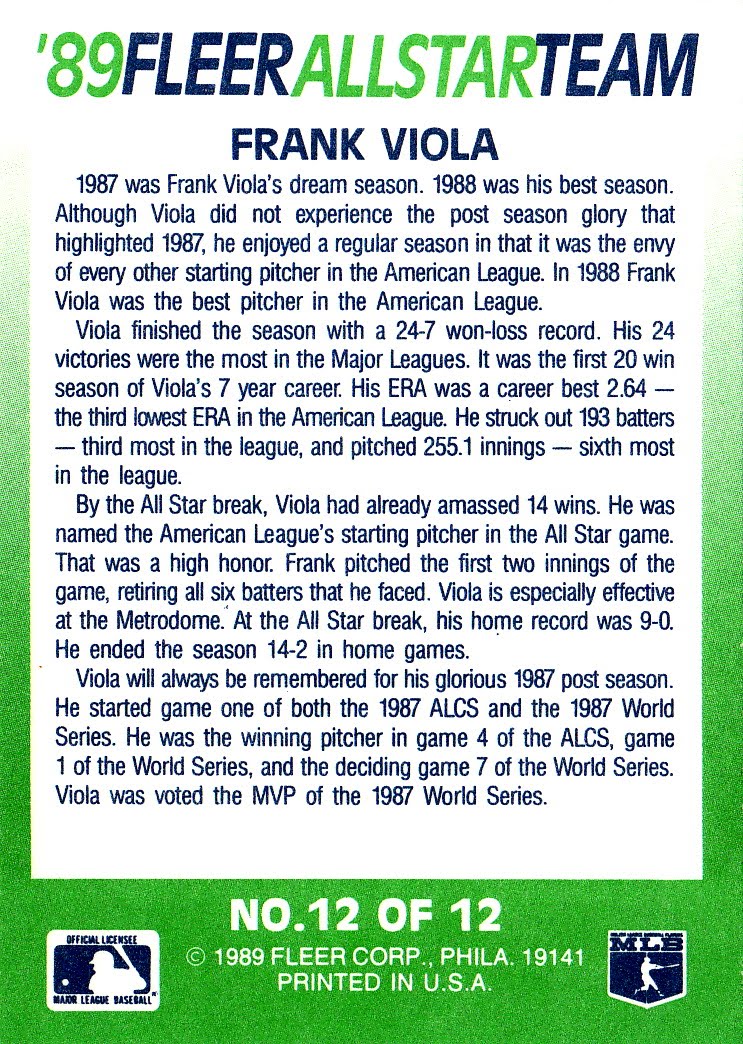
Frank Viola, 1989 Fleer All Star Team

I am trying to determine whether or not the inset on the front of the card is supposed to be a gold medal with a red, white, and blue ribbon, but instead of a gold medal it’s a picture of Frank Viola. I think that is what this is supposed to be, and I like it. It's classy. I also think that during the Cy Young Awards ceremony—which does not exist, but should—in 1988, Frank Viola should have stood on the top pedestal wearing this medal with his headshot on it while the National Anthem played and his curly fro-mullet blew dramatically in the breeze (the ceremony is outdoors).

Anyway, raise your hand if you would like to learn more about Frank Viola’s 1987 and 1988 seasons in short, succinct sentences. Really? Everybody? Alright, let’s go!


1987 was Frank Viola’s dream season. 1988 was his best season.

Do we know for sure that 1987 was Frank Viola’s dream season, or are we making the assumption that winning a WS title was Viola’s dream? And even if Viola asserted as much publicly, maybe in his heart he was like, “Winning a title was cool, but my dream has been to dominate mo fos! I’m livin’ the dream in ’88!”

Although Viola did not experience the post season glory that highlighted 1987, he enjoyed a regular season in that it was the envy of every other starting pitcher in the American League.

Another assumption. For what it’s worth, Roger Clemens posted a comparable WAR that season (6.7 to Viola’s 7), ERA (2.93 to 2.64), had a hundred more strikeouts, double the amount of complete games, more innings-pitched, six more shutouts, and gave up fewer home runs. He finished sixth in the Cy Young vote, by the way. Sixth. Behind Bruce Hurst. Also, Roger Clemens envies no one, especially a dude with a curly fro-mullet named after an instrument who lives in Minnesota. Just saying.

By the All-Star break, Viola had already amassed 14 wins. He was named the American League’s starting pitcher in the All-Star game. That was a high honor.

Really? Being a starting pitcher in Major League Baseball’s All-Star Game is a high honor? Who knew? I thought anybody could do that. To be sure, I looked it up, and it is indeed a high honor, one of the highest in fact:

Top Six Highest of Worldwide Honors in Descending Order

(Note: there are only six anyway)

6) Receiving an honorary degree from a university because you became famous for reasons that have nothing to do with your education at that university or any other
5) Your name on the Hollywood or any local “Walk of Fame”
4) Being a starting pitcher for either side, but preferably the American League, in MLB’s All-Star Game
3) Boy or Girl Scout “Badge of Heroism in the Face of Bears”
2) Purple Heart
1) Being knighted because you are a musician

I’d like to learn more about Frank Viola, but who has the time? So, in an effort to streamline things, I have collected only the best, most-informative, and succinct sentences from this tidbit and combined to form one, better tidbit. You can thank me later.

1987 was Frank Viola’s dream season. 1988 was his best season. In 1988 Frank Viola was the best pitcher in the American League. That was a high honor. Viola is especially effective at the Metrodome.

As a result of this edited tidbit, I was recently awarded the gold medal of succinctness by the National Committee of Blog Writers during their annual ceremony in Lisbon, OH. It was a medium honor.

January 25, 2011

Five Years


From the cluttered desk of The Baseball Card Blog


Five years ago I started writing this little blog. What began as a fun idea quickly became a large obsession for me as I wrote, collected, and generally did my part to cultivate the presence of baseball cards and baseball card collecting on the Internet. Lucky for me, lots of others felt the same way I did about these little pieces of cardboard, and soon the Web was buzzing with collectors in conversation.

The past five years have flown by on this blog, and what I love most about the Internet is the archive nature of it. I love that content generated years ago is still available with a few clicks of the mouse. I also find it fun that for all the high-tech mathematics and old fashioned jockeying for position within search engines, typing "1987 Topps" into Google, Yahoo! or Bing will still return a post I wrote in June 2006 within the first few results.

So what will the next five years bring at The Baseball Card Blog? Well, hopefully more fine writing about baseball cards. New co-writer Mike Kenny has contributed more than his share of that, providing us with some of the funniest insights into the topic anywhere; this blog is more than lucky to have him.

What else? Well, this year there will be more involvement from me. I'm going to start writing more often, contrasting Mike's insane bombast with more tempered reviews of baseball books and posts about my current obsession: the 1956 Topps baseball set.

It's a different, better, more amazing baseball card landscape on the Internet now than it was in 2006. And though there are literally hundreds of card blogs out there, I hope you'll continue to read ours.

Regards,
Ben

January 19, 2011

The Personals


Steve Avery, 1992 Leaf "Studio"

Let’s visit Steve Avery in the Studio, where he enjoys relaxing and forgetting about baseball for a while by removing his baseball hat.


PERSONAL: Steven Thomas Avery bats left and throws left…He was born 4/14/70 in Trenton, MI, and now resides in Taylor, MI…He is single.

Ladies, please form a line to the left, which is the direction from which your potential suitor throws and bats. Now, do you girls like Trenton, Michigan? I caaaan’t heeeear youuuuu! Okay, good. Now raise your hand if you’ve dated a major leaguer before. Go ahead, don’t be shy … we’re gonna find out eventually. Okay, you ladies with your hands up? You can leave. Steven Thomas Avery may be the fourth starter in a powerhouse rotation, but he’s the only ace in his relationships.

UP CLOSE: Hobbies are golf and fishing

I am shocked. An Atlanta Braves pitcher enjoys golf and fishing? I honestly … I just, I’m speechless. Just when you think you have someone figured out. Golf and fishing? I had Steve Avery pegged for a “break-dancing and juggling” kind of guy.

…Favorite group is Tesla (hard rock);

Would you like a mulligan on that one, Steven? No? Nobody should have been asked to name his favorite group in 1992—it’s not fair. Still though, if you want to stick with Tesla, I guess that’s fine, too. It’s hard to argue with loving a band whose Wikipedia page has a section called, “Bust a Nut and hiatus (1994-1999).” I mean, how do you not take a hiatus after busting a nut?

dessert is strawberry cheesecake…Once worked as a lifeguard


This is tmi. I have a disturbing image in my head of Steve Avery sitting shirtless on a lifeguard stand, eating strawberry cheesecake, and listening to Tesla on his walkman.

Would most like to meet Abe Lincoln.

That is going to be difficult, Steven. I do enjoy, however, your clever avoidance of clichés. Everyone always goes with Taft.

So there you have it, ladies. He plays baseball, fishes, and golfs, so he’ll never be home. He was once CPR certified and he likes strawberry cheesecake. Put your best face forward—he’s not going to be single for long.

January 12, 2011

He Is Legend


Charles Johnson, 1996 Fleer, "Tomorrow's Legends"

Surely we have all heard of “future stars.” It is both comical and sad to look back on future stars who never were, and lament other peoples’ inexplicable inability to accurately foresee into the baseball future. Truth be told, it seems as though baseball cards in particular are more often wrong than right when it comes to forecasting a player’s ability at the big league level. The anticipation of what could be sells cards though, and that is, I guess, the whole point?

In that vein, Fleer threw caution to the wind. Future stars? Pfft. How about “Tomorrow’s Legends.” The way Fleer figured it, legends > stars. Also, tomorrow is sooner than the future. Who wants a star a few years from now when they can have a legend tomorrow? But how can one predict the often-indefinable qualities and outside circumstances that constitute a legend-in-the-making? Easy.

Fleer utilized the “quadrant formula” in order to determine whether or not a specific player would become a legend of tomorrow. This formula is exemplified here, on the front of this very card. To wit:

Does Charles Johnson have a baseball glove? Check.

Does Charles Johnson play baseball, like the old timers did, by throwing the ball, catching it, and also hitting the ball sometimes? Check.

Does Charles Johnson play baseball with baseballs, and on a baseball field? Check.

Does Charles Johnson live on earth, preferably North America? Check.

Bam. Legend. Of tomorrow. What else does this card have to say?


The Marlin with the “Golden Gun,”

Indeed Charles Johnson had a rocket arm and was an awesome defensive catcher. But this reads weird to me because fish don’t carry guns. If he played for the Florida Cowboys, that would be a great lede. Then again, fish don’t have arms, so I’m not sure how this would work. Maybe, “The Marlin who spears baserunners with his dorsal thingee … “ Yeah, that’s better.

Charles Johnson’s awakening at the plate

Charles Johnson had an awakening at the plate? When did this happen? What was it like? In looking at his statistics, this awakening, which must have occurred before 1996, caused him to hit the ball pretty much the same as he always had. Cool! It was the “awakening of a legend … “

has made him a terror to opposing pitchers

.251 BA / .351 OBP / .410 SLG / .761 OPS = terror.

as well as baserunners.

Charles Johnson’s awakening at the plate made him a terror to baserunners? Hmmm. How so? Possibly he was hitting the ball very hard and in the direction of the baserunners? In which case he would be causing injury to his own teammates? That doesn’t seem very nice.

Then again, true legends aren’t always the nicest guys, I am told.

January 05, 2011

Men Who Are Dawgs


Ben Grieve, 1997 Skybox "Little Dawgs"

Seen here is famous “Little Dawg” Ben Grieve, part of Skybox’s “Dugout Access” series, in which we receive exclusive dugout access in the form of a baseball card. This past summer, I wore this card around my neck and attempted to enter the Diamondbacks dugout in order to figure out why the team was so horrible at baseball. I was stopped at the door by a security guard, who did not grant me access as a result of these credentials. I was informed that my Ben Grieve “Little Dawgs” baseball card, part of the “Dugout Access” series, only granted dugout access in the sense that the information contained on the back of the card was supposed to make me feel as though I were in the actual dugout. I was disappointed.

Many people know Ben Grieve as “Ben Grieve.” People close to him, however, know him as “Little Dawg,” with a “w.” And by people close to him, I mean “people who do not know his actual name.” And by people I mean Barry Larkin:


What is a “LITTLE DAWG”?


Excellent question. I do want to mention that the question mark should be inside the quotes, but again, we are dealing with DAWG in ALL CAPS spelled with a “W,” so I will let that one pass.

Major League teams invite as many as 70 players to Spring Training each year. With so many players, it’s sometimes difficult to learn everybody’s name, so Barry Larkin simply refers to the players he doesn’t recognize as “Little Dawgs.”

- - - - - - - - - - -

Spring training, ’97, A’s versus Reds. Ben Grieve doubles off the right field wall, and pulls up to second base. Standing there is Reds shortstop Barry Larkin.

Larkin: Nice hit, Little Dawg. (Slaps Ben Grieve on the butt with his glove.)

Grieve: Thanks. What?

Larkin: I said, “Nice hit, Little Dawg.”

Grieve: Okay, yeah. What’s a “Little Dawg?”

Larkin: You, man. You’re a Little Dawg.

Grieve: What? Why?

Larkin: Because I don’t know your name. Man, do you know how many players they invite to spring training? 70! And that’s each team! Times 70 by 30 and that’s a million Little Dawgs. I can’t be remembering all types of names and stuff. I’m Barry Larkin!

Grieve: My name is Ben.

Larkin: That’s cool. Listen, don’t feel bad, Little Dawg. My brother-in-law is a Little Dawg too, and that dude’s been married to my sister, what's-her-face, for like 30 years. That’s 10 in dawg years. Ha! Get it?

Grieve: Yeah. Good one. But don’t you think you should at least try to remember some people’s names? I mean, I’m a grown man, and I think I’m a good player—as does every other guy out here—and it’s kind of condescending to be equated with an annoying chihuahua.

Larkin: You Little Dawgs are crazy! You should feel lucky a player of my stature is even speaking to you. You see your boy Little Dawg over there? (Points to A's dugout ...)

Grieve: McGwire?

Larkin: Yeah. What does he call you?

Grieve: (Hangs head in shame.) He won’t speak to me.

Larkin: Exactly. But me? You’re my Little Dawg! C’mere. Gimmie a hug.

The two men hug at second base.

Grieve: Mr. Larkin?

Larkin: Call me Barry.

Grieve: Barry, what will you call me if I win “Rookie of the Year” this year?

Larkin: Hmmm. How about “Frank?” All you white guys look like Franks.

Grieve: Okay, deal.